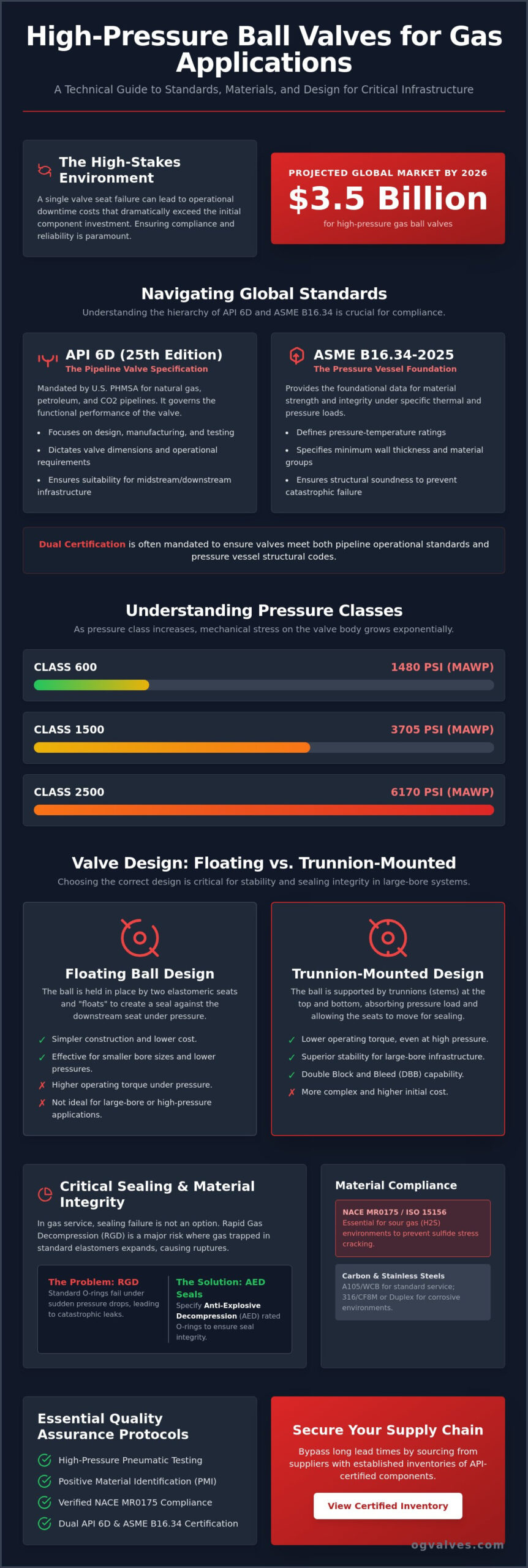
A single valve seat failure in a high-pressure system can result in operational downtime costs that far exceed the initial component investment. As the global market for high pressure ball valves for gas applications scales toward a projected $3.5 billion in 2026, the margin for engineering error has narrowed. You’re likely managing the pressure of meeting the U.S. PHMSA mandate for API Specification 6D 25th Edition compliance while facing the logistical reality of specialized component lead times.
It’s a difficult balance to maintain structural soundness under extreme pressure while adhering to the rigorous June 2026 updates in ASME B16.34-2025. This technical guide delivers a comprehensive analysis of the material standards and design criteria required for critical gas infrastructure. We’ll evaluate the mechanical performance of trunnion-mounted versus floating designs, the integration of PEEK for high-performance seating, and the specific requirements for hydrogen gas service as defined by the latest industry certifications. This analysis provides the data points necessary to secure a reliable supply chain and ensure long-term operational safety.
- Understand how ASME B16.34 and API 6D standards define pressure-temperature ratings for gas service ranging from Class 600 to Class 2500.
- Determine the specific material specifications required for high pressure ball valves for gas applications, focusing on NACE MR0175 compliance for sour gas environments.
- Compare the operational mechanics of floating and trunnion-mounted designs to ensure valve stability and sealing integrity in large-bore infrastructure.
- Establish rigorous quality assurance protocols, including high-pressure pneumatic testing and Positive Material Identification, to prevent catastrophic system failure.
- Optimize your procurement strategy to bypass long lead times by prioritizing suppliers with established inventories of API-certified components.
High-pressure gas service begins where standard industrial limits end. In technical terms, this transition typically occurs at Class 600, representing a working pressure of 1480 psi. As systems move toward Class 2500 and beyond, the mechanical stresses on the valve body increase exponentially. These high pressure ball valves for gas applications must maintain structural integrity under the unique conditions of gas compression, where potential energy storage is significantly higher than in liquid systems. The 2026 regulatory landscape has reinforced these requirements, with the U.S. PHMSA now mandating the 25th Edition of API 6D for all pipeline operators handling natural gas, petroleum, and CO2.
Structural soundness depends on precise shell design and wall thickness. Unlike liquid media, compressed gas expands rapidly upon decompression, making any wall thinning or casting defect a critical safety risk. Engineering teams must ensure that the pressure-containing envelope meets minimum thickness requirements specified by international codes to prevent catastrophic failure during pressure surges. The publication of ASME B16.34-2025 on June 12, 2026, introduced updated rules for stiffness and rigidity, ensuring that valve bodies can resist deformation under the extreme loads found in modern gas infrastructure.
API 6D vs. ASME B16.34: Understanding the Hierarchy
API 6D serves as the primary governing specification for pipeline valves, dictating the design, manufacturing, and testing protocols essential for midstream and downstream infrastructure. It’s often paired with ASME B16.34, which provides the foundational data for pressure-temperature ratings and material group classifications. While API 6D focuses on the functional performance and dimensions of the valve, ASME B16.34 ensures the chosen material can withstand the specific thermal and pressure loads of the application. Project specifications often mandate dual certification to ensure the component meets both the operational requirements of the pipeline and the structural requirements of the pressure vessel code.
Pressure Classes and Nominal Pipe Sizes (NPS)
Industrial gas applications require a precise understanding of the relationship between Nominal Pipe Size (NPS) and the maximum allowable working pressure (MAWP). As the NPS increases, the mechanical load on the closure member and the valve body grows, often requiring a shift from Class 600 to higher denominations like Class 1500 or 2500 to maintain safety factors. Basic Ball valve design principles dictate that wall thickness must increase alongside the pressure class to manage these stresses effectively. Maximum Allowable Working Pressure (MAWP) is defined as the highest pressure at which a component is rated to operate at a specific temperature according to its material classification and design standard.
Material integrity in high pressure ball valves for gas applications is a prerequisite for system safety. NACE MR0175/ISO 15156 compliance is the industry benchmark for sour gas (H2S) environments, providing the necessary resistance to sulfide stress cracking. The selection of the pressure-containing envelope depends entirely on the chemical composition of the gas stream and the environmental conditions of the installation site. Carbon steel, such as ASTM A105 for forgings or WCB for castings, remains the industrial standard for non-corrosive service. However, for aggressive or offshore environments, 316 stainless steel (CF8M) or Super Duplex alloys are required to prevent pitting and crevice corrosion. For a broader analysis of material classifications used across different valve types, consult our guide on industrial valves.
One of the most significant risks in gas infrastructure is Rapid Gas Decompression (RGD). When system pressure drops suddenly, gas trapped within the molecular structure of standard elastomers expands rapidly, causing internal ruptures and seal failure. To mitigate this, engineers must specify AED-rated (Anti-Explosive Decompression) O-rings. These specialized elastomers are engineered to resist explosive forces, ensuring the valve maintains its sealing integrity throughout its operational life. Procurement teams should verify that all Ball Valves specified for high-pressure gas include these critical AED certifications to avoid premature failure during depressurization cycles.
Soft Seating vs. Metal Seating in High-Pressure Gas
The choice between soft and metal seating depends on the purity and temperature of the gas flow. Soft seating materials like PEEK or Devlon are preferred for clean gas service where a bubble-tight shut-off is mandatory. These thermoplastics maintain excellent dimensional stability at high pressures. Conversely, metal-seated valves utilizing Tungsten Carbide or Chrome Carbide coatings are required for abrasive gas flows or high-temperature applications. While metal seats provide superior longevity in harsh conditions, they require significantly higher operating torque compared to soft-seated designs. This trade-off must be accounted for during the actuator sizing phase of the project.
Anti-Static Design and Blow-out Proof Stems
Safety shut-off devices must adhere to the ISO 23555-3:2024 Global Standard to ensure reliable performance under extreme loads. Anti-static devices are mandatory for any combustible gas application to prevent spark ignition caused by static buildup during high-velocity flow. Additionally, blow-out proof stems are a fundamental mechanical requirement. This design ensures that the stem cannot be ejected from the valve body under extreme pressure surges. For critical infrastructure, ensure all components are fire-tested according to API 607 or API 6FA, providing an additional layer of thermal protection in the event of an external fire.

The mechanical configuration of the closure member determines the operational limits of high pressure ball valves for gas applications. Floating ball valves operate on a pressure-assisted sealing principle. In this design, the ball isn’t fixed but is instead pushed by the upstream line pressure against the downstream seat to create a seal. While effective for lower pressure classes, this mechanism subjects the downstream seat to the full force of the gas column. At high pressures, this can result in seat deformation or excessive operating torque, potentially compromising the valve’s long-term sealing performance.
Trunnion-mounted valves address these limitations by mechanically anchoring the ball at the top and bottom. This fixed-axis design prevents the ball from moving toward the downstream seat. Instead, the seats are spring-loaded and move toward the ball under pressure. This configuration is essential for large-bore gas infrastructure and high-pressure service, as it significantly reduces the friction between the ball and seats. For engineers requiring a deeper mechanical breakdown of these assemblies, our ball valve specification guide provides comprehensive technical data on internal components.
Torque analysis is a critical factor in the selection process, particularly for automated gas systems. Because the trunnion bearings support the hydraulic load, the operating torque remains relatively constant even as line pressure increases. This predictability allows for more precise actuator sizing and reduces the overall footprint of the valve assembly. In contrast, floating valves exhibit a linear increase in torque proportional to the pressure differential, often requiring oversized actuators that add unnecessary cost and weight to the system.
Selection Criteria Based on Size and Pressure
Technical standards typically limit the use of floating ball valves to sizes NPS 2 and below, or pressure ratings up to Class 600. Once a project exceeds these parameters, the transition to trunnion-mounted designs becomes mandatory to manage the seat load effectively. In Class 900, 1500, and 2500 gas service, the mechanical stability of a trunnion-mounted valve is the only way to ensure structural integrity. These valves are engineered to handle the massive forces generated by compressed gas without risking the internal misalignment often seen in floating designs under similar loads.
Double Block and Bleed (DBB) Functionality
Trunnion-mounted valves are the primary choice for applications requiring Double Block and Bleed (DBB) functionality as defined by API 6D. This feature allows the valve to seal against pressure from both upstream and downstream simultaneously, with a dedicated port to vent the body cavity. DBB is critical for safety verification in gas metering stations and manifold isolation. By providing a verifiable seal, DBB functionality reduces the need for complex, multiple-valve configurations, streamlining the footprint of gas processing plants while maintaining rigorous safety standards.
High-pressure gas service necessitates a testing regime that exceeds basic hydrostatic protocols. While hydrostatic testing uses water to verify the pressure-containing envelope, high pressure ball valves for gas applications often require high-pressure pneumatic shell testing to simulate actual service conditions. Because gas molecules are significantly smaller than water molecules, pneumatic testing at 1.1 times the design pressure is more effective at identifying microscopic leak paths. This level of scrutiny is essential for maintaining the pressure boundary integrity across the entire system, a technical requirement shared by other critical components like check valves used in similar high-stakes environments.
Positive Material Identification (PMI) serves as a non-negotiable verification step. This process ensures that the metallurgy of every component, from the forged body to the internal trim, matches the specified Material Test Report (MTR). In 2026, the focus has intensified on fugitive emission testing under ISO 15848-1. This standard defines the classification system for the measurement and evaluation of leakage from valve stems and body joints. Adhering to these strict emission limits is now a mandatory requirement for environmental compliance and operational safety in modern gas infrastructure.
Non-Destructive Testing (NDT) Requirements
Radiographic (RT) and Ultrasonic (UT) testing are utilized to identify subsurface discontinuities in heavy-wall castings and forgings that could compromise the valve’s structural integrity. Surface-level defects are identified through Dye Penetrant (DP) and Magnetic Particle (MP) inspection. These methods ensure that no cracks or inclusions exist that could propagate under cyclic loading. NDT protocols provide the technical validation required to identify structural weaknesses before they manifest as catastrophic valve failures.
Firesafe and Low Leakage Certifications
Compliance with API 607 is mandatory for valves located in hazardous areas, ensuring the component maintains its sealing integrity during and after exposure to a fire. Modern gas processing also requires adherence to TA-Luft and ISO 15848 certifications to minimize atmospheric leakage. For cryogenic gas service, such as LNG, performance verification involves testing the valve at temperatures below -150°C to ensure that seals remain pliable and the valve operates without seizing. Ensure your infrastructure meets these rigorous benchmarks by sourcing API-certified ball valves that have undergone comprehensive technical validation.
Procurement cycles for high pressure ball valves for gas applications represent the primary bottleneck in critical infrastructure development. The specialized nature of API 6D and ASME B16.34 compliant components often results in lead times that exceed twelve months for custom forgings. This delay is unacceptable in the context of industrial shutdowns or fast-track pipeline expansions. Specialized suppliers address this challenge by maintaining an active inventory of high-spec valves; this enables project managers to bypass the standard manufacturing queue. This strategy ensures that critical path items are available for immediate dispatch, reducing the risk of project slippage.
Technical support during the procurement phase is equally vital. It’s not enough to simply supply a valve. Sizing a valve for high-pressure gas service requires precise calculations of flow coefficients (Cv) and pressure drops to prevent cavitation or excessive noise. Seamless integration with valve actuators must be verified during the assembly stage to ensure that the mounting kits and stem dimensions align perfectly. This pre-delivery verification eliminates the need for field modifications, which are both costly and technically risky.
The complexity of gas infrastructure demands a procurement partner who understands the nuances of the 25th Edition of API 6D. The supplier must act as a technical extension of the project team. This includes providing detailed GA drawings, torque data, and material certifications during the RFQ stage. Having this data upfront allows for more accurate system modeling and prevents late-stage design changes that can derail a project timeline.
Minimizing Downtime with Global Logistics
Strategic inventory management allows for the rapid deployment of components to international industrial sites. Technical expertise centered in Northern Ireland provides a logistical advantage for global gas infrastructure projects, offering a bridge between manufacturing standards and site-specific requirements. Efficiently managing the documentation and certification landscape is a prerequisite for successful international delivery. This includes the validation of Mill Test Reports, hydrostatic test certificates, and compliance documentation for international customs, ensuring that components aren’t held at borders due to administrative deficiencies.
Technical Consultation and Project Specification
Successful procurement relies on early collaboration between site engineers and valve specialists. Matching valve specifications to specific gas compositions is the only way to ensure structural soundness and operational longevity. Whether the application involves sour gas requiring NACE compliance or high-purity hydrogen, initial component selection dictates the future maintenance schedule. Selecting the correct metallurgy and seal configuration from the outset prevents premature failure. Request a technical consultation for high-pressure gas valve specifications to ensure your next project adheres to the highest engineering standards.
Managing the complexities of a global supply chain requires a partner with deep technical expertise in the petrochemical and gas sectors. We provide a reliable inventory of certified components designed to meet the most demanding specifications. Our logistical capabilities ensure fast-track global delivery for industrial shutdowns, keeping your projects moving forward without compromising on quality or safety benchmarks. Consult with our technical engineers for high-pressure gas valve procurement to align your system requirements with industry-leading hardware. We’re ready to assist you in achieving superior engineering precision.
What pressure class is required for natural gas ball valves?
Natural gas systems typically require pressure ratings starting at ASME Class 600, which corresponds to a working pressure of 1480 psi at ambient temperature. For high-pressure transmission and processing infrastructure, Class 900 and Class 1500 are common technical benchmarks. The specific class is determined by the maximum allowable working pressure (MAWP) and the operating temperature range defined by the ASME B16.34 standard.
Can I use a standard ball valve for high-pressure hydrogen service?
Standard valves aren’t suitable for high-pressure hydrogen service due to the high risk of hydrogen embrittlement. Materials must be specifically selected and tested to resist atomic hydrogen penetration, which can cause sudden cracking in standard carbon steels. Compliance with the API 6D 25th Edition Addendum 2 is the current industry standard for valves intended for hydrogen infrastructure to ensure structural soundness.
What is the difference between API 6D and API 608 for gas valves?
API 6D is the primary specification for pipeline valves, focusing on the design and testing of components used in midstream infrastructure. API 608 covers metal ball valves intended for refinery, petrochemical, and chemical process applications. While both standards ensure quality, API 6D includes more rigorous requirements for through-conduit designs and long-distance pipeline integrity, which are essential for high pressure ball valves for gas applications.
Why is NACE MR0175 compliance necessary for gas ball valves?
NACE MR0175/ISO 15156 compliance is mandatory for gas ball valves operating in sour environments containing hydrogen sulfide (H2S). This standard specifies material requirements to prevent sulfide stress cracking and stress corrosion cracking. Without this certification, the risk of sudden, brittle failure in high-pressure gas systems increases significantly, as standard alloys can’t withstand the corrosive mechanisms of sour service over time.
How does a trunnion-mounted ball valve improve safety in gas applications?
Trunnion-mounted designs improve safety by mechanically anchoring the ball at the top and bottom, which prevents internal misalignment under extreme pressure. This configuration ensures that seat loads remain manageable and operating torque stays constant, allowing for reliable actuation during emergency shutdowns. These features are critical for maintaining a bubble-tight seal where seat deformation in floating designs could lead to catastrophic failure.
What are the common causes of seat leakage in high-pressure gas valves?
Seat leakage in high-pressure gas service is often caused by particulate contamination or Rapid Gas Decompression (RGD). Debris in the gas stream can score the seating surface, while RGD can cause standard elastomers to rupture internally. Improper material selection for the specific gas composition or exceeding the temperature-pressure limits of the thermoplastic seats can also compromise the seal integrity in high pressure ball valves for gas applications.
What is fugitive emission testing (ISO 15848) and why is it important?
ISO 15848 is an international standard for fugitive emission testing that quantifies leakage from valve stems and body joints. It’s critical for environmental compliance and safety, particularly when handling combustible or toxic gases. The standard classifies valves based on their leakage rates, ensuring that the pressure boundary remains intact and atmospheric contamination is minimized during the operational life of the component.
The frequency for testing is determined by the Safety Integrity Level (SIL) of the system and local regulatory requirements. Critical isolation valves typically undergo partial stroke testing every six months and full functional testing during annual or bi-annual maintenance shutdowns. Regular verification of seat integrity and actuator performance is essential to ensure the valve responds correctly during an overpressure event or emergency isolation scenario.
 Responsive Menu