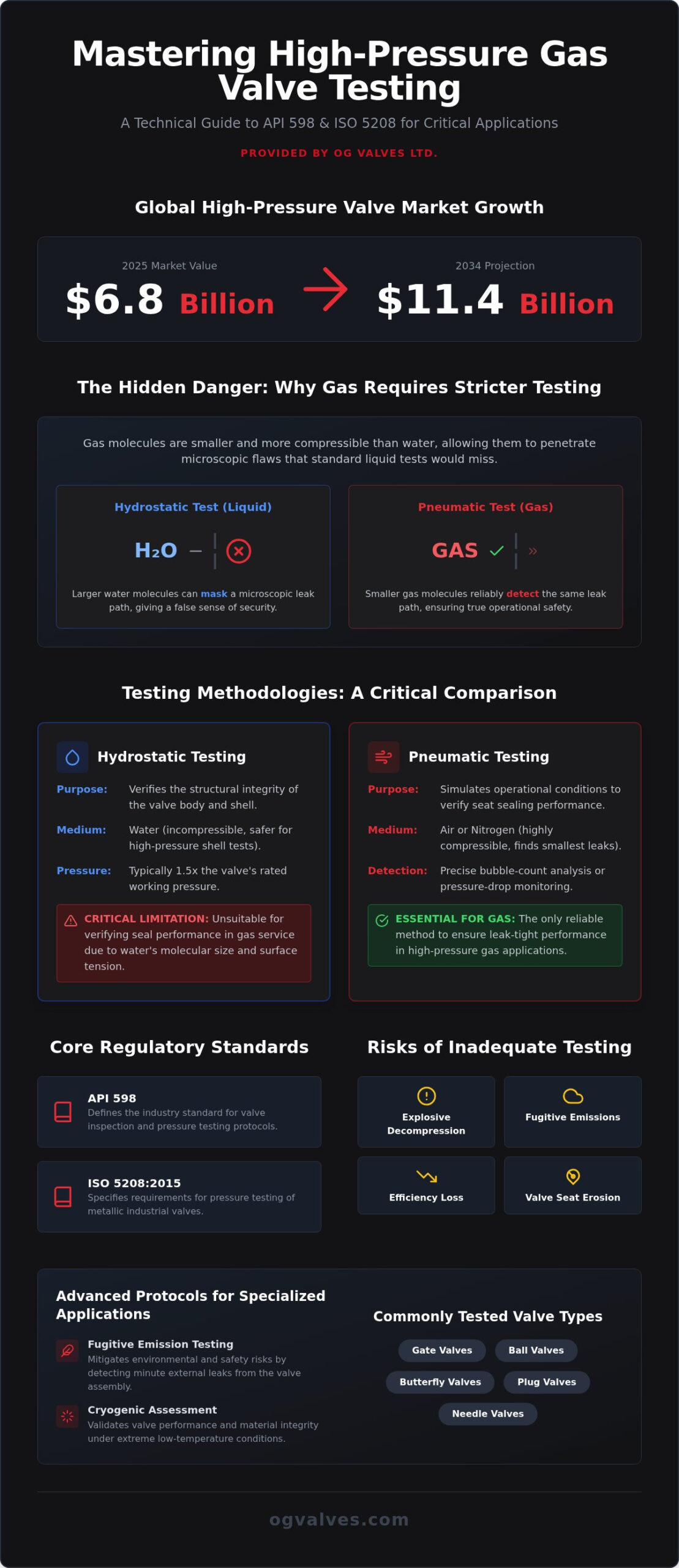
The global high-pressure valve market was valued at $6.8 billion in 2025 and is projected to reach $11.4 billion by 2034, leaving no room for technical ambiguity in high pressure gas valve testing protocols. A single leakage event in a high-stakes petrochemical environment doesn’t just halt production; it introduces a catastrophic risk to personnel and structural integrity. Technical experts recognize the difficulty of navigating the 11th Edition of API 598 alongside the rigorous demands of ISO 5208:2015, especially when operational safety depends on detecting minute gas bypass that standard hydrostatic methods might overlook.
This technical guide provides the industrial precision required to master these complex methodologies and international standards. You’ll gain a clear understanding of the specific testing requirements for gate, ball, and butterfly valves, ensuring every component in your infrastructure exceeds safety benchmarks. We’ll analyze the transition from generic shell integrity checks to advanced fugitive emission protocols and cryogenic assessments. By the end of this analysis, you’ll be equipped to specify the exact testing procedures necessary to maintain operational continuity. As a global partner in critical infrastructure, OG VALVES LTD. provides this framework to ensure that technical data translates into long-term performance and unwavering reliability.
Key Takeaways
- Determine the appropriate selection between hydrostatic and pneumatic testing mediums to ensure maximum leak detection sensitivity in gas applications.
- Align procurement specifications with the latest iterations of API 598 and ISO 5208 to guarantee regulatory compliance across global infrastructure projects.
- Implement high pressure gas valve testing protocols that incorporate fugitive emission and cryogenic standards to mitigate environmental and safety risks.
- Verify the technical integrity of critical components by accurately interpreting Material Test Reports and integrating third-party inspection during the validation phase.
The Critical Necessity of High-Pressure Gas Valve Testing in Heavy Industry
High pressure gas valve testing is a non-negotiable safety protocol. It serves as the primary barrier against catastrophic failure in heavy industrial sectors. In environments like petrochemical refineries or power generation facilities, the integrity of a Gate, Ball, or Butterfly valve isn’t just a maintenance concern; it’s a fundamental requirement for pressure containment. Every component must undergo rigorous validation to ensure it can withstand the extreme mechanical stresses of high-pressure gas service without compromising the safety of the surrounding infrastructure.
Gas service demands more stringent leak detection than liquid service. Because gas molecules are smaller and highly compressible, they can bypass seals that might appear tight under liquid pressure. This necessitates specialized pneumatic protocols that exceed the requirements for standard fluid handling. The relationship between material integrity and pressure containment is absolute. If the valve body exhibits even microscopic porosity or casting defects, the risk of shell failure increases exponentially under high-pressure conditions.
Risk Mitigation in High-Pressure Environments
Compressed gas stores immense potential energy. During high pressure gas valve testing or active operation, this energy can trigger explosive decompression if the valve shell or bonnet fails. Rigorous validation prevents these catastrophic events by identifying structural weaknesses before the valve is commissioned. Beyond physical safety, the financial implications of valve bypass are severe. Common risks associated with inadequate testing include:
- Explosive decompression of pressure-retaining components
- Environmental contamination from hazardous fugitive emissions
- Thermal efficiency loss in steam and gas turbines
- Rapid erosion of valve seats due to high-velocity gas bypass
The Role of Testing in Lifecycle Management
Testing isn’t a one-time event. It begins with pre-installation verification to ensure the component meets API or ISO standards. It then continues through periodic maintenance cycles. Proper seat and seal verification during these intervals ensures the valve’s longevity in harsh environments. By establishing a performance baseline through Hydrostatic Testing and subsequent gas-leakage checks, engineers can monitor degradation over time. This data-driven approach to lifecycle management allows for predictive maintenance, reducing the risk of sudden failure in critical infrastructure. It ensures that every Plug or Needle valve remains within its specified performance envelope throughout its operational service life.
The choice between liquid and gaseous mediums defines the efficacy of high pressure gas valve testing. Engineers must distinguish between the structural validation of the pressure boundary and the functional verification of the sealing mechanism. While hydrostatic testing serves as the global benchmark for shell integrity, pneumatic testing is the only reliable method for verifying the sealing performance of valves destined for gas service.
Hydrostatic Shell Testing Procedures
Hydrostatic testing focuses on the ability of the valve body and bonnet to contain pressure without rupture or permanent deformation. Standard industrial protocols, including ISO 5208, typically dictate a pressure ratio of 1.5 times the rated working pressure. Water remains the preferred medium for shell tests due to its incompressibility. This characteristic ensures that if a failure occurs, the energy release is localized and relatively low-velocity. However, hydrostatic methods have technical limitations for gas service. The surface tension and molecular size of water molecules are significantly larger than those of methane, hydrogen, or nitrogen. Consequently, water often masks minute leak paths that high-pressure gas would easily penetrate during operation. Relying solely on liquid testing is an engineering oversight for critical gas-handling infrastructure.
High-Pressure Pneumatic Seat Testing
Pneumatic seat testing utilizes air or nitrogen to simulate actual operational conditions. Nitrogen is the preferred medium for cryogenic and high-purity applications because it’s inert and prevents internal moisture contamination. This method detects leaks through bubble-count analysis or precise pressure-drop monitoring. Since gas is highly compressible, it identifies leakages that hydrostatic tests bypass. Safety is the primary constraint during these procedures. The stored energy in compressed gas is orders of magnitude higher than in liquids, necessitating rigorous risk mitigation. When procuring industrial Gate, Ball, or Check valves for gas service, engineers must specify the following safety and technical requirements:
- Mandatory energy release calculations based on test volume and pressure.
- Use of blast-resistant shielding or remote testing bunkers.
- Verification of seat tightness using bubble-count per minute (BPM) as defined by API 598.
- Post-test cleaning to remove traces of test mediums in high-purity systems.
The selection of the testing medium ultimately depends on the valve application. If the service medium is a gas or a low-boiling-point liquid, pneumatic testing is the only way to ensure the integrity of the seat and stem seals.
Regulatory Standards and Certification: API 598 and ISO 5208
Adherence to global regulatory benchmarks is the only method to verify the operational safety of high-pressure components. In the field of high pressure gas valve testing, two primary standards dominate: API 598 and ISO 5208. These documents define the rigorous inspection criteria and pressure requirements necessary to prevent catastrophic failure. Before any pressure test commences, Positive Material Identification (PMI) must be performed. This ensures that the alloy composition of the valve body and bonnet matches the Material Test Report (MTR). Without verified material integrity, pressure containment results are technically invalid, as the structural soundness of the pressure boundary cannot be guaranteed under extreme stress.
Understanding API 598 Requirements
API 598, currently in its 11th Edition (published February 2023), serves as the industry benchmark for valve inspection and testing. It specifies required test durations based on the nominal valve size and pressure class. For industrial gate valves, the standard mandates both shell and seat tests to confirm zero visible leakage in soft-seated designs. Metal-seated valves, however, have different acceptance criteria. API 598 allows for a specific number of bubbles per minute during pneumatic testing, depending on the valve’s diameter. Engineers must precisely apply these metrics to distinguish between a functional seal and a regulatory failure. The standard ensures that every component, from a small needle valve to a large gate valve, undergoes a uniform validation process before field deployment.
ISO 5208 and Global Compliance
ISO 5208:2015 provides the international framework for the pressure testing of metallic valves. This standard is critical for global projects that must align with the Pressure Equipment Directive (PED). It categorizes leakage rates from Rate A to Rate G. Rate A signifies “Zero Leakage,” which is the mandatory requirement for high-pressure gas service in hazardous environments. When specifying check valves for high-pressure loops, ISO 5208 provides the necessary technical clarity to ensure the component can handle reverse flow conditions without seal degradation. The standard’s structured approach allows procurement specialists to define exact performance expectations. This prevents the ambiguity often found in generic manufacturer claims and anchors quality assurance in quantifiable engineering data.
The distinction between “Zero Leakage” and allowable rates is not merely semantic. In gas service, even a Rate B or C leakage can lead to significant energy loss or the accumulation of flammable vapors. Technical experts prioritize Rate A certification for any high-pressure gas application to maintain the highest safety margins and operational output.
Advanced Testing: Fugitive Emissions and Cryogenic Protocols
Advanced testing protocols address the environmental and thermal complexities that standard pressure boundaries often ignore. While previous sections established the baseline for high pressure gas valve testing, fugitive emission and cryogenic assessments verify specialized performance variables. Helium leak detection serves as the technical benchmark for ultra-high pressure applications. Because helium’s molecular diameter is significantly smaller than methane or nitrogen, it penetrates microscopic leak paths in stem seals and gaskets that other mediums would fail to identify under static conditions.
Fugitive Emission Control
ISO 15848-1 provides the classification system and qualification procedures for type testing valves for fugitive emissions. This standard is critical for reducing the environmental footprint of industrial facilities, specifically targeting rising stem and quarter-turn valves. Modern butterfly valves utilized in petrochemical service often require this certification to meet stringent leak-detection mandates like API 641. Testing methodologies typically involve sniffing techniques using EPA Method 21 or the more precise vacuum hood technique. The vacuum hood method provides a quantitative measurement of total leakage, whereas sniffing identifies localized emission points around the stem packing and bonnet joints.
Extreme Temperature Pressure Testing
Operational reliability in LNG and power generation depends on a valve’s ability to maintain a seal during extreme thermal cycling. Cryogenic testing, governed by standards like BS 6364 and ISO 21011, subjects the component to temperatures as low as -196°C. At these extremes, thermal contraction can cause seat leakage or material embrittlement. Conversely, high-temperature cycle testing for steam service evaluates resistance to thermal expansion and seat galling. For ball valves in high-stakes isolation roles, verifying performance across these thermal gradients is essential for preventing seat bypass.
Consult with OG VALVES LTD. for technical verification of components certified to API 641 and ISO 15848-1 standards.
Procurement Strategy: Verifying Test Reports and Supplier Capability
The transition from technical specification to operational deployment requires a rigorous validation of supplier documentation. Procurement specialists must distinguish between generic manufacturer claims and verified engineering data. When managing high pressure gas valve testing requirements, the primary document for review is the Material Test Report (MTR). This report provides the chemical and mechanical properties of the pressure-retaining components, ensuring the alloy composition matches the specified ANSI/ASME class. Simultaneously, the Pressure Test Certificate confirms that the specific valve underwent the protocols discussed in previous sections, including shell and seat validation under documented conditions.
Third-party inspection (TPI) provides an essential layer of certainty for critical infrastructure. Having an independent body witness the testing phase ensures that the supplier didn’t deviate from API or ISO requirements during the validation process. Integrating these demands into the initial Request for Quote (RFQ) prevents technical mismatches later in the supply chain. Specialists should specify the testing medium, duration, and acceptance criteria upfront to avoid procurement delays. This proactive approach ensures that the supplier accounts for the costs and time associated with specialized pneumatic or fugitive emission tests before the contract is finalized.
Critical Checklist for Procurement Specialists
Technical experts prioritize specific data points during the review process to ensure the long-term containment of hazardous fluids. A comprehensive audit of industrial valves documentation should include several non-negotiable items:
- Verification that test pressures correlate precisely with the pressure-temperature ratings of the system.
- Confirmation that the testing medium is compatible with the process fluid to prevent internal contamination.
- Validation of heat numbers and documented traceability from the foundry to the final test bench.
- Review of the TPI signature and stamp on the final Pressure Test Certificate to ensure independent oversight.
Identifying fast-track suppliers who maintain pre-tested inventory can significantly reduce lead times for critical maintenance outages. However, it’s essential to verify that their standard testing protocols meet your specific project requirements. A pre-tested valve is only valuable if its certification matches the operational demands of the high-pressure environment.
The OG VALVES LTD. Advantage in Technical Supply
OG VALVES LTD. functions as a technical partner rather than a mere vendor. We understand the necessity of rigorous high pressure gas valve testing and the impact of component failure on global industrial reliability. Our expertise in sourcing high-specification Gate, Ball, and Butterfly valves for complex petrochemical and power generation projects ensures that every component meets the highest regulatory standards. We maintain an extensive inventory and global logistics capability to support critical infrastructure demands with speed and precision. Request a technical consultation or quote to align your procurement strategy with our engineering excellence.
Securing Industrial Infrastructure Through Technical Validation
The technical integrity of critical infrastructure depends on the rigorous application of the standards discussed throughout this guide. Transitioning from generic hydrostatic methods to precise pneumatic protocols ensures that your pressure boundaries remain secure under the most volatile gas service conditions. Adhering to the latest iterations of API 598 and ISO 5208 isn’t just a regulatory checkbox; it’s the foundation of operational safety and long-term performance.
Advanced protocols like fugitive emission control and cryogenic validation further mitigate risk in high-stakes environments. As you move forward with your next infrastructure project, prioritize documented traceability and technical expertise to avoid the high cost of valve failure. OG Valves serves as a global supplier of API-certified industrial valves with deep technical expertise in the oil, gas, and power sectors. We maintain a comprehensive inventory of gate, ball, and butterfly valves to support your fast-track delivery requirements.
Consult with OG VALVES for High-Pressure Valve Specification to ensure your high pressure gas valve testing requirements are met with engineering precision. You’ll find that aligning your procurement with a partner rooted in functional reality ensures the longevity of your most critical systems.
Frequently Asked Questions
What is the standard test pressure for a high-pressure gas valve?
The standard shell test pressure for industrial valves is 1.5 times the maximum rated working pressure at 100°F (38°C). Seat tests are conducted at 1.1 times the rated working pressure. These values ensure the pressure boundary can withstand operational surges without structural deformation. For high pressure gas valve testing, these ratios are strictly applied based on the ANSI/ASME B16.34 pressure-temperature ratings for the specific material classification.
Why is pneumatic testing considered more rigorous than hydrostatic for gas valves?
Pneumatic testing is more rigorous for gas service because air or nitrogen molecules are significantly smaller than water molecules. Water’s surface tension can effectively bridge microscopic leak paths, masking defects that would be apparent under gas pressure. High pressure gas valve testing using gaseous mediums provides a realistic simulation of operational conditions, ensuring seat integrity for low-molecular-weight fluids where hydrostatic methods might yield false-positive results.
What is the difference between a shell test and a seat test in API 598?
A shell test validates the structural integrity of the valve body, bonnet, and joints by applying pressure to the entire internal cavity with the valve partially open. In contrast, a seat test evaluates the sealing capability of the internal closure mechanism. While the shell test prevents external leakage and catastrophic pressure boundary failure, the seat test ensures the valve successfully isolates the flow when in the closed position.
Can a valve be certified for gas service if only a hydrostatic test was performed?
A valve cannot be fully certified for high-pressure gas service based solely on a hydrostatic test. While hydrostatic methods verify the strength of the pressure-retaining parts, they don’t adequately confirm seat tightness for gaseous applications. Most industrial standards, including API 598, require a supplemental pneumatic seat test to ensure the component meets the “Zero Leakage” or allowable bubble-count criteria necessary for safe gas handling.
What are the allowable leakage rates for metal-seated high-pressure valves?
Allowable leakage rates for metal-seated valves are defined by valve size and the specific testing standard. Under API 598, metal-seated valves have a permissible leakage rate often measured in bubbles per minute during pneumatic testing. For example, a 6-inch metal-seated valve allows a specific number of drops or bubbles depending on the test duration. Soft-seated valves, however, must demonstrate “Zero Leakage” to pass certification for critical high-pressure service.
How does fugitive emissions testing differ from standard pressure testing?
Fugitive emissions testing focuses on minute gas leaks from stem seals and packing, typically measured in parts per million (ppm). Standard pressure testing evaluates the primary pressure boundary and seat isolation. Standards like ISO 15848-1 require thermal and mechanical cycling during the emissions test, which isn’t part of standard API 598 protocols. This advanced validation ensures environmental compliance and minimizes the escape of hazardous gases during long-term operation.
What safety precautions are mandatory for high-pressure gas valve testing?
Safety precautions for gas testing are mandatory due to the high stored energy in compressed gases. Facilities must utilize blast-resistant shielding or specialized testing bunkers to protect personnel from potential explosive decompression. Mandatory protocols include energy release calculations, remote pressure monitoring, and strict exclusion zones. All testing equipment, including gauges and hoses, must have current calibration certificates and be rated for pressures exceeding the test requirements.
How often should high-pressure valves undergo re-testing in an industrial facility?
Re-testing frequency depends on the criticality of the service and the specific maintenance philosophy of the facility. Most industrial operators follow a cycle of one to five years for periodic validation. Valves in highly corrosive or high-cycle environments require more frequent inspection. Any valve that undergoes major repair, such as seat lapping or bonnet gasket replacement, must undergo a full pressure test before being returned to active service.
 Responsive Menu