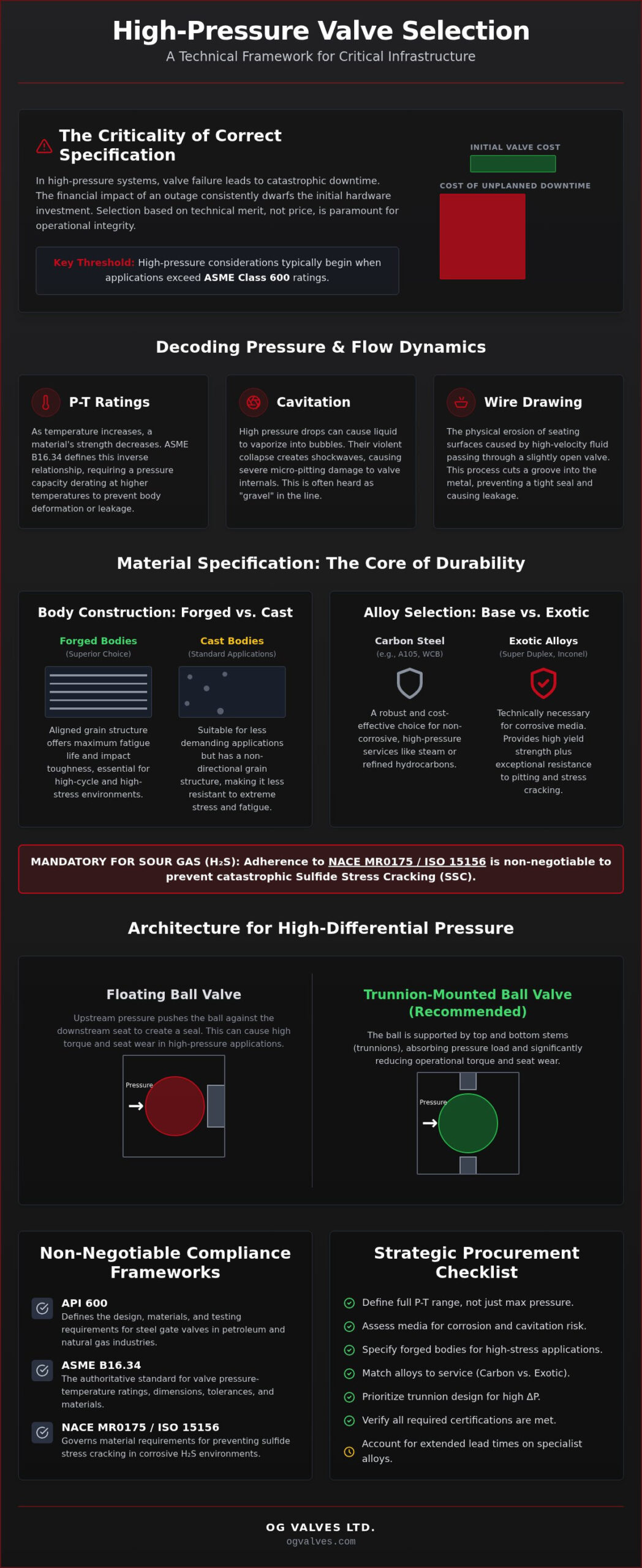
In critical industrial infrastructure, the integrity of a high-pressure valve is the only barrier between a controlled process and a catastrophic system failure. You understand that the cost of unplanned downtime often dwarfs the initial capital expenditure of the hardware itself. Navigating the complexities of high pressure valve selection criteria requires a clinical assessment of metallurgical properties, sealing technologies, and strict adherence to global engineering standards such as API 600 and ASME B16.34. Selecting a valve based on price rather than technical specification often leads to premature fatigue in extreme environments.
This guide provides the rigorous technical framework necessary to specify gate, ball, globe, and check valves that withstand extreme mechanical stresses while ensuring absolute regulatory compliance. You’ll gain the expertise to match specific material classifications to corrosive high-pressure media without ambiguity. We will analyze how pressure-temperature ratings dictate component longevity, examine the role of international certifications in risk mitigation, and provide a definitive checklist for precise technical specification. This methodical approach ensures your infrastructure maintains operational output and structural soundness under the most demanding conditions.
Key Takeaways
- Define the engineering threshold between static and dynamic pressure to ensure component durability under extreme operational conditions.
- Execute rigorous high pressure valve selection criteria when specifying metallurgical properties to mitigate the risk of stress-induced failure.
- Assess the functional limitations of valve architectures, prioritizing trunnion-mounted configurations for high-differential pressure applications.
- Align technical specifications with international benchmarks like ASME B16.34 and API 600 to ensure absolute safety and regulatory adherence.
- Strategize procurement by accounting for the extended lead times of specialist alloys required for high-pressure industrial environments.
Defining High-Pressure Parameters: Beyond PSI and Bar
Industrial valve specification requires a departure from binary pressure assessments. While PSI and Bar provide a baseline, high pressure valve selection criteria must account for the dynamic transition from static containment to high-velocity flow. For many engineering teams, the “high pressure” threshold begins where ASME Class 600 ratings are exceeded. At these levels, the physical properties of the media change, and the risk of “wire-drawing” becomes a primary failure mode. This phenomenon involves the physical erosion of seating surfaces due to high-velocity fluid passing through a restricted orifice, resembling a thin wire cutting through the metal. A foundational understanding valve basics is necessary to recognize that nominal pressure (PN) ratings are not static values; they are variables dependent on thermal load.
Understanding Pressure-Temperature (P-T) Ratings
ASME B16.34 establishes the definitive framework for Maximum Allowable Working Pressure (MAWP). As temperatures rise, the molecular integrity of the valve body and trim materials decreases, necessitating a significant derating of the valve’s pressure capacity. This isn’t a linear relationship. Different alloys exhibit unique derating curves that engineers must analyze during the design phase. Thermal expansion also introduces mechanical stress. It impacts valve seating and increases the operational torque required for actuation. Engineers shouldn’t overlook the impact of heat on seal elasticity and structural soundness. Failure to cross-reference PN ratings with actual operating temperatures often leads to body deformation or seat leakage during rapid thermal cycling.
Media Velocity and the Risk of Cavitation
High-pressure differentials across a valve trim often trigger cavitation. This phenomenon occurs when local pressure drops below the vapor pressure of the liquid, forming bubbles that collapse violently upon reaching higher pressure zones. The resulting shockwaves cause micro-pitting in globe and butterfly valves. It often sounds like gravel passing through the system. Identifying these signs early is critical for preventing catastrophic failure. To prevent this, specifiers must select anti-cavitation trim designs that manage pressure drops in controlled, multi-stage increments. This reduces media velocity and maintains the local pressure above the vapor point. Proper high pressure valve selection criteria must include an analysis of the cavitation index to ensure long-term reliability in throttling services.
Material Specification for Extreme Pressure Environments
High-pressure containment demands metallurgical integrity that exceeds standard commercial requirements. When assessing high pressure valve selection criteria, engineers must prioritize materials capable of withstanding extreme hoop stress. This internal radial pressure exerts a constant load on the valve body, necessitating precise wall thickness calculations according to ASME Section VIII. Forged bodies are superior to cast alternatives in high-cycle environments. Forging aligns the grain structure of the metal, which significantly improves the fatigue life and impact toughness of industrial valves. This structural soundness is the primary defense against catastrophic failure in critical infrastructure.
In sour gas applications, material specification is strictly governed by NACE MR0175/ISO 15156. This compliance framework is mandatory because high-pressure H2S environments trigger sulfide stress cracking (SSC). Without adherence to these specific hardness limits and heat treatment protocols, the risk of brittle failure is absolute. If your project involves complex chemical media, our technical specialists can assist in specifying high-alloy valve components to ensure long-term reliability.
Carbon Steel vs. Exotic Alloys (Super Duplex, Inconel)
While carbon steel grades like ASTM A105 or WCB suffice for non-corrosive high-pressure service, they fail when corrosion-erosion synergy is present. High pressure accelerates the rate of material loss by physically stripping protective oxide layers from the metal surface. In these scenarios, moving to Super Duplex (F51/F53) or Inconel 718 becomes a technical necessity. These alloys provide the high yield strength required for pressure containment while maintaining exceptional resistance to pitting and crevice corrosion. Engineers must evaluate the total cost of ownership, as the longevity of exotic alloys in extreme environments often offsets their higher initial procurement cost.
Sealing Technologies and Fugitive Emission Control
High pressure significantly complicates fugitive emission management. It forces media through the microscopic gaps in the stuffing box with greater intensity than low-pressure systems. Modern specifications now require compliance with ISO 15848-1, which establishes rigorous testing benchmarks for low-leakage performance. Engineers must choose between graphite packing for high-temperature resilience and PTFE for chemical inertness; however, high pressure often necessitates reinforced graphite to prevent material extrusion. Gasket selection is equally critical. High-pressure flange faces, specifically Ring Type Joints (RTJ), provide the mechanical seal needed where standard spiral wound gaskets might reach their compression limits.
Selecting Valve Architecture for High-Pressure Service
High pressure valve selection criteria demand a precise understanding of how internal hydraulic forces interact with mechanical valve components. Floating ball valves, while effective in low-pressure systems, reach a functional limit where the upstream pressure forces the ball into the downstream seat with excessive intensity. At Class 900 and above, this creates high operational torque and accelerated seat wear. Consequently, ball valves with trunnion-mounted designs are the engineering standard for high-differential pressures. These designs fix the ball in place with upper and lower bearings, allowing the seats to move independently against the ball to ensure a reliable seal without compromising the stem integrity.
Trunnion-Mounted vs. Floating Designs
Floating designs are typically restricted to lower pressure classes because the seat must support the entire load of the ball. In contrast, trunnion-mounted valves handle Class 900 to 2500 services by distributing the hydraulic load through the trunnion plate and stem. This architecture is essential for Double Block and Bleed (DBB) capabilities. DBB allows for the simultaneous sealing of both upstream and downstream ports, providing a verifiable safety barrier in high-pressure hydrocarbon service. This feature is critical for maintenance procedures where absolute isolation is required to protect personnel and equipment.
For high-pressure steam and heavy hydrocarbon isolation, gate valves provide a reliable metal-to-metal seal with minimal pressure drop across the bore. They aren’t suitable for throttling. In systems requiring precise flow regulation, globe valves are necessary despite the inherent pressure drop caused by their internal geometry. Check valves are also indispensable for protecting upstream equipment from high-pressure backflow and hydraulic surge, particularly in high-head pump discharge lines where water hammer risks are prevalent.
Globe Valves for High-Pressure Throttling
The tortuous flow path of a globe valve makes it ideal for high-pressure control by dissipating fluid energy through the trim. When specifying these components, engineers must choose between balanced and unbalanced plug designs. Balanced plugs use internal bypass holes to equalize pressure across the plug. This configuration significantly reduces the actuator torque requirements for large-bore, high-pressure service, allowing for smaller and more cost-effective automation packages. To combat the erosion mentioned in earlier sections, specifying hardened trim materials like Stellite is mandatory. This cobalt-based alloy maintains its hardness at elevated temperatures. It ensures the seating surfaces resist the high-velocity “wire-drawing” effect common in high-differential pressure environments, maintaining tight shut-off over long operational cycles.
Compliance Frameworks: API, ASME, and ISO Standards
Regulatory adherence provides the technical foundation for industrial safety. In high-pressure environments, the hierarchy of standards dictates the design envelope and testing rigor. ASME B16.34 serves as the primary benchmark for pressure-temperature ratings and wall thickness. For pipeline applications, API 6D provides the specific requirements for ball and check valves, while API 600 defines the heavy-duty standards for steel gate valves. Fire-safe certification, specifically API 607 or API 6FA, is a non-negotiable high pressure valve selection criteria for hydrocarbon service. These certifications ensure that the valve maintains its sealing integrity during and after a fire, preventing a localized incident from escalating into a catastrophic failure. Global procurement also necessitates compliance with the Pressure Equipment Directive (PED) and CE marking to meet European safety benchmarks.
Establishing a robust Quality Assurance (QA) plan is essential for high-pressure valve acquisition. This plan must verify that every component meets the design specifications before it enters the field. For projects requiring absolute regulatory adherence, you can procure API-certified high-pressure valves through our global supply network to ensure full compliance with these rigorous standards.
Critical Testing Protocols: Hydrostatic and Gas Testing
Standard hydrostatic testing remains the baseline for structural integrity, but it doesn’t always reveal the microscopic leak paths present in high-pressure gas service. While API 598 is the most common testing standard, ISO 5208 offers a more granular leakage classification system, ranging from Rate A (zero visible leakage) to Rate G. For critical high-pressure service, high-pressure gas testing using Nitrogen or Helium is required to validate seat tightness at maximum operating pressures. Positive Material Identification (PMI) is another essential step in the validation process. It uses X-ray fluorescence to verify the metallurgical composition of the valve body and trim, ensuring that the material matches the certified Material Test Report (MTR).
Documentation and Traceability
Traceability is the only way to guarantee the provenance of high-pressure components. EN 10204 3.1 certification provides manufacturer-verified data, while 3.2 certification requires independent third-party validation of the testing process. This level of documentation ensures the valve is traceable to the specific heat lot of the metal, which is vital for forensic analysis if a failure occurs. Engineers should also demand comprehensive Non-Destructive Examination (NDE) reports. Radiography (RT) is used to detect internal volumetric defects in cast bodies, while Ultrasonic Testing (UT) is preferred for verifying the integrity of forged components. Maintaining a technical data book for each valve creates a digital record of its compliance status and testing history throughout its lifecycle.
Strategic Procurement: Optimising High-Pressure Valve Lead Times
Procurement of high-pressure components necessitates a strategic approach to lead time management. Specialist alloys such as F51 Super Duplex or Inconel 718 often require extended manufacturing cycles due to metallurgical testing and forging requirements. Balancing technical rigor with urgent project deadlines is a primary challenge for procurement specialists in critical infrastructure sectors. OG VALVES LTD. addresses this by maintaining a global supply chain optimized for fast-track delivery of high-pressure gate, ball, and check valves. This capability reduces the window of operational exposure during unplanned outages. Technical support during the initial specification phase is vital. It prevents the mis-specification of high pressure valve selection criteria, ensuring that the hardware delivered meets the exact mechanical and chemical requirements of the facility.
The Role of Specialist Suppliers in Critical Infrastructure
Generalist vendors often lack the technical depth required to support high-pressure sectors. A specialist distributor provides value through an extensive inventory of Class 900 to 2500 components, allowing for the immediate replacement of failed infrastructure. This inventory depth is coupled with expert technical consultation during the Request for Quotation (RFQ) process. By vetting technical data sheets against international standards like API 600 or ASME B16.34, specialists mitigate the risk of project delays caused by non-compliant hardware. This partnership ensures that technical experts receive components that have already undergone the necessary quality control protocols.
Final Selection Checklist for High-Pressure Valves
Before finalizing a procurement order, engineers must verify a consolidated list of technical variables. This checklist serves as the final validation of the high pressure valve selection criteria established during the design phase.
- Fluid Characteristics: Confirm chemical compatibility and the presence of abrasive particulates that may require hardened trim.
- P-T Ratings: Verify the Maximum Allowable Working Pressure at the specific peak operating temperature, not just the ambient rating.
- End Connections: Ensure flange faces, such as Ring Type Joints (RTJ), match the existing piping specification for high-pressure containment.
- Actuation Requirements: Validate that the actuator torque output exceeds the break-torque requirements at maximum differential pressure.
- Certification: Confirm that EN 10204 3.1 or 3.2 certificates and NDE reports are included in the technical data book.
This methodical verification prevents installation failures and ensures the long-term structural soundness of the high-pressure system. It’s the final safeguard in a risk-mitigation strategy that prioritizes engineering excellence over initial capital savings.
Securing Long-Term Integrity in High-Pressure Systems
Engineering excellence in extreme environments relies on the rigorous application of high pressure valve selection criteria. Moving beyond nominal pressure ratings to analyze the synergy between thermal loads, metallurgical fatigue, and valve architecture ensures system longevity. You’ve seen that the choice between trunnion-mounted ball valves and hardened globe valve trims isn’t merely a matter of preference; it’s a risk-mitigation strategy dictated by global benchmarks like API 600 and ASME B16.34.
OG VALVES LTD. acts as a dependable partner for critical infrastructure projects. We provide specialist technical support to ensure your specifications meet every regulatory and operational requirement. Our extensive inventory of API-certified gate, ball, globe, and check valves facilitates global fast-track delivery, which significantly reduces the cost of unplanned downtime and operational failure.
Don’t compromise on the structural soundness of your facility. Request a Technical Quote for High-Pressure Valves today to align your procurement with industry-leading safety standards. We look forward to supporting your next industrial project with technical precision and unwavering reliability.
Frequently Asked Questions
What is the most common cause of high-pressure valve failure?
The primary causes of high-pressure valve failure are erosion and cavitation resulting from high-velocity media. When fluids pass through restricted orifices at extreme pressure differentials, they physically strip the protective oxide layers from the metal. This leads to seat leakage and structural compromise. Inadequate high pressure valve selection criteria that ignore the relationship between pressure and temperature also contribute to premature fatigue and seal extrusion in critical industrial environments.
How do I determine the correct pressure class for my valve?
Determining the correct pressure class requires cross-referencing your maximum operating pressure with the peak operating temperature using ASME B16.34 Pressure-Temperature tables. A valve rated for Class 1500 at ambient temperature will have a significantly lower Maximum Allowable Working Pressure at 400°C. Engineers must specify the class based on the most extreme thermal and pressure conditions the system will encounter to ensure the structural soundness of the valve body.
Can I use a floating ball valve in high-pressure gas service?
Floating ball valves are generally unsuitable for high-pressure gas service exceeding Class 600. In high-pressure environments, the upstream pressure forces the ball into the downstream seat with excessive intensity, resulting in high operational torque and seat deformation. Trunnion-mounted designs are the technical standard for Class 900 to 2500 services because they fix the ball in place, allowing the seats to move independently to maintain a reliable seal under high-differential pressures.
What is the difference between API 6D and ASME B16.34 for high-pressure valves?
ASME B16.34 is a foundational design standard that dictates pressure-temperature ratings, wall thicknesses, and material requirements for all pressure-containing valves. API 6D is a specific performance standard for pipeline valves, including ball, gate, and check valves. While a valve can comply with both, API 6D includes more rigorous testing and documentation requirements specifically tailored for the midstream and upstream hydrocarbon sectors, ensuring operational output in global infrastructure.
Why is Stellite trim often specified for high-pressure globe valves?
Stellite trim is specified because this cobalt-based alloy provides exceptional hardness and resistance to mechanical wear at elevated temperatures. In high-pressure globe valves used for throttling, the media moves at high velocities, which causes “wire-drawing” erosion on standard seating surfaces. Stellite maintains its structural integrity under these abrasive conditions, ensuring tight shut-off and extending the service life of critical components in high-differential pressure applications.
What is fugitive emission testing, and is it required for high-pressure valves?
Fugitive emission testing, governed by ISO 15848-1, is a mandatory requirement for high-pressure valves in modern industrial facilities. High operating pressures intensify the risk of media escaping through the stem packing and gaskets. Testing involves using Helium or Nitrogen to detect microscopic leaks at maximum pressure. Adhering to strict high pressure valve selection criteria regarding low-leakage performance is vital for environmental compliance and the safety of personnel in hazardous environments.
How does cavitation differ from flashing in high-pressure flow control?
Cavitation occurs when the local pressure drops below the fluid’s vapor pressure, forming bubbles that subsequently collapse as pressure rises, causing micro-pitting. Flashing happens when the pressure remains below the vapor pressure through the valve’s exit, resulting in a two-phase flow of liquid and vapor. Both phenomena cause significant erosion, but cavitation is particularly destructive to valve seats and internal trim due to the high-energy shockwaves produced by bubble implosion.
What documentation should I expect with a high-pressure industrial valve?
You should expect a comprehensive technical data book containing Material Test Reports (MTRs) traceable to the specific heat lot, typically certified to EN 10204 3.1 or 3.2. Additional documentation includes Non-Destructive Examination (NDE) reports, such as Radiography or Ultrasonic testing results, and hydrostatic and gas pressure test certificates. These records provide the necessary validation of metallurgical integrity and regulatory compliance required for high-stakes procurement in heavy industrial sectors.
 Responsive Menu