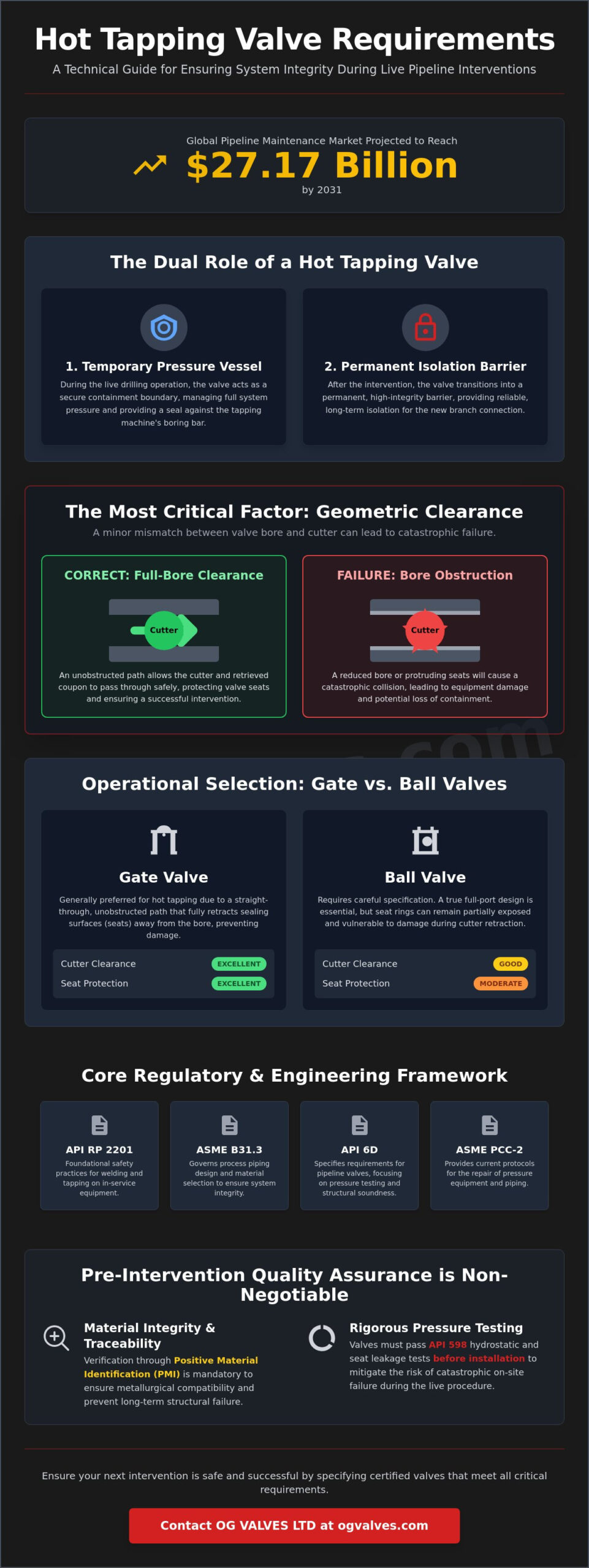
A hot tapping valve isn’t merely a component. It functions as a temporary pressure vessel and a permanent isolation barrier that must meet precise geometric and metallurgical benchmarks to ensure intervention safety. With the global pipeline maintenance market projected to reach 27.17 billion dollars by 2031, the pressure to maintain system uptime while adhering to hot tapping valve requirements has never been higher. You’re likely aware that the margin for error during a live drilling operation is zero. A minor mismatch between the valve bore and the tapping machine cutter can lead to catastrophic system failure or uncontainable leaks.
This technical guide details the rigorous standards required to ensure a successful branch connection without system shutdown. We’ll examine the specific design specifications mandated by API RP 2201 (5th edition) and the latest ASME PCC-2-2022 standards. You’ll learn how to navigate PHMSA’s April 2026 rulemaking actions regarding pipeline safety and how to verify that your valve selection, whether a gate or ball valve, provides the necessary clearance for coupon retrieval and long-term isolation reliability.
Key Takeaways
- Understand the dual function of hot tapping valves as both temporary pressure containment vessels and permanent, high-integrity isolation barriers.
- Identify the specific hot tapping valve requirements for full-bore internal diameter tolerances to ensure unobstructed cutter passage and successful coupon retrieval.
- Specify metallurgical compatibility and material traceability protocols, including Positive Material Identification, to maintain long-term structural integrity.
- Compare the operational performance of gate valves versus ball valves regarding seating protection during the live cutting and retraction phases.
- Implement rigorous pre-installation quality assurance measures, such as API 598 hydrostatic and seat leakage testing, to mitigate the risk of intervention failure.
Fundamental Engineering Principles of Hot Tapping Valves
A hot tapping valve is a specialized component designed to facilitate a branch connection to a pressurized system without interrupting the flow of media. It transitions from a temporary conduit for the drilling equipment to a permanent isolation barrier once the procedure concludes. Industrial operators prioritize this method because the financial consequences of a total system shutdown often exceed the cost of the intervention itself. This hot tapping overview illustrates how the process maintains operational continuity in high-stakes environments like refineries and midstream terminals. By avoiding a shutdown, facilities maintain their output while expanding infrastructure or performing critical repairs.
The engineering logic behind hot tapping valve requirements centers on the valve’s ability to maintain structural integrity under dynamic loads. Unlike standard isolation valves installed during a planned outage, these units must function as a temporary pressure-containment vessel for the tapping machine’s cutter and boring bar. This dual-purpose role requires specific design considerations for the valve body, seals, and bore diameter to ensure the system remains sealed while the mechanical cut is performed. The valve doesn’t just stop flow; it houses the entire intervention process.
The Valve as a Pressure-Containment Boundary
During the drilling process, the valve body is subjected to the full operating pressure of the live pipeline. It must manage the differential pressure between the internal media and the tapping machine’s housing. If the valve body lacks the necessary wall thickness or material strength, the risk of deformation or catastrophic rupture increases. The valve must also provide a secure seal against the boring bar to prevent leaks during the retraction of the cutter and the retrieved pipe section, known as the coupon. The hot tapping valve serves as the primary safety interface between the pressurized pipeline and the external environment during all stages of the intervention.
Core Regulatory Framework: API 2201 and Beyond
Rigorous adherence to international standards is a prerequisite for any live intervention. API RP 2201, currently in its 5th edition (2020), provides the foundational safety practices for welding and tapping on equipment in service. This standard dictates the criteria for safe installation and the necessary precautions to prevent burn-through or hydrogen cracking. Meeting hot tapping valve requirements ensures that the component provides long-term isolation reliability long after the tapping machine is disconnected.
Technical specifications for these valves often align with several global benchmarks:
- ASME B31.3: Governs the design and material selection for process piping to ensure the new branch connection meets the system’s original engineering benchmarks.
- API 6D: Establishes the requirements for pipeline valves, focusing on pressure testing and structural soundness for high-pressure applications.
- ASME PCC-2-2022: Provides the current protocols for the repair of pressure equipment and piping, including hot tap procedures.
Engineers must verify that the selected valve, whether a gate valve or ball valve, complies with these specific codes to satisfy safety audits and regulatory compliance. Failure to match the valve’s technical output to these standards can result in catastrophic failure during the drilling phase.
Geometric and Design Requirements for Cutter Clearance
The physical geometry of the valve is the most critical factor in the hardware selection process. While standard isolation valves focus on sealing performance, hot tapping valve requirements prioritize the internal clearance necessary for the boring bar and cutter assembly. If the valve’s inner diameter (ID) doesn’t provide a completely unobstructed path, the cutter will impact the internal seats or the valve body. This leads to immediate equipment damage and potential loss of pressure containment. According to the EPA hot tapping guidelines, selecting the correct fitting and valve size is the foundation of a leak-free intervention.
Dimensional accuracy extends to the face-to-face measurements of the valve. The total length of the valve body determines the travel distance required for the tapping machine’s boring bar. If the valve is excessively long, the machine might not reach the pipe wall. Conversely, if it’s too short, there may be insufficient space to house the cutter and the retrieved pipe coupon once the valve is closed. The valve must also feature vent and drain ports. These ports allow technicians to equalize pressure across the valve before the cut and to perform a hydrostatic test of the entire setup to verify the integrity of the seals before the drilling process begins.
Full-Bore vs. Reduced-Bore Pitfalls
Reduced-bore valves are strictly prohibited in hot tapping operations. Even a slight protrusion into the flow path can catch the pilot drill or the cutter teeth. Engineers must calculate the clearance margin by comparing the actual valve ID against the maximum outer diameter of the cutter. A standard rule of thumb is to ensure the valve bore is at least 1/2 inch larger than the cutter diameter to account for potential misalignment. For high-pressure applications, selecting precision-engineered gate valves with verified full-bore IDs is essential to prevent mechanical interference during coupon retrieval.
Piggability and Long-Term System Integrity
The valve selection impacts the pipeline’s lifecycle long after the hot tap is complete. If the valve ID doesn’t match the branch pipe’s ID, it creates a “dead leg” or a shelf that induces flow turbulence. This turbulence often leads to localized erosion or the accumulation of debris. Furthermore, the branch connection must remain piggable if the new line requires internal cleaning or inspection. Ensuring internal diameter consistency across the entire branch connection prevents future operational bottlenecks and maintains the structural integrity of the pipeline system.

Metallurgical integrity is a foundational pillar of hot tapping valve requirements. The valve body material must be strictly compatible with the existing pipeline metallurgy to prevent galvanic corrosion and ensure a high-strength weld at the flange interface. Procurement specialists must verify Mill Test Reports (MTRs) for every pressure-containing component, including the body, bonnet, and bolting. This documentation provides the specific chemical composition and mechanical properties required to satisfy safety audits and engineering benchmarks. According to API RP 2201, the selection of materials for in-service welding and tapping requires a thorough analysis of the carbon equivalent to mitigate the risk of hydrogen cracking. Without precise material matching, the heat-affected zone (HAZ) of the weld can become brittle, leading to structural failure under operational pressure.
For systems transporting hydrogen sulfide or other corrosive media, the valve must adhere to NACE MR0175/ISO 15156 standards. This compliance is mandatory to prevent sulfide stress cracking, which can cause sudden, catastrophic failure during the drilling phase. The valve’s internal trim, including the stem and seating surfaces, requires alloys that resist both the chemical environment and the mechanical wear caused by the cutting process. Meticulous material selection ensures the valve remains a dependable isolation barrier for the duration of its service life.
PMI Testing and Chemical Compatibility
Positive Material Identification (PMI) serves as a requisite verification step before any hardware is staged for a live intervention. While MTRs provide a paper trail, field-based PMI testing confirms that the alloy composition of the valve flange matches the engineering specification without damaging the component. This process is particularly vital when ensuring the weldability of the valve to the tapping fitting. Engineers must verify specific carbon equivalent (CE) limits, typically keeping the CE below 0.43 percent to ensure the weld remains ductile and resistant to cracking during the cooling phase on a live, flowing system.
High-Temperature and Cryogenic Considerations
Extreme thermal environments in petrochemical processing require specialized alloys to maintain dimensional stability. Thermal expansion can alter the tolerances between the valve gate and seats, potentially compromising the seal during the critical “hot” phase of the operation. Integrating rigorous material selection for high-temperature valves into the initial specification prevents seal bypass or mechanical binding. The valve must maintain its structural soundness and seating tightess across the entire specified temperature gradient to ensure safe cutter retraction and coupon retrieval.
Operational Selection: Gate Valves vs. Ball Valves for Hot Tapping
The selection between gate and ball valves represents a critical engineering decision in satisfying hot tapping valve requirements. While both valve types provide the necessary full-bore clearance, their mechanical responses to the cutting process differ significantly. Engineers must evaluate the media characteristics, such as viscosity and temperature, alongside the potential for mechanical interference from metal shavings. In high-pressure interventions, the valve must not only facilitate the cut but also ensure a bubble-tight seal once the boring bar is retracted. Double Block and Bleed (DBB) capabilities are often specified for high-consequence pipelines to provide an additional layer of safety verification before the tapping machine is removed.
Operational torque and actuator compatibility also influence the selection. As line pressure increases, the force required to seat the valve after the cut can escalate. If the valve is equipped with an actuator, it must be calibrated to handle the specific differential pressure present during the intervention. Failure to account for these mechanical loads can result in an incomplete seal, leaving the new branch connection vulnerable to leaks during the final stages of the operation.
The Case for Industrial Gate Valves
Slab gate valves are frequently the preferred choice for hot tapping in high-pressure steam and heavy crude applications. Unlike wedge-style gates, slab designs provide a smooth, through-conduit bore that minimizes turbulence and prevents the accumulation of metal shavings in the valve cavity. A detailed analysis of industrial gate valves reveals that their robust construction handles thermal expansion more effectively than many ball valve designs. This makes them ideal for petrochemical environments where temperature fluctuations are common. The slab gate’s ability to wipe its seats during every stroke helps maintain seal integrity even when the media is laden with debris from the drilling process.
The Case for Industrial Ball Valves
Industrial ball valves are prized for their rapid quarter-turn operation and exceptional seal reliability in gas and light liquid services. When specifying industrial ball valves for hot tapping, trunnion-mounted designs are mandatory for high-pressure systems. Trunnion mounting secures the ball at the top and bottom, preventing the ball from shifting under pressure and damaging the seats. A primary concern with ball valves is the protection of the soft seats from the sharp metal shavings generated during the tap. To mitigate this risk, engineers often specify metal-seated ball valves or designs with seat-injection fittings that allow for the application of sealant to ensure a positive shut-off after the coupon is retrieved.
For procurement specialists managing critical infrastructure projects, selecting the correct hardware is non-negotiable. Explore our full range of API-certified valves to find the ideal match for your next hot tapping intervention.
Procurement and Quality Assurance for Critical Interventions
The final stage of satisfying hot tapping valve requirements involves a rigorous procurement and quality assurance protocol that validates every engineering decision made during the selection phase. Technical specifications are only effective if the hardware arrives with verified performance data and full material traceability. Every valve destined for a live intervention must undergo pre-installation hydrostatic and seat leakage testing in accordance with API 598. This testing confirms that the valve will maintain its integrity during the high-stress drilling phase and provide a reliable seal once the coupon is retrieved. For high-consequence pipelines in North America or the North Sea, third-party inspections provide an unbiased verification of the valve’s structural soundness before it’s welded to the system.
Documentation packages are a non-negotiable component of the delivery process. These packages must include Mill Test Reports (MTRs), pressure test certificates, and detailed General Arrangement (GA) drawings that confirm internal bore dimensions. In emergency scenarios, such as leak containment or critical bypass operations, the ability to secure fast-track delivery is as vital as the technical specification itself. Procurement specialists must partner with suppliers who understand that a delay in hardware delivery translates directly into lost operational uptime and increased system risk.
Quality Control Benchmarks
Visual and dimensional inspection protocols must confirm the full-bore internal diameter tolerances established in the engineering design. Technicians should verify that the valve bore is free of any manufacturing debris or seat protrusions that could interfere with the tapping machine’s cutter. If the intervention includes bypass loops, verifying the seating integrity of the check valves is necessary to prevent backflow during the system switchover. Shell and seat pressure test certifications are mandatory to prove the valve can withstand the maximum allowable operating pressure (MAOP) of the live pipeline.
Specifying for Global Infrastructure
OG VALVES LTD. maintains a clinical focus on adherence to international API valve standards to ensure safety in high-stakes industrial environments. We provide procurement officers in the oil, gas, and power generation sectors with the precise technical data required for complex project management. Our global logistics network is structured to handle large-scale industrial demands, ensuring that critical isolation hardware reaches the site without compromising project timelines. This unwavering commitment to engineering excellence and regulatory compliance makes us a dependable partner for infrastructure projects where the cost of failure is unacceptable.
Securing Long-Term Integrity in Live Pipeline Interventions
Ensuring operational continuity through hot tapping requires a meticulous approach to component specification. Successful interventions depend on the precise alignment of valve geometry with cutter dimensions and the verification of metallurgical compatibility through Positive Material Identification. Adhering to the latest hot tapping valve requirements ensures that the component functions as a reliable pressure barrier during the drilling phase and a high-integrity isolation point for the remainder of its service life. Failure to meet these technical benchmarks can lead to catastrophic system failure and uncontainable leaks.
OG VALVES LTD. maintains a comprehensive inventory of API 6D and API 600 compliant gate and ball valves specifically engineered for these high-stakes applications. Every unit undergoes rigorous quality control and PMI testing to meet the stringent benchmarks required by global infrastructure projects. Our global logistics network supports fast-track delivery to minimize downtime during emergency repairs and scheduled expansions. Consult with our technical team for high-specification hot tapping valves to ensure your next intervention meets the highest safety and engineering standards. With the right hardware, your facility remains productive and secure.
Frequently Asked Questions
Can any gate valve be used for a hot tapping operation?
No, only specific full-bore valves are suitable for these operations. Standard wedge gate valves often feature internal cavities or body configurations that obstruct the cutter’s path or prevent the secure retrieval of the pipe coupon. For most industrial applications, a through-conduit slab gate valve is required to ensure a completely unobstructed bore and reliable sealing after the boring bar is retracted.
What is the minimum pressure rating required for a hot tap valve?
A hot tap valve’s pressure and temperature ratings must be at least equal to the pipeline’s maximum allowable operating pressure (MAOP) and its highest potential operating temperature. Engineering specifications typically mandate compliance with ASME B16.34 or API 6D pressure classes. This ensures the valve body can function as a temporary pressure vessel during the drilling phase without deforming under load.
Why is full-bore geometry mandatory for hot tapping valves?
Full-bore geometry is essential because the internal diameter must accommodate the passage of both the pilot drill and the full-diameter cutter assembly. If the bore is restricted, the cutter will impact the valve seats or the body wall, causing catastrophic mechanical failure. This geometric precision is a fundamental aspect of hot tapping valve requirements to allow for the safe retraction of the coupon.
Is a ball valve better than a gate valve for live pipeline tapping?
The choice depends entirely on the media and operational environment. Ball valves provide efficient quarter-turn operation and excellent sealing in gas services, provided they utilize trunnion mounting to handle high differential pressures. However, slab gate valves are often superior for high-temperature steam or heavy crude applications because their seating mechanisms are less susceptible to damage from the metal shavings generated during the cut.
What industry standards govern the design of valves for hot tapping?
The primary standards include API RP 2201 for safe hot tapping practices and API 6D for pipeline valve specifications. Additionally, ASME PCC-2-2022 provides the current protocols for the repair of pressure equipment and piping. These regulations define the mandatory hot tapping valve requirements for metallurgical integrity, pressure containment, and structural soundness in high-stakes industrial environments.
How do you test a valve before performing a hot tap?
Valves must undergo a primary hydrostatic and seat leakage test per API 598 at the manufacturing facility. Once the valve is installed on the tapping fitting in the field, technicians perform a secondary pressure test through the valve’s vent or drain ports. This test verifies the integrity of the flange gaskets and the tapping machine seals before the cutter makes contact with the live pipe wall.
Does the valve remain on the pipeline after the hot tap is complete?
Yes, the valve becomes a permanent part of the pipeline infrastructure once the intervention is finished. It serves as the primary isolation point for the newly created branch connection. This allows operators to perform maintenance or shut down the branch line in the future without requiring a full system outage on the main header pipe.
What are the material traceability requirements for hot tap valves?
Every pressure-containing component must be accompanied by a Mill Test Report (MTR) that verifies its chemical composition and mechanical properties. For sour service environments, the valve must also comply with NACE MR0175/ISO 15156 to prevent sulfide stress cracking. Positive Material Identification (PMI) is often performed on-site to confirm that the valve flange metallurgy matches the tapping fitting and the existing pipeline.
 Responsive Menu