Is your facility prepared for the 2026 regulatory shift in valve performance standards? With the global industrial valves market valued at USD 101.56 billion in 2025, the financial risk of premature component failure has reached a critical threshold for the oil and gas sectors. Most engineers recognize that unplanned downtime due to valve seizure or corrosion in cryogenic applications creates an unacceptable strain on operational budgets. Learning how to extend the life of industrial valves requires a shift from reactive cleaning to a clinical focus on material integrity and rigorous engineering precision.
You understand that high-pressure environments demand more than basic maintenance to prevent the high cost of total replacement. This guide provides the engineering protocols and maintenance frameworks necessary to maximize the service life of high-specification gate, globe, and check valves. We will examine the technical requirements of the February 2026 updates to ISO 22109 and ISO 5211. This analysis ensures your facility remains compliant with the latest performance testing and safety standards for valve gearboxes and actuator attachments while reducing the frequency of emergency replacements.
Key Takeaways
- Analyze the relationship between Total Cost of Ownership (TCO) and plant safety protocols to quantify the economic value of component longevity.
- Identify the specific material grades, such as Super Duplex and forged steel, required to resist premature corrosion in high-pressure and cryogenic service.
- Discover how to extend the life of industrial valves through the implementation of data-driven maintenance frameworks that align with API 600 and ISO standards.
- Execute technical “Valve Exercise” protocols and advanced stem seal lubrication techniques to eliminate the risk of mechanical seizure in dormant assets.
- Verify mechanical integrity during procurement using Positive Material Identification (PMI) and rigorous testing to ensure adherence to international engineering specifications.
The Economic and Operational Impact of Industrial Valve Longevity
The mechanical integrity of flow control systems is a primary determinant of operational uptime. For engineers in the oil, gas, and water treatment sectors, the Total Cost of Ownership (TCO) for industrial valves encompasses far more than the initial procurement price. It includes the costs associated with installation, rigorous maintenance, potential downtime, and eventual decommissioning. Understanding how to extend the life of industrial valves is not merely a maintenance preference; it’s a financial necessity in high-stakes infrastructure.
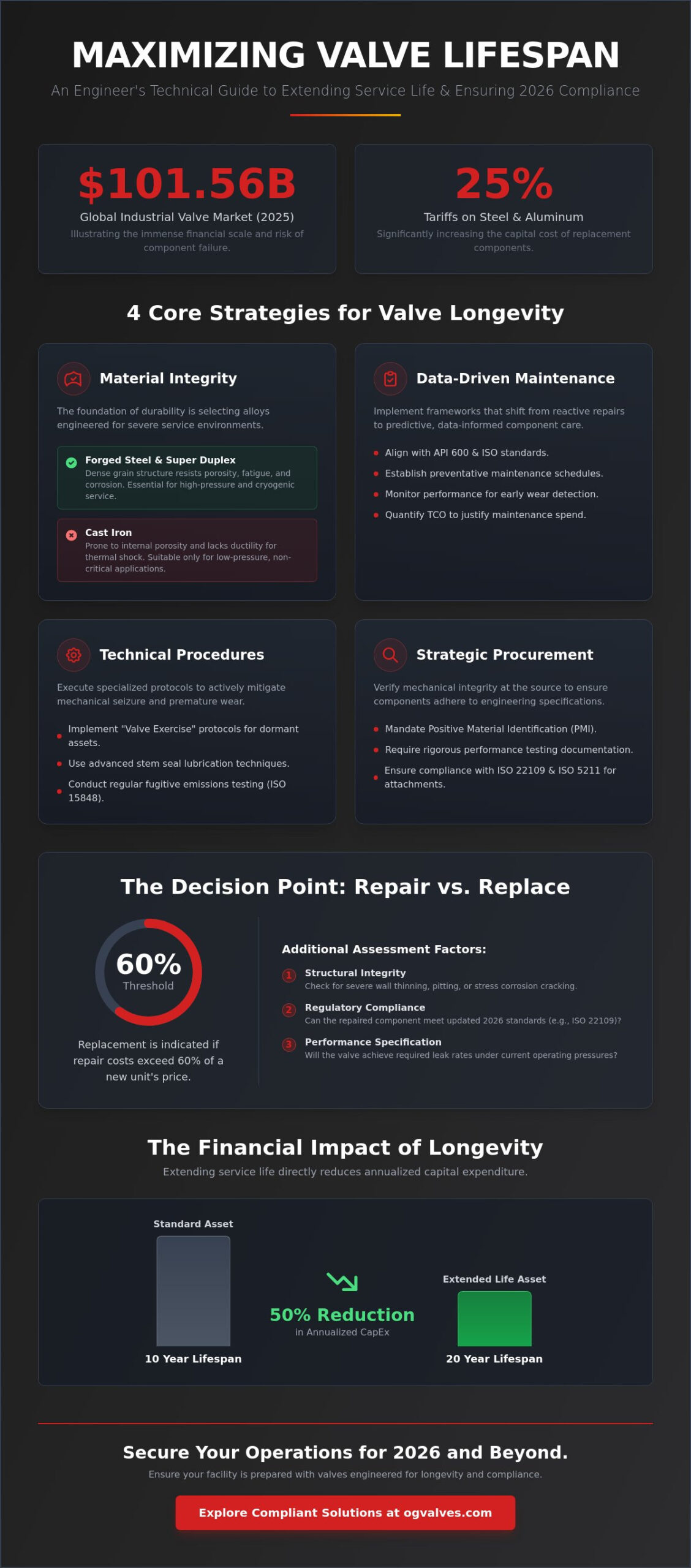
Current market conditions emphasize this requirement. With the 25% tariffs on steel and aluminum imports enacted in February 2025, the capital cost of replacement components has risen significantly. Extending the service life of existing assets directly mitigates these inflationary pressures. A technical focus on critical industrial valves ensures that global supply chain delays don’t compromise plant safety protocols or operational reliability.
Determining the “Repair vs. Replace” threshold requires a clinical assessment of several technical factors:
- Structural Integrity: Evidence of severe wall thinning, pitting, or stress corrosion cracking.
- Economic Viability: If repair costs exceed 60% of the price of a new unit, total replacement is typically indicated.
- Compliance: The ability of the repaired component to meet updated 2026 standards like ISO 22109 for gearboxes.
- Performance: Whether the valve can achieve the required leak rate specifications under current operating pressures.
The Real Cost of Unplanned Valve Failure
Unplanned failures in high-pressure or cryogenic systems result in catastrophic downtime losses. In the power generation sector, a single valve seizure can halt production, leading to financial losses that often exceed the valve’s value by several orders of magnitude. Beyond direct financial loss, mechanical failure compromises environmental compliance. Stricter standards for fugitive emissions, such as ISO 15848 and API 622, mean that a leaking valve isn’t just a maintenance issue; it’s a regulatory liability that can trigger severe safety audits and environmental penalties.
Calculating ROI on Lifecycle Extension Strategies
The ROI of a lifecycle extension strategy is measured by the delta between preventative maintenance costs and the cumulative cost of emergency procurement and lost production. Amortizing the cost of high-alloy materials like Super Duplex over an extended period justifies the higher initial investment. If an engineer successfully extends the service life of a high-specification gate valve from 10 to 20 years through rigorous lubrication and exercise protocols, the asset’s annualized capital expenditure is reduced by 50% while avoiding the 25% surcharge associated with current steel tariffs. This data-driven approach clarifies how to extend the life of industrial valves while maintaining absolute compliance with international engineering standards.
Engineering for Durability: Material Integrity and Environmental Stressors
The technical foundation of valve longevity is established during the metallurgical specification phase. Selecting the appropriate alloy is the primary defense against premature failure in severe service environments. Forged steel remains the industry standard for high-specification infrastructure. Its dense grain structure prevents the internal porosity common in cast iron components. This distinction is vital when evaluating how to extend the life of industrial valves in high-pressure steam or hydrocarbon service. While cast iron is suitable for low-pressure water applications; it lacks the ductility required to withstand the thermal shock and mechanical fatigue found in power generation or chemical processing.
High-alloy materials such as Super Duplex stainless steel are required for environments where chloride-induced pitting is a constant threat. These materials provide superior mechanical strength and corrosion resistance compared to standard 316 stainless steel. In high-temperature or cryogenic applications, thermal stress can lead to body deformation or seat leakage. Mitigating these stressors involves using materials with low thermal expansion coefficients and implementing cryogenic extensions to protect the stem packing from freezing. To further enhance wear resistance, engineers often utilize High-Velocity Oxy-Fuel (HVOF) thermal spray coatings. These carbide-based coatings create a mechanical bond that resists erosion and abrasion far more effectively than traditional hard chrome plating.
Metallurgical Selection for Extended Service
Matching the valve material to specific chemical stressors is a prerequisite for durability. Engineers must calculate the Pitting Resistance Equivalent Number (PREN) to ensure the alloy can withstand localized corrosion. A PREN value above 40 is typically required for Super Duplex materials in seawater service. This precise material selection is particularly critical for the internal components of a ball valve when handling abrasive slurries or corrosive media. For assistance in selecting the correct material grade for your project, you can consult our technical specification team for data-driven guidance.
Environmental Stress Cracking and Corrosion Mitigation
Stress Corrosion Cracking (SCC) is a silent failure mode that affects austenitic stainless steels in the presence of tensile stress and corrosive ions. Identifying early signs of SCC requires rigorous non-destructive testing (NDT) during scheduled inspections. In high-salinity or subsea environments; protecting sealing surfaces is paramount. Techniques such as the application of sacrificial anodes or protective cladding with corrosion-resistant alloys (CRA) are standard engineering practices. These methods provide a secondary layer of defense, ensuring that the primary pressure-retaining boundary remains intact even in the most aggressive environments. Understanding these metallurgical nuances is fundamental to determining how to extend the life of industrial valves beyond their standard warranty periods.
Implementing a Rigorous Maintenance Framework Based on API and ISO Standards
Adherence to international standards is the primary method for validating asset integrity. Effective maintenance protocols prioritize compliance with API 600 standards, which define the heavy-wall thickness and robust design requirements for gate valves in severe service. Maintaining a rigorous audit trail is mandatory for technical compliance and safety audits. Every inspection event, material certification, and pressure test result must be documented to provide a transparent lifecycle history. This documentation serves as the technical basis for determining how to extend the life of industrial valves beyond the initial manufacturer warranty.
A data-driven Preventative Maintenance (PM) program shifts the focus from reactive repair to strategic intervention. Approximately 40% of companies are currently transitioning to smart valve systems to facilitate real-time performance tracking. This transition enables engineers to move toward predictive maintenance, where IoT sensors provide continuous data on pressure differentials and temperature fluctuations. Such frameworks ensure that maintenance occurs only when technical indicators suggest a deviation from the performance baseline, optimizing resource allocation and reducing unnecessary mechanical stress.
Standardized Inspection Protocols
Visual inspection criteria for butterfly valves in water treatment must focus on seat degradation and disc erosion. Utilizing Non-Destructive Testing (NDT), such as ultrasonic thickness gauging or magnetic particle inspection, identifies internal thinning and surface cracks before a breach occurs. All pressure testing and leak detection must strictly follow API 598 standards to ensure the component maintains its pressure-retaining integrity. These protocols are essential for meeting the stringent leakage limits set by ISO 15848 and API 622 regarding fugitive emissions.
Predictive Technologies and Condition Monitoring
Predictive maintenance utilizes high-sensitivity IoT sensors to monitor acoustic emissions, which serve as an early indicator of internal seat leakage that’s often undetectable by standard gauges. Vibration analysis is critical for identifying actuator misalignment, which can cause uneven wear on the packing and stem. Real-time torque monitoring prevents stem failure by identifying excessive resistance before the material’s yield strength is exceeded. By integrating these technologies, facility managers gain a clinical understanding of how to extend the life of industrial valves through precise, evidence-based interventions.
Technical Procedures to Mitigate Wear and Mechanical Seizure
Mechanical seizure is a primary cause of failure in isolation valves that remain static for extended durations. Implementing a “Valve Exercise” protocol is a critical operational requirement in how to extend the life of industrial valves. This procedure involves cycling the valve through its full range of motion at scheduled intervals to prevent the fusion of the wedge or ball to the seat. In high-temperature service, galling and static friction can lead to permanent component bonding. Regular cycling breaks down accumulated scale and ensures that the internal components remain mobile, significantly reducing the risk of stem breakage during emergency operations.
Managing check valves requires specific technical attention to prevent mechanical fatigue caused by water hammer and flow turbulence. Improper sizing often leads to disc chattering, which accelerates wear on the hinge pin and seat. Engineers must ensure that the minimum flow velocity is maintained to hold the disc in a stable, fully open position. For valves exhibiting minor seat leakage, field machining and on-site seat lapping can restore sealing integrity without requiring total removal from the pipeline. These technical interventions maintain the pressure-retaining boundary while extending the service interval. For high-specification components that meet these rigorous standards, view our full range of industrial valves to ensure your facility uses only the most durable equipment.
Lubrication and Sealing Integrity
Lubricant selection must strictly align with the process media and operating temperature. Oxygen-service valves require specialized non-hydrocarbon lubricants to prevent spontaneous combustion, while high-temperature steam applications demand graphite-based compounds. Repacking a valve stuffing box is a precision task; engineers must remove all old packing material and inspect the stem for scoring or pitting before installing new braided graphite or PTFE rings. Managing gasket and seal replacement cycles in high-cycle applications prevents fugitive emissions and ensures compliance with ISO 15848-1 standards.
Mechanical Exercise and Testing Procedures
Partial Stroke Testing (PST) allows for the verification of valve movement without fully interrupting the process flow. This is particularly vital for Emergency Shutdown Valves (ESV). A measurable increase in operating torque during these tests often signals the early stages of stem binding or packing dehydration. Procedures for flushing contaminants from valve cavities are also essential, as the accumulation of solids can prevent full closure and damage the sealing surfaces. These methodical testing procedures provide the clinical data required for determining how to extend the life of industrial valves through evidence-based maintenance.
Strategic Procurement and Technical Support for Maximum Service Life
The technical foundation of asset longevity is established during the procurement phase. Strategic sourcing ensures that components possess the metallurgical properties required for specific service conditions. Positive Material Identification (PMI) is a critical quality control measure that verifies alloy composition before a valve enters the supply chain. This protocol prevents the installation of substandard materials that might lead to premature failure. Understanding how to extend the life of industrial valves requires a procurement strategy that prioritizes material validation over initial cost savings. Specification accuracy is the primary determinant of service life; a mismatch between material grade and process media will negate any subsequent maintenance efforts.
Quality Assurance and Material Validation
Utilizing EN 10204 3.1 and 3.2 material certifications provides a documented audit trail for lifecycle planning. While 3.1 certificates are issued by the manufacturer’s authorized representative, 3.2 certificates involve independent third-party inspection (TPI). This higher level of validation is a safeguard for critical infrastructure projects where the cost of failure is catastrophic. Rigorous testing protocols during procurement ensure that every gate, ball, and check valve meets the precise requirements of its intended application. When engineers prioritize specification accuracy at the point of purchase, they establish the baseline for long-term performance and regulatory compliance.
Partnering with OG VALVES LTD. for Technical Excellence
OG VALVES LTD. acts as a technical partner by providing access to specialized inventory tailored for high-performance applications. Our procurement framework anchors every transaction in rigorous testing and international compliance standards. Technical consultation ensures that valve specifications are optimized for corrosive, high-pressure, or cryogenic service. Proactive system upgrades are facilitated through fast-track delivery options, allowing engineers to replace aging assets before mechanical seizure occurs. This methodical approach to supply chain management is a fundamental component of how to extend the life of industrial valves. The clinical integration of expert material supply and rigorous engineering standards is the only reliable path to sustained operational integrity.
Achieving operational excellence requires a clinical focus on material integrity and engineering compliance. You’ve seen that the choice of high-alloy materials and adherence to rigorous API and ISO standards form the baseline for durability. Integrating predictive IoT monitoring with traditional “Valve Exercise” protocols provides the data necessary to prevent mechanical seizure and fugitive emissions. Mastery of how to extend the life of industrial valves ultimately rests on the precision of your maintenance framework and the accuracy of your technical specifications.
Reliability in severe service environments depends on a dependable supply chain partner. OG VALVES LTD. maintains an extensive inventory of API and ISO compliant components designed for the most demanding oil, gas, and water treatment sectors. Our specialists focus on high-alloy materials for severe service and offer global logistical support with fast-track delivery options to minimize downtime. Consult with OG VALVES LTD. for high-specification valve solutions and technical support to ensure your infrastructure meets the highest standards of safety and performance. Your commitment to engineering precision today secures the functional reality of your facility for decades to come.
Frequently Asked Questions
How often should industrial valves be exercised?
Exercise frequency depends on the criticality and process media of the asset. For isolation valves in static service; a quarterly exercise cycle is recommended to break down mineral deposits and prevent wedge-to-seat fusion. This frequency ensures mechanical mobility without inducing excessive packing wear. Failure to cycle infrequently used components is a primary cause of stem breakage during emergency shutdowns.
What is the average lifespan of a high-quality gate valve?
A high-specification gate valve manufactured to API 600 standards typically achieves a service life of 20 to 25 years when properly maintained. Lifespan is contingent upon the process environment and material selection. Forged steel components in non-corrosive service often exceed this range; whereas valves in high-cycle or abrasive slurry service may require more frequent internal component replacement to maintain the pressure-retaining boundary.
Can protective coatings actually double a valve’s service life?
Protective coatings such as High-Velocity Oxy-Fuel (HVOF) thermal sprays can significantly extend the interval between major overhauls. In abrasive service; carbide-based coatings provide a sacrificial layer that resists erosion far more effectively than untreated base metals. While the exact extension depends on specific environmental stressors; these technical enhancements are a proven method for how to extend the life of industrial valves in chemical processing and mining applications.
What are the first signs of internal valve failure?
An increase in operating torque is often the first quantifiable indicator of internal degradation. This symptom suggests stem binding; packing dehydration; or the accumulation of solids in the valve cavity. Other early indicators include subtle changes in downstream pressure and the detection of ultrasonic acoustic emissions; which signal the onset of internal seat leakage before a total seal failure occurs.
Is it always more cost-effective to repair rather than replace a valve?
Repair is not always the most cost-effective path for high-specification components. If the estimated cost of refurbishment exceeds 60% of the price of a new unit; total replacement is technically and financially indicated. Engineers must also account for current 25% steel tariffs and the potential for updated 2026 standards; such as ISO 5211; which may render older valve-actuator interfaces obsolete.
How does PMI testing contribute to valve longevity?
Positive Material Identification (PMI) verifies that the alloy composition of the valve body and trim matches the technical specification exactly. This testing prevents the accidental installation of lower-grade materials that lack the pitting resistance required for severe service. Ensuring metallurgical compliance via PMI is a critical step in how to extend the life of industrial valves by eliminating the risk of rapid; localized corrosion.
What international standards govern valve maintenance?
Valve maintenance and testing are governed by several international benchmarks; including API 600 for design and API 598 for pressure testing. The ISO 15848-1 standard defines the requirements for fugitive emission testing; while the February 2026 update to ISO 22109 provides new requirements for valve gearboxes. Compliance with these standards ensures that maintenance activities align with global safety and performance expectations.
What is the difference between preventative and predictive valve maintenance?
Preventative maintenance follows a predetermined schedule based on time or cycle counts; regardless of the valve’s actual condition. Predictive maintenance utilizes real-time data from IoT sensors; such as vibration analysis and acoustic monitoring; to identify specific failure modes before they occur. This transition to condition-based monitoring reduces unplanned downtime and prevents the unnecessary mechanical stress associated with invasive; schedule-based inspections.
 Responsive Menu