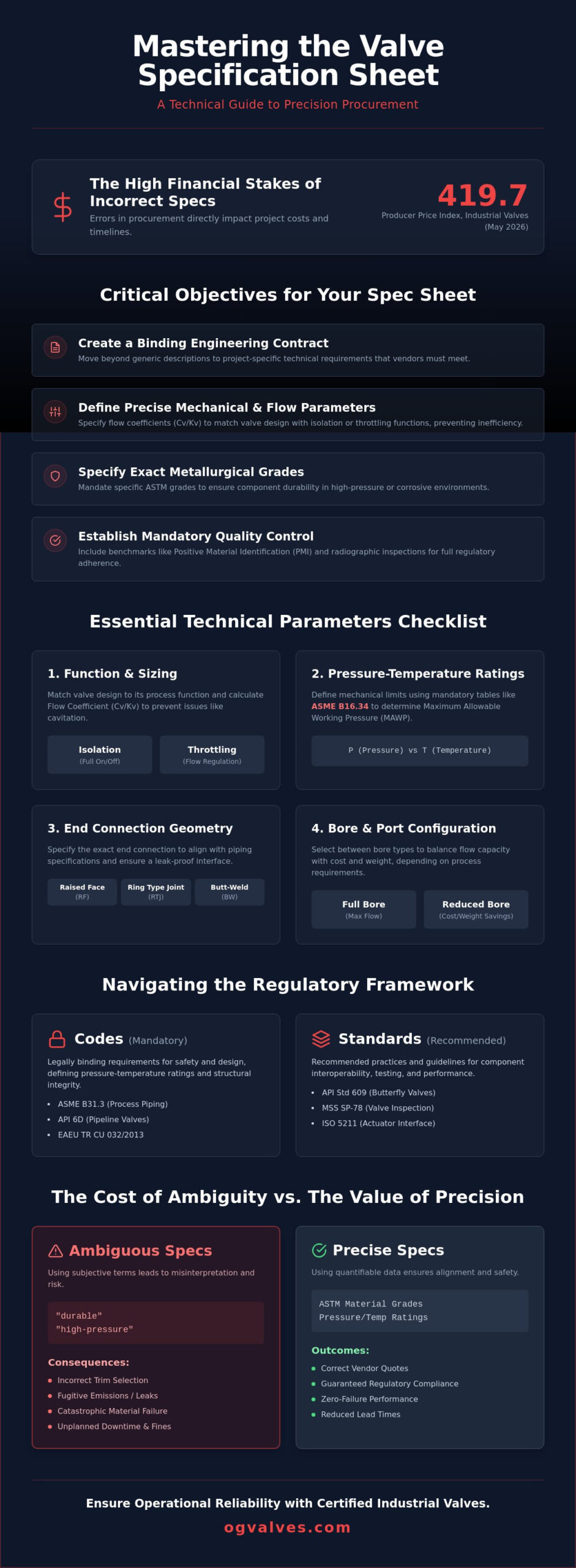
A single ambiguous line in a technical data sheet can result in catastrophic material failure or a significant procurement error that compromises industrial safety. With the Producer Price Index for industrial valve manufacturing reaching 419.7 as of May 2026, the financial stakes of specifying incorrect hardware are higher than ever. Mastering how to write a valve specification sheet is no longer just a clerical task; it’s a critical engineering requirement to ensure adherence to the latest standards like API Std 609 Tenth Edition and MSS SP-78-2026.
You recognize that vague parameters lead to incorrect vendor quotes and extended lead times that stall critical infrastructure projects. This technical guide provides the precision required to draft specifications that guarantee regulatory compliance and operational reliability. We will detail the essential mechanical data points for ball, gate, and butterfly valves, providing a standardized framework to achieve zero-failure performance in high-pressure environments. This methodical approach ensures that every technical detail, from material classifications to ISO 5211:2026 interface requirements, is accounted for before procurement begins.
- Learn how to write a valve specification sheet that functions as a binding engineering contract, moving beyond generic manufacturer descriptions to project-specific technical requirements.
- Identify the precise mechanical parameters and flow coefficient calculations necessary to match valve design with specific process isolation or throttling functions.
- Understand the necessity of specifying exact ASTM metallurgical grades to ensure component durability in specialized environmental applications and high-pressure service.
- Establish mandatory quality control benchmarks, including Positive Material Identification (PMI) and radiographic inspections, to ensure full regulatory adherence.
- Implement a standardized documentation process that accelerates the procurement cycle and reduces lead times for complex, bespoke valve configurations.
In heavy industrial sectors, a valve specification sheet serves as the primary engineering control document. It bridges the gap between process design and physical procurement. Unlike manufacturer catalogues, which provide a generalized overview of essential valve components and capabilities, a project-specific data sheet defines the exact mechanical and metallurgical boundaries required for a specific application. Understanding how to write a valve specification sheet is essential for maintaining the integrity of the Piping and Instrumentation Diagram (P&ID) and the associated line lists. The data sheet translates the flow requirements of the P&ID into a technical reality that vendors can fulfill without guesswork.
Precise technical data eliminates subjective interpretation during global bidding. When procurement specialists engage with international vendors, the data sheet acts as a legal and technical benchmark. It ensures that quotes for Ball Valves or Gate Valves are based on identical performance criteria. This prevents the “lowest cost, highest risk” scenario often caused by vague descriptions. By defining every parameter from bore size to actuator interface, you ensure that the hardware delivered to the site matches the original engineering intent.
Regulatory Frameworks: Codes vs. Standards
Codes like ASME B31.3 for process piping or API 6D for pipeline valves dictate the baseline safety and design requirements. These are mandatory legal requirements that define the pressure-temperature ratings and structural integrity of the pressure-retaining envelope. Standards, such as those from ISO or MSS, provide the recommended practices for component interoperability and testing. A professional specification must reference the correct regulatory framework to ensure that components like Butterfly Valves or Check Valves meet the structural soundness required by the jurisdiction of installation. Referencing the latest revisions, such as API Std 609 Tenth Edition, ensures that the procurement process remains compliant with current global safety benchmarks.
The Consequences of Specification Ambiguity
Ambiguity in a data sheet is a direct precursor to operational failure. Using descriptive adjectives like “durable” or “high-pressure” instead of quantifiable ASTM material grades or specific pressure-temperature ratings leads to incorrect trim selection. In high-pressure environments, an incorrect end-connection or an unverified elastomer choice can result in fugitive emissions or total loss of containment. The financial impact extends beyond the cost of the hardware; it includes unplanned downtime and potential regulatory fines for non-compliance with standards like EAEU TR CU 032/2013. Safety is only achieved through quantifiable data and rigorous adherence to the technical parameters defined in the initial specification.
Precision in defining technical parameters is the foundation of how to write a valve specification sheet that ensures operational safety. You must match the specific valve design, such as a Ball Valve or Butterfly Valve, to its intended process function: isolation, throttling, or non-return flow. Sizing is not merely about pipe diameter. It requires calculating the Flow Coefficient (Cv) or Metric Flow Coefficient (Kv) to ensure process efficiency and prevent cavitation. Engineers should consult the IOGP S-729 Control Valve Specification for supplementary guidance on high-fidelity technical requirements in complex systems. Engineers don’t rely on guesswork; they rely on data.
Pressure-temperature ratings define the mechanical limits of the valve body. Utilizing ASME B16.34 tables is mandatory to determine the Maximum Allowable Working Pressure (MAWP) based on the material group and operating temperature. End connection geometry, whether Raised Face (RF), Ring Type Joint (RTJ), or Butt-Weld (BW), must align with the piping specification to ensure a leak-proof interface. For those sourcing high-integrity components, reviewing a portfolio of certified industrial valves helps align theoretical specs with available engineering solutions.
Defining Valve Bore and Port Configurations
Selecting between full bore and reduced bore configurations impacts both pressure drop and the ability to perform pigging operations. Full bore valves provide an unobstructed flow path, whereas reduced bore options offer weight and cost advantages for less critical lines. For a deeper analysis of these configurations in isolation systems, refer to our A Technical Guide to Industrial Gate Valves. Standardizing face-to-face dimensions according to ASME B16.10 is also critical for drop-in compatibility during maintenance.
Specifying Pressure Classes and Leakage Rates
The specification must clearly define the pressure class, ranging from Class 150 to Class 2500, and the required shut-off integrity. You must specify whether the valve requires testing according to API 598 or ISO 5208 leakage classes. API 598 is the standard for resilient-seated and metal-seated valves, defining the duration and allowable leakage for shell and seat tests. ISO 5208 provides a broader range of leakage rates, from Rate A to Rate G, that may be more appropriate for specific industrial applications. Defining these benchmarks prevents operational failure.

Generic material descriptions are a primary cause of premature component failure in heavy industrial applications. When determining how to write a valve specification sheet, you must move beyond vague terms like “carbon steel” or “stainless steel.” These labels lack the technical precision required to ensure structural soundness under high-pressure or corrosive conditions. You must specify exact ASTM classifications for the pressure-retaining envelope. For instance, ASTM A216 WCB is the benchmark for carbon steel castings in non-corrosive service, whereas ASTM A351 CF8M defines the requirements for 316 stainless steel castings. Failure to specify the exact grade can result in stress corrosion cracking or rapid wall thinning if the media exceeds the material’s chemical resistance limits.
The valve trim, comprising the stem, seating surfaces, and bushings, requires its own metallurgical validation. Engineers utilize the API 600 trim chart to standardize these selections. Specifying “Trim 8” (13Cr with hard-faced seats) provides different wear characteristics than “Trim 5” (Full Stellite). This level of detail is necessary to prevent galling and ensure the seat maintains shut-off integrity over the valve’s operational lifespan. Additionally, seal and gasket compatibility must be addressed through precise elastomer selection. Materials like PTFE, Viton, or EPDM must be chosen based on their specific thermal and chemical resistance profiles to prevent explosive decompression or chemical degradation.
NACE MR0175/ISO 15156 and Sour Service Compliance
Sour service environments containing hydrogen sulfide (H2S) necessitate strict adherence to NACE MR0175/ISO 15156. This standard dictates hardness limits, typically a maximum of 22 HRC for carbon steels, to prevent sulfide stress cracking. Material traceability is mandatory; every pressure-retaining component must be supported by a Mill Test Report (MTR) to verify chemical composition and heat treatment. For detailed insights into material selection for high-performance isolation, see our Industrial Ball Valves: Technical Engineering Guide. Technical precision in these environments is not optional.
Corrosion Allowances and Surface Treatments
Ensuring a 20-year design life requires a calculated corrosion allowance, typically ranging from 1.5mm to 6mm, based on the erosivity of the process fluid. Beyond the base metallurgy, surface treatments provide essential wear resistance. You should specify Electroless Nickel Plating (ENP) or Stellite hard-facing for components subject to high-velocity flows or abrasive media. External coating requirements, such as high-build epoxy systems, must also be defined to protect the valve body from atmospheric corrosion in coastal or offshore installations. These quantifiable data points ensure the valve survives its intended service environment.
Quality assurance is the final engineering control that validates the mechanical and metallurgical integrity of the hardware. When finalizing how to write a valve specification sheet, you must define the verification protocols that guarantee the integrity of the pressure-retaining envelope. Mandating Positive Material Identification (PMI) is a non-negotiable requirement for alloy verification. It prevents the installation of incorrect materials that could lead to galvanic corrosion or mechanical failure in the field. Without PMI, the ASTM grades specified in previous design phases remain unverified risks.
Non-Destructive Testing (NDT) protocols must be explicitly listed to ensure structural soundness. Radiographic Testing (RT) is the preferred method for detecting internal casting defects in high-pressure bodies. Magnetic Particle (MT) and Dye Penetrant (PT) inspections identify surface discontinuities in welds and machined faces. For quarter-turn valves in hydrocarbon service, the specification must reference fire-safe certifications like API 607 or API 6FA. These standards ensure the valve maintains downstream shut-off integrity even after the primary soft seals are destroyed by intense heat. Distinguishing between EN 10204 3.1 and 3.2 certificates is also critical. A 3.1 certificate is issued by the manufacturer’s authorized representative, while a 3.2 certificate requires verification by an independent third-party inspector, providing an additional layer of reliability for high-stakes infrastructure.
Hydrostatic and Pneumatic Testing Requirements
The data sheet must specify the exact pressures for hydrostatic and pneumatic testing. Shell tests are typically performed at 1.5 times the design pressure to verify the structural soundness of the casting or forging. Seat integrity in gas applications often requires low-pressure air testing at 80 to 100 psi to detect leaks that water might bridge. For non-return applications, refer to our guide on Understanding Industrial Check Valves to align testing with specific valve functions. These tests ensure that the valve performs to its rated shut-off class before it leaves the factory floor.
Fugitive Emission Standards and Environmental Compliance
Environmental regulations demand strict control of fugitive emissions. Specifying ISO 15848-1 or API 622/624 ensures the use of low-leakage packing systems that minimize the release of volatile organic compounds. For hazardous fluid containment where zero leakage is mandatory, bellows seals provide a hermetic barrier. Compliance is verified through rigorous Type Testing and production testing protocols. Ensure your project meets these rigorous benchmarks by sourcing API-certified industrial valves that adhere to global environmental standards.
Critical lead-time considerations must be factored into the initial design phase. Specifying exotic materials like Super Duplex or requiring extensive bespoke testing, such as high-pressure gas seat tests, can extend manufacturing timelines by several months. A well-structured data sheet identifies these long-lead items early. This allows procurement teams to secure production slots and manage project schedules with precision. With the Producer Price Index for industrial valve manufacturing rising to 419.7 as of May 2026, efficient procurement is a financial necessity to avoid the compounding costs of project delays.
Partnering with a technical supplier for specification review ensures that theoretical designs align with manufacturing realities. OG Valves provides the technical expertise necessary to review complex specifications for Gate Valves, Ball Valves, and Globe Valves. This collaborative approach ensures that every line item adheres to international standards while remaining commercially viable. We bridge the gap between complex engineering needs and global supply chain capabilities, ensuring that high-stakes infrastructure receives the exact hardware required for zero-failure performance.
The Importance of Vendor Technical Support
Technical review by metallurgical experts can identify opportunities to leverage existing stock through “equal or better” material substitutions. For instance, substituting a higher-grade alloy that exceeds all process requirements can significantly reduce delivery times without compromising safety or regulatory compliance. This strategy requires a deep understanding of ASTM grades and pressure-temperature ratings. For a deeper look at these strategic decisions, consult our Industrial Valves: Engineer’s Comprehensive Guide.
Fast-Track Procurement for Critical Infrastructure
Minimizing operational downtime requires a combination of precise technical documentation and rapid global logistics. OG Valves supports heavy industrial sectors by maintaining a high-specification inventory that meets the most rigorous engineering standards. This infrastructure allows for the immediate deployment of critical components to global project sites, reducing the risks associated with volatile raw material prices and geopolitical supply chain disruptions. Consult with OG VALVES LTD. for your technical specification needs to ensure your project benefits from industry-leading engineering support and reliable global delivery.
Technical precision in the design phase is the primary safeguard against operational failure. By mastering how to write a valve specification sheet, you establish a clinical benchmark for mechanical integrity and regulatory compliance. This guide has detailed the necessity of aligning Cv calculations, ASTM metallurgical grades, and NDT protocols with international standards to ensure structural soundness. These documents are more than procurement lists; they are the engineering contracts that define the safety and durability of heavy industrial systems.
OG VALVES LTD. acts as a specialist supplier for the oil, gas, and power generation industries, providing the technical expertise required for complex material selection and testing. We maintain an extensive inventory of API and ASME compliant Gate, Ball, and Butterfly valves ready for global delivery. Our commitment to industrial excellence ensures that every component meets the highest benchmarks for operational output and safety. Contact OG VALVES LTD. for Technical Support and Procurement to secure reliable hardware for your critical infrastructure needs.
What is the difference between a valve standard and a valve specification?
A valve standard is a universal benchmark established by regulatory bodies like API or ASME to define design and testing rules. A valve specification is a project-specific document that dictates the exact mechanical, metallurgical, and operational requirements for a unique application. Knowing how to write a valve specification sheet involves translating these universal standards into precise data points that vendors must follow to ensure component interoperability.
Why is ASME B16.34 critical for writing valve specifications?
ASME B16.34 is the primary engineering reference for determining pressure-temperature ratings and minimum wall thickness for the pressure-retaining envelope. It provides the tables necessary to calculate the Maximum Allowable Working Pressure (MAWP) based on the specific material group and operating temperature. Without this reference, a specification cannot guarantee the structural integrity of the valve body under high-pressure conditions.
How do I specify the correct trim for a high-temperature globe valve?
Specify the correct trim by referencing the API 600 trim chart to select materials that resist thermal expansion and galling. For a high-temperature Globe Valve, you should specify Trim 5 or Trim 8, which utilize Stellite or 13Cr with hard-facing on the seating surfaces. This ensures the disc and seat maintain shut-off integrity and prevent mechanical wear during extreme thermal cycling.
What information is required for a NACE MR0175 compliant valve specification?
A NACE MR0175 compliant specification must define the H2S partial pressure and specify hardness limits, typically a maximum of 22 HRC for carbon steels. You must also mandate Mill Test Reports (MTRs) to verify the heat treatment and chemical composition of all pressure-retaining components. This level of detail is necessary to prevent sulfide stress cracking in sour service environments common in petrochemical applications.
When should I require EN 10204 3.2 certification over 3.1?
Require EN 10204 3.2 certification when independent, third-party verification is necessary for critical infrastructure or high-risk applications. While 3.1 certification is issued by the manufacturer’s authorized representative, 3.2 involves an external inspector who witnesses testing and verifies material traceability. This provides an additional layer of reliability and is often mandatory for projects requiring full regulatory compliance with PED or ASME codes.
How does the Flow Coefficient (Cv) impact valve sizing in a spec sheet?
The Flow Coefficient (Cv) defines the volume of water in gallons per minute that will flow through a valve with a pressure drop of 1 psi. In a technical specification, Cv is critical for ensuring the valve is sized for process efficiency rather than simply matching the pipe diameter. Calculating the required Cv prevents cavitation and ensures the valve can handle the intended flow rates without excessive energy loss.
What are the most common mistakes found in industrial valve data sheets?
The most frequent errors include using vague adjectives like “durable” instead of specific ASTM material grades and omitting mandatory Non-Destructive Testing (NDT) protocols. Many engineers also fail to define the specific leakage class according to API 598 or ISO 5208. These omissions in how to write a valve specification sheet result in procurement ambiguity, leading to incorrect vendor quotes and potential operational failure.
Can I use a manufacturer’s standard specification for oil and gas applications?
Manufacturer standards are generally insufficient for the high-integrity demands of the oil and gas sector. These applications require specific adherence to API 6D, fire-safe certifications like API 607, and NACE MR0175 compliance, which generic commercial specifications often lack. A project-specific data sheet is required to ensure the hardware meets the rigorous safety and environmental benchmarks of heavy industrial environments.
 Responsive Menu