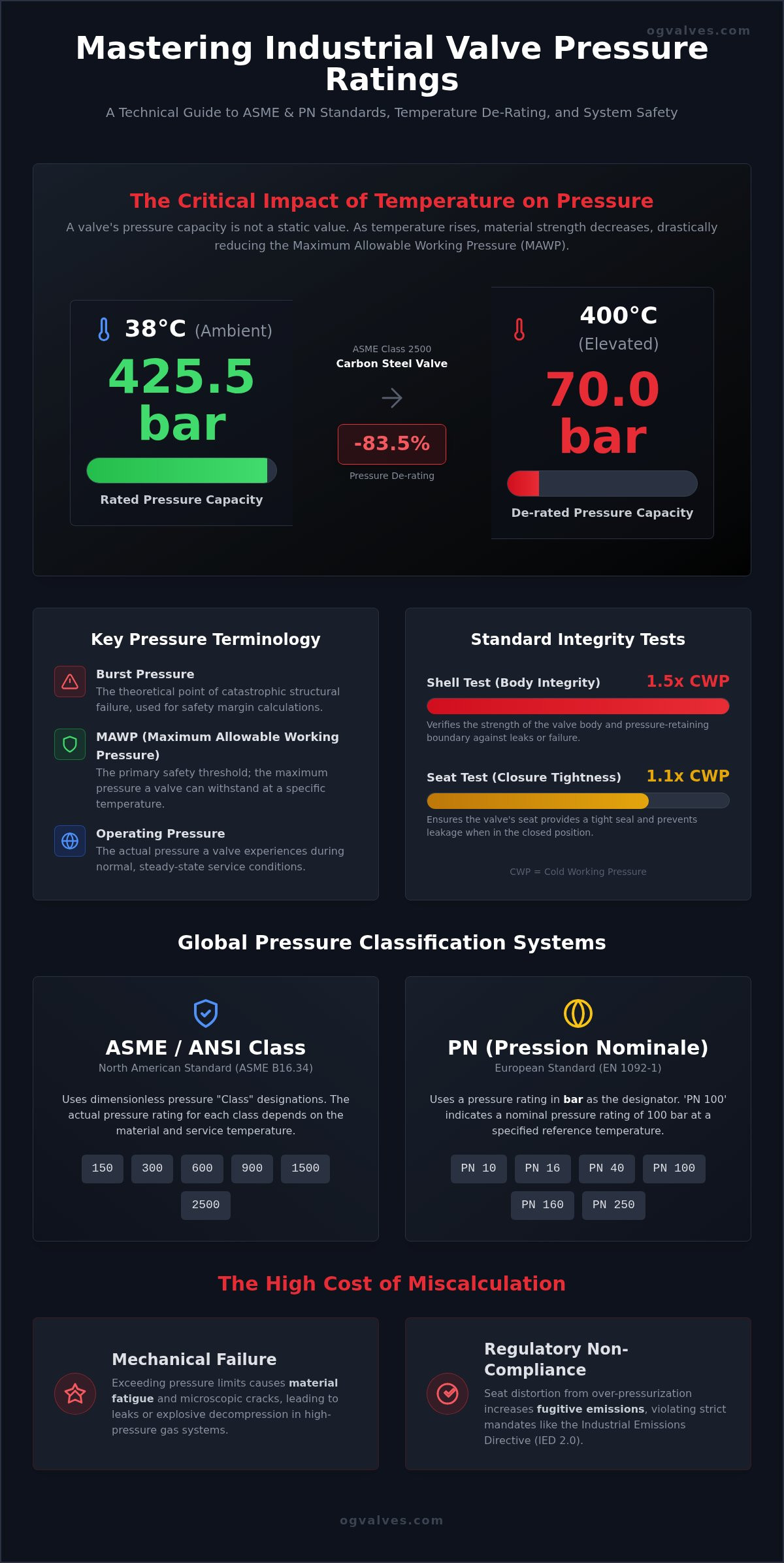
A carbon steel ASME Class 2500 valve maintains a pressure rating of 425.5 bar at 38°C, yet that same component’s structural integrity is rated for only 70.0 bar once temperatures reach 400°C. This drastic de-rating underscores why industrial valve pressure rating standards are not static figures but dynamic engineering calculations. You likely understand that specifying the wrong pressure class isn’t just a procurement error; it’s a primary risk factor for catastrophic system failure and regulatory non-compliance in high-pressure industrial sectors.
This technical guide provides the authoritative framework required to master global pressure rating systems across diverse jurisdictions. You’ll gain the precision needed to navigate the June 2026 updates to ASME B16.34 and the evolving constraints of the EU Industrial Emissions Directive (IED 2.0). We’ll analyze the clinical relationships between metallurgy and pressure-temperature calculations, providing a roadmap for specifying gate, ball, and globe valves that satisfy both API 6D benchmarks and 2026 energy efficiency mandates. This analysis ensures that your procurement strategy remains grounded in engineering excellence and operational reliability.
Key Takeaways
- Define the technical boundaries between design and burst pressures to establish a safe Maximum Allowable Working Pressure (MAWP).
- Interpret the fundamental differences between ASME and PN systems within industrial valve pressure rating standards to ensure seamless international procurement.
- Quantify the de-rating effects of elevated temperatures on valve integrity using standardized Pressure-Temperature (P-T) charts.
- Assess how advanced metallurgy, such as Super Duplex and Nickel alloys, extends operational limits in high-pressure offshore applications.
- Align technical specifications with API 600 and 6D benchmarks to ensure compliance with 2026 global regulatory frameworks.
The Fundamentals of Valve Pressure Ratings and MAWP
The Maximum Allowable Working Pressure (MAWP) serves as the primary safety threshold for any pressurized system. It’s the maximum pressure a valve is rated to withstand at a specific temperature, determined by the weakest component in the assembly. Engineers must distinguish this from design pressure, which is the value used to calculate the minimum required thickness of the valve body. Operating pressure, meanwhile, is the actual pressure during steady-state service. Burst pressure is the theoretical point of structural failure; it’s a value used for safety margin calculations rather than operational limits. Under industrial valve pressure rating standards like ASME B16.34, these margins are strictly defined to prevent mechanical yielding. The valve body and stem act as the primary pressure-containing boundary. If the stem’s cross-sectional area or the body’s wall thickness is insufficient, the component will fail long before reaching its theoretical burst pressure.
Defining Pressure Terminology for Engineers
Safe Working Pressure (SWP) represents the maximum load a valve can handle during routine operation. This differs from hydrostatic test pressure, which is a temporary stress test conducted to verify the integrity of the casting and seals. According to Piping and plumbing fitting standards, the shell test pressure is typically 1.5 times the cold working pressure (CWP). Key test parameters include:
- Shell Test: Conducted at 1.5x CWP to verify body and stem integrity.
- Seat Test: Conducted at 1.1x CWP to ensure closure tightness.
- Backseat Test: Required for valves with a backseat feature to verify stem seal integrity.
This 1.5x multiplier ensures that the valve can handle transient pressure spikes without compromising the pressure-retaining boundary. Nominal Pressure (PN) is the metric equivalent used in EN 1092-1, though the reference temperatures and material groups differ from the ASME system. These discrepancies require careful translation during international procurement to avoid installing under-rated equipment.
The Consequences of Pressure Rating Miscalculation
Exceeding the rated pressure limits leads to immediate and long-term mechanical degradation. Material fatigue occurs when fluctuating pressures cause microscopic cracks to propagate through the valve body or stem. In high-pressure gas applications, this creates a risk of explosive decompression, where gas trapped in internal cavities expands rapidly during a pressure drop. This phenomenon can destroy seals and O-rings instantly. Engineers can’t afford to overlook these dynamics in high-stakes environments.
Miscalculation also compromises environmental compliance. The 2026 Industrial Emissions Directive (IED 2.0) mandates stricter leakage controls across industrial sites. If a valve operates too close to its MAWP, the resulting seat distortion increases seat leakage rates and fugitive emissions. Maintaining a rigorous adherence to industrial valve pressure rating standards is the only way to ensure both operational safety and regulatory standing. It’s a clinical necessity in heavy industrial environments where the cost of failure is measured in both capital and safety.
Global Pressure Classification Systems: ASME Class vs. PN Ratings
Global engineering procurement requires a dual-competency in both ASME and PN classification systems. These industrial valve pressure rating standards dictate the mechanical limits of pressure-retaining components based on material groupings and service temperatures. While the North American ASME B16.34 system utilizes dimensionless classes, the European EN 1092-1 system relies on nominal pressure (PN) expressed in bar. Misinterpreting the differences between these frameworks often results in mismatched flange geometries or catastrophic material failure under high-stress conditions.
ASME/ANSI Pressure Classification Breakdown
The ASME B16.34 valve standard establishes six primary pressure classes: 150, 300, 600, 900, 1500, and 2500. These are not static values. A Class 600 valve in carbon steel (ASTM A216 WCB) is rated at 102.1 bar at 38°C, but that rating drops to 70.0 bar when the temperature reaches 400°C. The June 2026 review of this standard reaffirmed these P-T relationships, emphasizing that “pound” designations are obsolete. Modern procurement must focus on the specific material’s yield strength at elevated temperatures rather than a nominal class number. High-pressure specifications for Class 1500 and 2500 require even more rigorous wall thickness calculations to maintain safety margins.
Understanding PN and ISO Standards
The PN system represents the maximum allowable pressure at a reference temperature of 20°C. PN 16, 40, and 100 are common industrial benchmarks. While PN 100 is a close approximation of ASME Class 600, they aren’t interchangeable. ISO 7005-1 provides a harmonization framework, yet engineers must verify specific hydrostatic test multipliers. Consider these common European benchmarks:
- PN 16: Rated for 16 bar at 20°C; shell tested at 24 bar.
- PN 40: Rated for 40 bar at 20°C; shell tested at 60 bar.
- PN 100: Rated for 100 bar at 20°C; shell tested at 150 bar.
These designations are strictly bar-based, making them intuitive but geographically limited. If you’re operating across borders, you can review our high-spec inventory to see how these standards are applied across different valve types.
Regional project location often dictates the choice between API 6D and ASME B16.34. API 6D is the specialized standard for pipeline valves in the oil and gas sector, whereas ASME B16.34 covers a broader range of industrial applications. Standardizing your project’s industrial valve pressure rating standards across global sites requires a deep understanding of these technical variations. Selecting the correct benchmark ensures that the valve’s wall thickness and stem diameter meet the safety factors required by the specific industry.
The Critical Relationship Between Temperature and Pressure
The metallurgical properties of valve alloys are intrinsically temperature-dependent. Under industrial valve pressure rating standards, the Maximum Allowable Working Pressure (MAWP) is inversely proportional to the operating temperature. As thermal energy increases, the molecular lattice of the metal weakens, reducing its tensile and yield strength. Cold Working Pressure (CWP) serves as the primary baseline for these ratings, typically measured at 38°C (100°F). Conversely, cryogenic applications introduce different risks; while pressure ratings may remain high, the loss of material ductility increases the risk of brittle fracture under mechanical stress. Engineers must account for these fluctuations to prevent the material from transitioning from elastic to plastic deformation.
Interpreting Pressure-Temperature Charts
ASME B16.34 categorizes materials into specific groups, such as Group 1.1 for carbon steel (WCB), and provides corresponding P-T tables. It’s vital to identify the “knee” in the curve, which is the temperature point where the pressure-bearing capacity begins to decline sharply. For example, a Class 600 WCB valve maintains its 102.1 bar rating until it exceeds 38°C, but its capacity drops to approximately 82.7 bar at 250°C. Temperature correction factors must be applied when operating in non-standard environments. This ensures the component’s internal stresses stay within the allowable limits defined by the specific material classification.
High-Temperature Limitations for Common Valve Designs
Thermal expansion creates significant mechanical challenges for specific valve architectures. In a gate valve, excessive heat can cause the wedge to expand at a different rate than the body, leading to thermal binding or seat leakage. Above 400°C, carbon steel becomes susceptible to creep deformation, which is a slow, permanent stretching of the material under constant stress. This can eventually lead to a breach of the pressure-retaining boundary.
The temperature ceiling of a butterfly valve is frequently dictated by the seat material rather than the body rating. While the metal body may withstand extreme heat, soft seats like PTFE or EPDM will degrade rapidly, necessitating the use of metal-seated designs for high-heat service. Rigorous adherence to industrial valve pressure rating standards requires a clinical understanding of these P-T dynamics to ensure long-term operational integrity in high-stakes environments.
Metallurgy dictates the baseline for all industrial valve pressure rating standards. While carbon steel (ASTM A216 WCB) remains the industrial standard for many applications, its pressure capacity differs significantly from stainless steel (ASTM A351 CF8M) at identical classes. For instance, an ASME Class 2500 WCB valve is rated at 425.5 bar at 38°C. In contrast, a CF8M valve of the same class is rated at only 342.5 bar at that same temperature. This 19.5% reduction in pressure capacity is a direct result of the lower allowable stress values inherent to stainless steel alloys. Engineers must account for these metallurgical variances during the initial specification phase to avoid installing components that cannot meet the system’s MAWP.
High-pressure offshore environments increasingly demand the use of Super Duplex and Nickel alloys. These materials offer superior yield strength and resistance to localized corrosion in saline environments. In “sour” service, where hydrogen sulfide is present, compliance with NACE MR0175/ISO 15156 is mandatory. This standard restricts material hardness to prevent sulfide stress cracking (SSC), a phenomenon that can cause sudden, brittle failure in high-pressure components. Positive Material Identification (PMI) serves as the primary verification tool to ensure that the delivered alloy matches the precise engineering specification required for safe operation.
Metallurgical Factors in Valve Design
Yield strength represents the point of permanent deformation, while tensile strength is the maximum stress a material can withstand before structural failure. In pressure-retaining components, yield strength is the critical metric for defining MAWP. Alloying elements such as chromium, molybdenum, and nitrogen are essential for preventing stress corrosion cracking in aggressive media. For high-pressure alloy bodies, ball valve trunnion designs are technically superior. They distribute the massive pressure loads onto the trunnion bearings rather than the valve seats, which preserves the integrity of the alloy body and prevents seat distortion.
Material Certification and Traceability
Traceability is non-negotiable in critical infrastructure. EN 10204 3.1 certifications provide a statement of compliance validated by the manufacturer’s authorized inspection representative. For high-stakes applications, 3.2 certifications require independent third-party verification of the material’s chemical and mechanical properties. Every pressure-retaining part must carry a unique heat number, linking it directly to its original melt shop batch. At OG VALVES LTD., we enforce rigorous testing protocols to ensure every component adheres to the highest industrial valve pressure rating standards. You can view our full range of certified components to ensure your project meets all global regulatory requirements.
Procurement and Selection: Ensuring Regulatory Adherence in Critical Systems
Procurement of high-specification components requires a clinical approach to technical verification. Global project sites often operate under conflicting regulatory frameworks, necessitating a standardized interpretation of industrial valve pressure rating standards. Failure to align ASME B16.34 ratings with local jurisdictional requirements leads to mismatched flange connections or non-compliant safety factors. Verification must extend beyond the physical valve to its documentation, ensuring compliance with API 600 for heavy-duty gate valves or API 6D for pipeline service. Third-party inspections (TPI) act as a critical safeguard, providing an objective audit of the hydrostatic testing and material traceability before equipment leaves the factory.
Optimizing lead times for industrial valves involves more than logistics. It requires a supplier with a deep inventory of pre-certified components. In high-stakes sectors like power generation, the cost of downtime far exceeds the capital cost of the valve. Procurement specialists should prioritize suppliers who can navigate complex international logistics while maintaining a rigid focus on engineering standards. This specialized knowledge prevents the selection of under-rated components that could compromise system safety.
The Procurement Checklist for Pressure Ratings
A structured approach to selection mitigates the risk of operational failure. Use these steps to verify compliance during the specification phase:
- Step 1: Define maximum operating temperature and pressure to establish the required P-T rating.
- Step 2: Identify relevant international and local standards, such as ASME, EN, or API benchmarks.
- Step 3: Verify material compatibility with the process medium, accounting for corrosion or sour service.
- Step 4: Confirm certification and testing requirements, including EN 10204 3.1 or 3.2 documentation.
Partnering with Specialist Suppliers
Technical expertise is the primary defense against over-specification, which unnecessarily inflates project costs. A seasoned partner understands that a Class 1500 rating isn’t always necessary if a Class 900 component satisfies the MAWP and safety factors. Inventory availability is particularly critical for check valves, where rapid replacement prevents backflow-induced damage. OG VALVES LTD. leverages a global supply chain to provide technical certainty. This approach ensures every component meets the rigorous industrial valve pressure rating standards required for long-term reliability in critical infrastructure.
Securing Operational Integrity Through Technical Standardisation
Mastery of industrial valve pressure rating standards requires a clinical understanding of how metallurgy, temperature, and international regulatory frameworks intersect. Engineers must move beyond static class numbers to evaluate the specific yield strengths and de-rating curves defined by the June 2026 ASME B16.34 revisions. This technical discipline ensures that every gate, ball, and globe valve maintains structural soundness under the most aggressive service conditions. It’s the only way to mitigate the risks of catastrophic failure in high-stakes environments.
As global supply chains face stricter environmental and safety mandates, partnering with a specialist supplier becomes a strategic necessity. You can consult with OG VALVES LTD. specialists for high-pressure technical specifications to leverage our technical expertise in API and ASME standards. Our commitment to rigorous quality assurance and PMI testing ensures that your infrastructure remains compliant and reliable. We provide the global delivery capability required for critical industrial projects, ensuring that technical precision is never sacrificed for speed. Reliable high-pressure performance is achievable when engineering data drives every procurement decision.
Frequently Asked Questions
What is the difference between ASME Class 150 and PN 16?
ASME Class 150 and PN 16 are distinct classification systems with different reference temperatures and pressure limits. A Class 150 carbon steel valve has a Cold Working Pressure of approximately 19.6 bar, whereas a PN 16 valve is limited to 16 bar at 20°C. Flange dimensions and bolt patterns also differ between these standards. Engineers must verify the specific Pressure-Temperature (P-T) tables for the selected material to ensure compatibility with the system’s operational requirements.
How does temperature affect the pressure rating of a stainless steel valve?
Increased temperatures cause a reduction in the allowable stress of stainless steel alloys, leading to a de-rating of the valve’s pressure capacity. For example, an ASME Class 2500 CF8M valve is rated at 342.5 bar at 38°C, which is significantly lower than its carbon steel counterpart. As thermal energy increases, the material’s yield strength diminishes. Consult industrial valve pressure rating standards to determine the precise de-rating factors for your specific alloy and operating environment.
What does CWP mean on a valve body?
CWP stands for Cold Working Pressure, representing the maximum pressure a valve can safely withstand at ambient temperatures, typically defined as -29°C to 38°C. It serves as the primary baseline for pressure rating calculations before any temperature-related de-rating is applied. This figure is critical for identifying the valve’s primary mechanical limit. Always ensure that the system’s maximum operating pressure doesn’t exceed the CWP during ambient start-up or hydrostatic testing phases.
Is API 6D the same as ASME B16.34?
API 6D and ASME B16.34 are complementary but serve different industrial applications. API 6D focuses specifically on pipeline valves for the oil and gas midstream sector, mandating stricter testing and design requirements for long-distance transport. ASME B16.34 is a broader standard covering pressure-temperature ratings and dimensions for general industrial use. While many valves meet both standards, API 6D requires additional documentation and specific internal features, such as cavity pressure relief, not mandated by ASME.
Can I use a higher pressure rated valve than my system requires?
Utilizing a valve with a higher pressure rating than the system requires is technically safe but often inefficient from a procurement perspective. Higher-rated valves, such as a Class 900 valve in a Class 300 system, provide a greater safety margin but increase project weight and capital expenditure. Engineers must also verify that the higher-rated valve’s flange dimensions and face-to-face lengths remain compatible with existing piping. Over-specification should be balanced against the necessity for structural soundness.
What is a WOG rating in industrial valve standards?
WOG is an acronym for Water, Oil, and Gas, indicating the maximum pressure rating for a valve when handling these specific non-shock fluids at ambient temperatures. It’s an older designation often found on smaller, threaded valves rather than large-scale flanged components. In the context of modern industrial valve pressure rating standards, WOG is largely superseded by ASME Class or PN designations. It typically reflects the valve’s Cold Working Pressure (CWP) for non-corrosive service media.
How often should high-pressure valves be re-certified?
Re-certification frequency depends on local jurisdictional regulations, industry-specific standards like API 570, and the severity of the service environment. In high-pressure or corrosive applications, annual inspections and pressure testing are common to verify continued structural integrity. Critical safety valves often require more frequent intervals to ensure they function within their original design parameters. Maintenance teams must document all hydrostatic tests and material inspections to maintain regulatory compliance and ensure long-term operational reliability.
Why do some valves have multiple pressure ratings listed?
Valves may list multiple pressure ratings to satisfy requirements for different international markets or service conditions. A single body casting might meet both ASME Class 300 and PN 40 benchmarks, allowing it to be used in diverse global projects. Additionally, ratings may vary based on the seat material used; a valve body rated for high pressure may have a lower limit if soft seats are installed. Always specify the most restrictive rating to ensure the entire assembly operates within safe limits.
 Responsive Menu