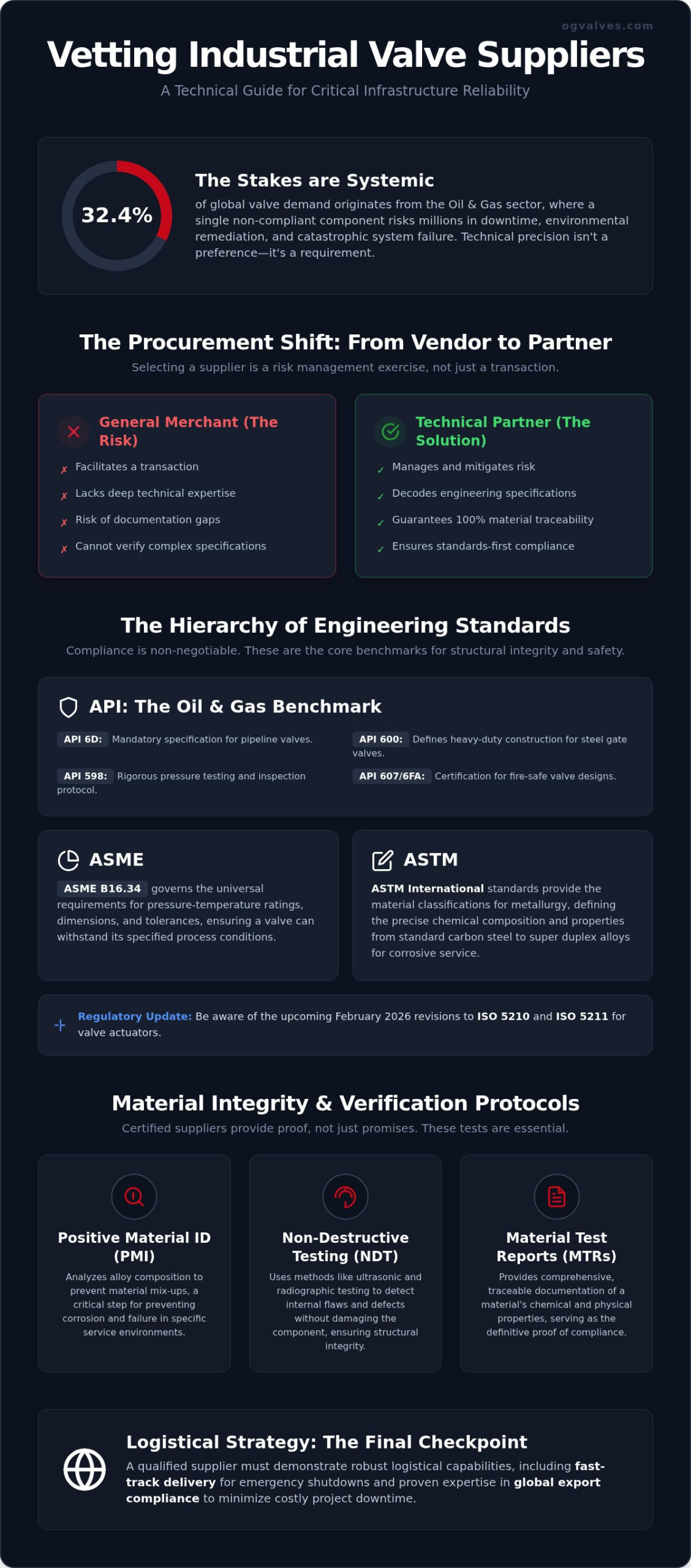
A single non-compliant component in a high-pressure system doesn’t just cause a leak; it risks a systemic failure that can cost millions in unplanned downtime and environmental remediation. Procurement specialists and engineers recognize that selecting industrial valve suppliers is a high-stakes risk management exercise where technical precision outweighs mere unit cost. The oil and gas sector alone accounts for 32.4% of global valve demand. In these volatile environments, material traceability isn’t a luxury; it’s a fundamental requirement for operational safety and long-term performance.
You need a supply chain built on rigorous adherence to API 6D and ASME B16.34 standards to maintain facility integrity. This article provides a clinical analysis of the technical criteria and regulatory updates, including the February 2026 revisions to ISO 5210 and ISO 5211, necessary to vet partners for critical infrastructure. We’ll examine the logistical protocols and pressure testing benchmarks required to eliminate documentation gaps. This guide ensures your gate, ball, and check valves meet every engineering specification before they reach the site. By prioritizing these benchmarks, you can establish a reliable supply chain that minimizes risk and guarantees 100% adherence to safety protocols.
Key Takeaways
- Identify the technical benchmarks that distinguish specialized industrial valve suppliers from general merchants to ensure high-stakes infrastructure reliability.
- Analyze the hierarchy of API, ASME, and ASTM certifications required to verify structural integrity and pressure-temperature ratings.
- Evaluate the role of Positive Material Identification (PMI) and Non-Destructive Testing (NDT) in preventing catastrophic material failure.
- Assess logistical protocols for fast-track delivery and global export compliance to minimize costly downtime during emergency shutdowns.
The Role of Industrial Valve Suppliers in Critical Infrastructure
In high-stakes industrial environments, the distinction between a general hardware merchant and specialized industrial valve suppliers is defined by technical accountability. A general merchant facilitates a transaction; a technical supplier manages risk through the clinical application of engineering standards. For high-pressure petrochemical and power generation facilities, valves are not commodities. They’re precision-engineered instruments required to maintain system integrity. The oil and gas sector accounts for 32.4% of global demand for these components, highlighting the scale of infrastructure that relies on technical procurement accuracy.
From Vendor to Technical Partner: A Procurement Shift
Modern procurement necessitates a transition from transactional sourcing to technical partnership. Specialized industrial valves are governed by complex material science and mechanical requirements that generalists cannot interpret. A technical partner possesses the expertise to decode complex engineering specifications and ensure that industrial valves, such as high-alloy gate or globe valves, meet the thermal and chemical demands of the environment. This standards-first approach ensures that inventory, including specialized plug and needle valves, aligns with the facility’s design life and safety benchmarks.
The Consequences of Substandard Valve Sourcing
The operational impact of a single valve failure is severe in both upstream and downstream operations. Non-compliant components frequently result in extended lead times and facility downtime, causing substantial loss in production output. Safety risks include fugitive emissions and catastrophic loss of containment. Engineers must vet industrial valve suppliers based on their capacity to provide 100% material traceability and adherence to pressure testing protocols. Facility integrity depends on the elimination of documentation gaps and the prevention of alloy mix-ups in corrosive environments. The cost of failure is the total aggregate of production loss, environmental remediation, and the compromise of structural safety standards.
Essential Regulatory Standards and Certifications for Industrial Valves
Engineering compliance is the primary metric for evaluating industrial valve suppliers. Procurement specialists must navigate a rigid hierarchy of standards established by the American Petroleum Institute (API), the American Society of Mechanical Engineers (ASME), and ASTM International. These benchmarks ensure every component maintains structural soundness under extreme pressure and temperature variables. Verifying adherence to API 600 is mandatory for steel gate valves with bolted bonnets, as this standard specifies the heavy-duty construction required for petroleum applications. Additionally, critical infrastructure requires fire-safe designs certified under API 607 or API 6FA to prevent catastrophic leakage during thermal events.
API Standards: The Benchmark for Oil and Gas Valves
The oil and gas industry relies on API valve standards to define mechanical performance and safety. API 6D serves as the mandatory specification for pipeline valves used in transmission systems. It dictates specific requirements for valve configuration, including minimum wall thicknesses and stem diameters, to ensure long-term durability. Every unit supplied must undergo pressure testing according to API 598. This standard establishes rigorous inspection protocols for seat leakage and shell integrity that all API 6D, 600, and 608 valves must pass. These standards aren’t optional; they’re the foundation of operational safety in high-stakes environments.
ASME and ASTM: Material and Dimensional Precision
Dimensional and material precision is governed by ASME B16.34. This standard provides the universal requirements for pressure-temperature ratings and dimensions. It is the technical reference point for determining if a valve body can withstand specific process conditions without yielding. Material classifications are further refined by ASTM standards. These cover a broad spectrum of metallurgy, ranging from standard carbon steel to super duplex alloys for highly corrosive environments. Professional industrial valve suppliers must provide comprehensive Material Test Reports (MTRs) for every component. These documents guarantee chemical and physical property traceability back to the original heat of the steel.
Operational quality is further validated by ISO 9001 and ISO 14001 certifications. These indicate a supplier’s commitment to consistent manufacturing processes and environmental management systems. For projects requiring high-specification components, you should partner with a distributor that maintains 100% adherence to these global benchmarks. Fire-safe testing and rigorous NDT protocols are essential to minimize the risk of facility compromise and ensure the longevity of critical infrastructure.
Testing Protocols and Material Integrity in Supplier Selection
Professional industrial valve suppliers must demonstrate a capacity for rigorous verification that transcends basic certification paperwork. Material integrity is non-negotiable in high-pressure environments where alloy mix-ups lead to catastrophic structural failure. Non-Destructive Testing (NDT) methodologies, including Radiography (RT), Ultrasonic Testing (UT), and Magnetic Particle Inspection (MPI), serve as the primary defense against internal casting defects and surface discontinuities. These protocols ensure compliance with federal safety standards for industrial valves, particularly in high-pressure gas transmission systems where component reliability is a legal mandate.
The Critical Nature of PMI Testing
Positive Material Identification (PMI) is essential for high-specification components fabricated from Monel, Inconel, or super duplex alloys. PMI testing prevents galvanic corrosion in mixed-metal systems by verifying that the electrochemical potential of each component aligns strictly with the engineering design. Without this verification, the risk of installing a sub-standard alloy in a corrosive process stream increases significantly. Reliable suppliers take responsibility for providing verified material documentation, ensuring that every valve body and trim component matches the Material Test Report (MTR) specifications without ambiguity.
Advanced Pressure and Fugitive Emission Testing
Evaluating seat leakage rates is conducted according to API 598 or ISO 5208 benchmarks to ensure shell and seat integrity. Hydrostatic shell tests and pneumatic seat tests verify that every unit maintains pressure containment under maximum allowable working pressures. For environmental regulatory compliance, low-emission (Low-E) packing tests are mandatory to mitigate fugitive emissions in volatile organic compound (VOC) service. This testing is especially critical for high-cycle applications, such as the specific requirements for check valves where backflow prevention must remain absolute throughout the component’s service life. A supplier’s commitment to these testing protocols ensures that components don’t just meet theoretical standards but perform reliably under functional stress.
Logistical Strategy: Fast-Track Delivery and Global Distribution
Operational continuity in heavy industry is contingent on the logistical agility of your supply chain. For critical infrastructure, unplanned outages or scheduled Turnarounds (TARs) demand immediate component replacement to prevent compounding financial losses. Leading industrial valve suppliers recognize that technical compliance is irrelevant if the component cannot reach the site within the required window. Fast-track delivery protocols are essential for mitigating the impact of emergency shutdowns, particularly when dealing with high-specification components that typically carry long manufacturing lead times. Speed is a technical requirement.
Minimizing Downtime through Inventory Depth
Efficient procurement requires a partner that maintains a comprehensive inventory across varied pressure classes, ranging from 150lb to 2500lb. Maintaining stock for complex items like butterfly valves ensures that long-lead manufacturing cycles don’t jeopardize project timelines. Suppliers who prioritize inventory depth for specialized ball valves allow for immediate dispatch to global industrial hubs. This strategic warehousing approach bridges the gap between engineering demand and physical availability; it provides a necessary buffer against supply chain volatility.
Global Supply Chain and Export Expertise
International transit for heavy-duty components introduces complexities in customs and technical documentation. A “Certificate of Origin” and comprehensive technical data packages are mandatory for global site acceptance and regulatory clearance. Professional industrial valve suppliers must navigate these export requirements with precision to avoid delays at international borders. Beyond documentation, the physical integrity of the valve during transit is paramount. Industrial-grade packaging and specialized crating are utilized to prevent damage to flange faces, stems, and actuators during sea or air freight. Proper crating preserves calibration.
Ensuring that your critical infrastructure components arrive on time and in perfect condition requires a partner with proven global reach. You can contact OG VALVES for an inventory check to secure your supply chain against future disruptions and minimize facility downtime.
OG VALVES LTD.: Technical Procurement for Heavy Industry
OG VALVES LTD. functions as a specialist entity within the global landscape of industrial valve suppliers, prioritizing the technical requirements of critical infrastructure. We don’t operate as a general hardware merchant; our focus is strictly on the distribution of high-specification components for the oil, gas, and power sectors. Every component in our inventory is vetted against the rigorous engineering benchmarks discussed throughout this guide, ensuring that structural integrity and material traceability remain absolute. Our role is to act as a dependable partner that understands the cost of failure in high-pressure environments.
A Comprehensive Portfolio of Industrial Valves
Our inventory includes a diverse range of high-alloy and super duplex materials designed for aggressive process environments. We specialize in providing gate valve solutions tailored for high-pressure isolation where bubble-tight shut-off is mandatory. Beyond isolation, our technical capabilities extend to the supply of butterfly and globe valves engineered for precise throttling applications. For systems requiring granular flow control or high-pressure instrumentation, we maintain a comprehensive stock of plug and needle valves. This depth of inventory ensures that procurement specialists can source all essential components, from standard check valves to specialized alloy units, from a single technical partner.
Partnering for Industrial Reliability
OG VALVES LTD. understands the severe financial implications of facility downtime. Our operational model is built around a technical-first approach, where our team interprets complex data sheets to ensure 100% specification alignment before dispatch. We facilitate fast-track global delivery to support emergency repairs and scheduled maintenance windows, bridging the gap between engineering needs and site availability. This logistical agility is supported by a commitment to rigorous quality control and international engineering benchmarks, including API and ASME standards. By maintaining strict focus on heavy industry applications, we provide the specialized expertise required for upstream, midstream, and downstream operations.
Establishing a resilient supply chain requires more than just a vendor; it requires a partner with deep-rooted engineering knowledge. You can consult with our technical team for your valve specifications to ensure your next project meets all safety and performance criteria. Whether you’re managing a major turnaround or a critical infrastructure expansion, our focus on durability and regulatory adherence guarantees that your facility’s integrity remains uncompromised.
Advancing Operational Safety through Technical Procurement Standards
The selection of industrial valve suppliers must remain a clinical exercise in risk mitigation and engineering compliance. Technical adherence to API and ASME standards serves as the primary benchmark for ensuring long-term facility integrity. By prioritizing material traceability and rigorous pressure testing protocols, procurement specialists can effectively eliminate the documentation gaps that lead to operational failure. A dependable partner provides the specialized inventory and logistical agility required to support critical infrastructure in the oil, gas, and power sectors.
OG VALVES LTD. acts as a strategic technical partner, offering global fast-track delivery to minimize costly industrial downtime. Our focus remains strictly on high-specification components that meet the demanding requirements of heavy industry. It’s essential to ensure 100% adherence to safety and pressure testing protocols by leveraging proven engineering expertise. Request a Technical Quote from OG VALVES LTD. to secure your supply chain with precision-engineered solutions. We look forward to supporting your operational goals with unwavering reliability.
Frequently Asked Questions
What are the primary certifications I should look for in an industrial valve supplier?
Technical procurement requires verification of API 6D for pipeline valves and API 600 for steel gate valves. Quality management systems should be certified under ISO 9001:2015 to ensure consistent manufacturing and documentation processes. For systems handling volatile or flammable media, fire-safe certifications such as API 607 or API 6FA are mandatory to ensure the component maintains its seal during high-thermal events.
How does PMI testing ensure the quality of high-alloy valves?
Positive Material Identification (PMI) utilizes X-ray fluorescence to confirm the chemical composition of valve alloys. This process ensures that high-specification materials, such as super duplex or Monel, align strictly with the Material Test Report (MTR). By verifying metallurgy at the point of supply, industrial valve suppliers prevent the installation of substandard materials that would otherwise lead to rapid corrosion or structural failure in aggressive process streams.
What is the difference between a valve manufacturer and a technical valve supplier?
A manufacturer focuses on the fabrication of specific product lines within defined factory capacities. A technical supplier acts as a strategic partner by managing complex global supply chains and providing technical specification support across multiple brands. These suppliers offer inventory depth in specialized components like plug or needle valves, facilitating faster procurement and engineering consultation that a single manufacturer’s limited scope cannot provide.
How can fast-track delivery reduce the total cost of ownership for industrial valves?
Fast-track delivery minimizes facility downtime during unplanned outages or scheduled turnarounds. While initial logistics costs may be higher, the reduction in production loss significantly lowers the total cost of ownership over the component’s lifecycle. Rapidly securing critical infrastructure components prevents compounding financial damage caused by extended facility inactivity and labor stand-by costs during emergency repair windows.
What technical standards govern the design of industrial gate valves?
Industrial gate valves are primarily governed by API 600 for bolted bonnets and API 602 for compact forged steel valves. ASME B16.34 defines the essential pressure-temperature ratings and dimensional requirements for these units. Adherence to these standards ensures the valve body, stem, and seating materials can withstand the specific mechanical stresses and thermal expansion characteristic of high-pressure isolation service.
Can a supplier provide custom testing protocols for specialized applications?
Technical suppliers can facilitate custom testing protocols tailored to specific environmental demands. This includes cryogenic testing for LNG service, high-pressure gas testing, or fugitive emission testing to meet local environmental regulations. These supplemental tests verify that the valve assembly performs beyond standard API 598 requirements, ensuring reliability in specialized or extreme operating conditions where standard benchmarks are insufficient.
What documentation should accompany a technical valve delivery?
Every technical valve delivery must be accompanied by a comprehensive data package. This includes Material Test Reports (MTRs) for heat traceability, pressure test certificates according to API 598, and a Certificate of Conformity. For international projects, industrial valve suppliers must also provide a Certificate of Origin and detailed GA drawings to verify compliance with engineering specifications and global customs regulations.
How do I verify the pressure rating of a valve for a high-temperature system?
Pressure ratings are verified using the pressure-temperature tables found in ASME B16.34. As operating temperatures increase, the allowable working pressure of the material group decreases. Engineers must cross-reference the specific material classification, such as ASTM A216 WCB, with the system’s maximum operating temperature to ensure the valve body remains within its safe operating envelope and maintains structural integrity.
 Responsive Menu