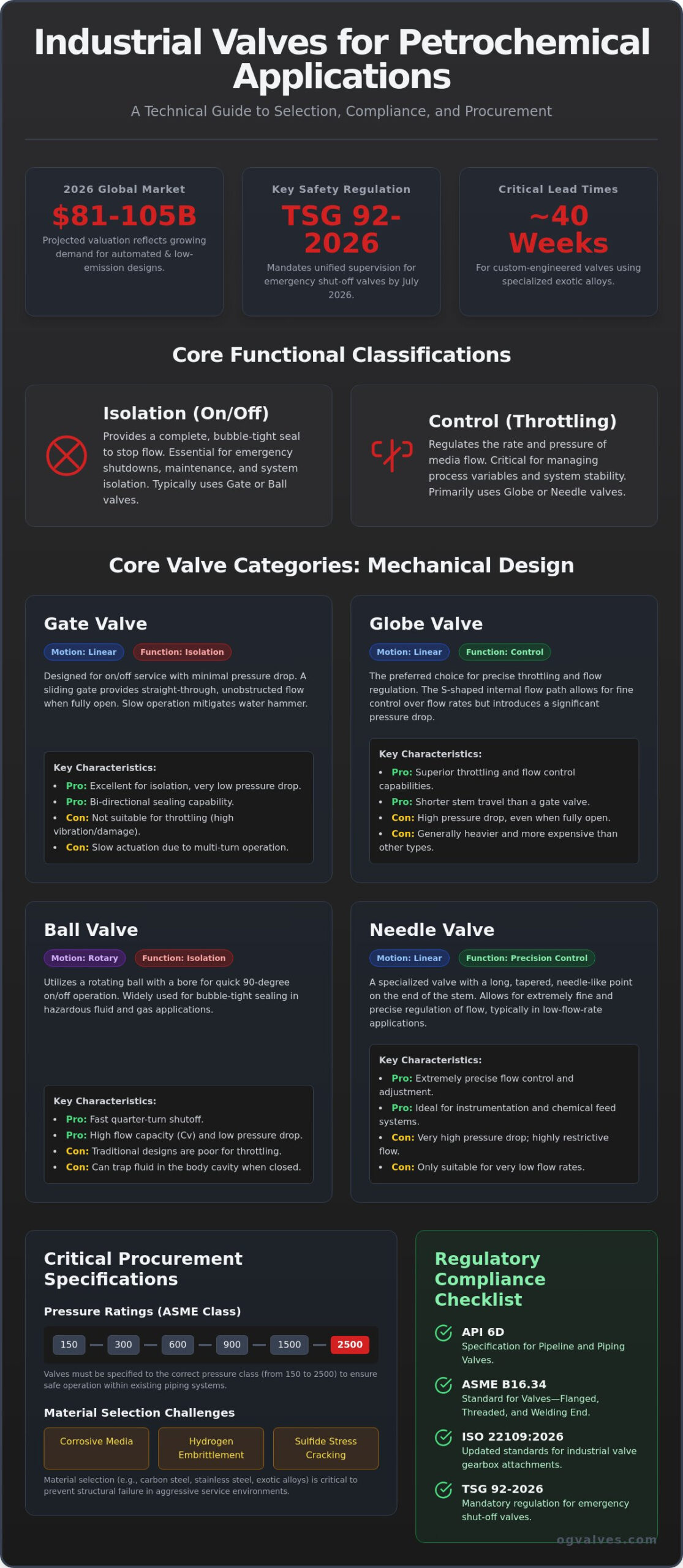
In high-pressure petrochemical processing, the margin between operational continuity and catastrophic failure is defined by the metallurgical integrity of your flow control systems. Selecting industrial valves for petrochemical industry applications is no longer a matter of simple replacement; it is a complex engineering calculation governed by aggressive corrosive media and increasingly stringent global benchmarks. You recognize that the risk of material fatigue or non-compliance with the July 2026 TSG 92-2026 safety regulations can compromise entire infrastructure projects.
This technical guide provides a comprehensive framework for identifying, specifying, and procuring high-specification valves designed for volatile environments. We prioritize engineering precision and regulatory adherence to help you maintain plant safety while securing a resilient supply chain. We will examine the functional requirements of gate, ball, and needle valves under extreme thermal stress. Our analysis covers the latest ISO 22109:2026 standards for gearboxes and provides data-driven strategies to navigate current lead times, which can extend to 40 weeks for custom-engineered exotic alloys. This ensures your procurement process remains aligned with both global safety mandates and critical project timelines.
Key Takeaways
- Identify the optimal mechanical architecture-whether linear or rotary-required for precise isolation and regulation in high-volatility environments.
- Navigate complex international standards such as API 6D and ASME B16.34 to ensure rigorous regulatory compliance for industrial valves for petrochemical industry projects.
- Evaluate material classifications against corrosive media requirements to prevent structural failure and maintain long-term operational output.
- Specify precise pressure ratings from Class 150 to 2500 and exact flange finishes to ensure seamless integration into existing piping systems.
- Optimize procurement strategies by utilizing global supply chains and extensive inventory of specialized components to mitigate the impact of extended lead times.
Defining Industrial Valves and Their Role in Critical Petrochemical Infrastructure
Industrial valves are mechanical assemblies engineered to isolate, regulate, or direct the flow of volatile fluids and gases within pressurized piping systems. In heavy industrial contexts, these devices function as the primary interface between the process media and the external environment. This Industrial Valve Overview defines the fundamental components-including the body, bonnet, trim, and actuator-that must maintain structural integrity under extreme operational stress. Specifying industrial valves for petrochemical industry assets requires a comprehensive understanding of fluid dynamics and material compatibility to prevent catastrophic containment loss.
The global industrial valve market in 2026, estimated between $81 billion and $105 billion, is characterized by a shift toward automated and low-emission designs. This transition is largely dictated by the July 2026 enforcement of the TSG 92-2026 safety technical regulation, which mandates unified supervision for emergency shut-off valves. Modern petrochemical infrastructure demands that these components provide unwavering reliability while adhering to updated ISO 22109:2026 standards for gearbox attachments and actuator integration. Engineering precision in valve selection is the benchmark for operational safety in high-stakes environments.
Isolation vs. Control: Functional Classifications
Refinery operations utilize distinct mechanical architectures to manage specific flow requirements. Isolation services rely on on/off valves, such as Gate Valves or Ball Valves, designed to provide a bubble-tight seal in hazardous areas. These are essential for emergency shutdowns and maintenance bypasses. Throttling and flow regulation involve Globe Valves or specialized Needle Valves that modulate flow rates to manage pressure drops. Safety relief valves provide critical pressure management, preventing vessel over-pressurization during thermal expansion or rapid chemical reactions in volatile petrochemical environments.
Industry-Specific Demands: Petrochemicals and Power
Downstream petrochemical processing presents unique challenges involving corrosive media and high-temperature gradients. Material selection must account for hydrogen embrittlement and sulfide stress cracking in sour gas environments. Facilities integrating power generation require industrial valves for petrochemical industry applications that can withstand the thermal fatigue of high-pressure steam cycles. The consequences of mechanical failure are severe. While onshore refineries face localized containment risks, offshore assets face amplified dangers due to limited space and egress, necessitating components with documented adherence to API and ASME standards to ensure long-term durability.
Core Valve Categories: Mechanical Design and Flow Dynamics
The mechanical architecture of industrial valves determines their suitability for specific process conditions. Linear motion valves use a sliding-stem design to move the closure element, while rotary motion valves rotate the element 90 degrees. This distinction impacts the flow coefficient (Cv), which quantifies the volume of fluid that passes through a valve at a given pressure drop. High Cv values are critical for minimizing energy loss in large-bore transfer lines. Adherence to Petrochemical Valve Safety Standards ensures these mechanical designs prevent fugitive emissions and maintain system integrity. Integrating industrial valves for petrochemical industry applications into complex piping architectures requires precise alignment with the flow dynamics of the media.
Linear Motion: Gate and Globe Valve Specification
Engineers specify gate valves for isolation services where a straight-through flow and minimal pressure drop are required. Their multi-turn operation provides a slow closure, which mitigates water hammer risks in long pipelines. It’s the standard for bulk fluid transport. Conversely, globe valves are the preferred choice for precise throttling in chemical feed systems. Their internal S-shaped flow path creates a higher pressure drop but allows for fine-tuned flow regulation. Stem design and packing considerations are critical specification points; low-emission packing materials are mandatory to meet environmental compliance in modern petrochemical assets.
Rotary Motion: Ball and Butterfly Valve Performance
Rotary designs offer rapid quarter-turn operation, making them ideal for automated emergency shutdown systems. A high-pressure ball valve is typically specified as either floating or trunnion-mounted. Floating designs rely on upstream pressure to push the ball against the downstream seat, while trunnion-mounted designs use a fixed shaft for high-pressure stability. Triple offset butterfly valves are increasingly utilized for high-performance sealing in large-diameter piping. These designs offer significant space and weight savings compared to gate valves, which is a vital consideration for offshore platforms and modular refinery units.
Specialised Components: Check, Plug, and Needle Valves
System protection requires the integration of check valves to prevent backflow in pump discharge lines. This protects rotating equipment from reverse flow damage. For high-slurry or abrasive media, plug valves provide a robust alternative to ball valves due to their large seating area. Precision instrumentation requires needle valves, which offer fine-threaded stems for exact flow control in sampling lines. For projects requiring specific metallurgical grades, technical experts often consult specialized global inventories to secure high-specification industrial valves for petrochemical industry projects without the typical 40-week lead time for custom orders.
Material Selection and Regulatory Compliance Standards
Structural soundness in volatile environments is fundamentally dependent on rigorous regulatory adherence. Specifying industrial valves for petrochemical industry assets requires precise alignment with international design codes such as API 600 for gate valves or API 6D for pipeline components. These standards define the minimum wall thicknesses and stem diameters necessary to withstand mechanical fatigue. Verification is achieved through API 598 testing protocols; these ensure that every pressure-containing assembly meets strict leakage criteria before site delivery. ASME B16.34 dictates pressure-temperature ratings, establishing the maximum allowable working pressure for specific material groups across varying thermal gradients. It’s the primary benchmark for ensuring that a valve body won’t deform under peak operational loads.
Operational safety in sour gas service depends on compliance with NACE MR0175/ISO 15156. This standard limits material hardness and chemical composition to mitigate the risk of sulfide stress cracking in the presence of hydrogen sulfide. Traceability is a mandatory requirement for high-specification procurement. Engineers must secure EN 10204 3.1 or 3.2 certification to validate metallurgical integrity. While 3.1 provides manufacturer-authorized verification, 3.2 involves independent third-party inspection. This level of documentation ensures that every component adheres to the specified mechanical and chemical benchmarks. It’s a non-negotiable protocol for maintaining the reliability of critical infrastructure.
Metallurgical Considerations for Corrosive Environments
Material choice is dictated by the chemical composition of the process media. Carbon steel remains the primary choice for standard hydrocarbon service. However, for environments prone to pitting, 316/316L stainless steel offers enhanced resistance. Stainless steel valves currently hold approximately 45% of the market share due to their versatility. Offshore assets often require Duplex or Super Duplex alloys to combat high chloride concentrations. In extreme cases involving aggressive chemical attack or high-velocity erosion, Inconel 625 or Monel 400 trims are specified to ensure long-term durability and prevent premature component failure.
Sealing Technology: Soft Seated vs. Metal Seated
Seat selection is a balance between leak tightness and thermal resistance. Soft seats using PTFE or reinforced polymers provide bubble-tight isolation but are generally restricted to temperatures under 200°C. High-temperature petrochemical applications or those involving abrasive catalysts require metal-to-metal seating. For flammable media, API 607 fire-safe certification is a critical requirement. This ensures that even if the primary soft seal is consumed by fire, a secondary metal-to-metal contact prevents catastrophic leakage of volatile fluids. Choosing the wrong seal type doesn’t just impact performance; it compromises the entire plant safety profile.
Procurement Criteria: Sizing, Pressure Ratings, and Lead Times
The procurement of industrial valves for petrochemical industry infrastructure requires a clinical focus on technical specifications and logistical feasibility. Pressure class selection follows the ASME B16.34 framework, ranging from Class 150 for low-pressure utilities to Class 2500 for high-pressure hydrocracking units. Each class dictates the maximum allowable pressure at specific temperatures. Beyond pressure, engineers must specify exact face-to-face dimensions according to ASME B16.10 to ensure compatibility with existing piping spools. Flange finish requirements, such as a 125-250 AARH serrated finish, are critical for achieving effective gasket compression and preventing leaks in volatile media service.
Total Cost of Ownership (TCO) serves as the primary metric for long-term project viability. This calculation extends beyond the initial purchase price to include maintenance intervals, the availability of replacement trims, and the reliability of the valve’s sealing performance. High-specification components might carry a higher capital expenditure but significantly reduce the risk of unplanned shutdowns. Mitigating project risk depends on securing fast-track delivery schedules. In 2026, standard lead times for industrial valves typically range from 6 to 10 weeks, while custom-engineered units using exotic alloys can extend to 40 weeks. Inventory management strategies that prioritize ex-stock availability are essential for maintaining operational continuity during emergency turnarounds.
Technical Sizing and Actuation Requirements
Correct sizing involves matching the valve’s operational torque with specific actuator capabilities. Under-sizing an actuator leads to incomplete closure or mechanical failure, while over-sizing increases unnecessary load on the valve stem. Adherence to EN ISO 5211:2026 ensures that part-turn actuator attachments meet standardized mounting patterns for seamless integration. In high-velocity gas flows, sizing must also account for cavitation and noise control to prevent internal erosion. End connections, whether flanged, butt-weld, or socket-weld, must be selected based on the specific refinery safety protocol and the frequency of required component removal.
Supply Chain Strategy and Inventory Management
Strategic procurement relies on the ex-stock availability of specialized components. Sourcing from a partner with an extensive inventory of gate, ball, and check valves allows for the immediate mitigation of supply chain disruptions. Vetting suppliers for documentation accuracy, including material test reports and certification compliance, is a mandatory step in the procurement workflow. Global logistics capability is the final pillar of a successful strategy. Moving heavy industrial components across international borders requires a partner who understands the practicalities of transport for specialized alloys. To ensure your project remains on schedule despite volatile market conditions, you should view our current high-specification inventory for immediate fast-track delivery options.
Global Supply Chain Solutions for Petrochemical Valve Requirements
OG VALVES LTD. functions as a specialized technical partner for the procurement of high-specification industrial valves for petrochemical industry applications. Managing the complexities of modern refinery infrastructure requires more than a standard vendor relationship; it necessitates a partner with deep expertise in metallurgical integrity and international regulatory frameworks. We maintain a comprehensive inventory of Gate, Ball, Globe, and Check valves engineered to withstand the aggressive media and extreme pressures typical of downstream processing. By anchoring our operations in rigorous quality control and material traceability, we ensure that every component meets the documented requirements of the global energy sector. Our role is to provide the engineering certainty required for high-stakes industrial environments.
The 2026 industrial landscape presents significant challenges, including volatile material costs and extended manufacturing lead times for specialized alloys. We mitigate these risks by positioning ourselves as a global entity with the capability to handle large-scale industrial demands. Our commitment to durability and regulatory adherence ensures that our clients receive components that aren’t just functional but are benchmarks for industrial safety. We prioritize functional reality and long-term performance, acting as a dependable partner in critical infrastructure rather than a mere vendor of mechanical parts.
Specialist Inventory and Fast-Track Delivery
Our stock profile is strategically managed to include specialized Plug Valves and Needle Valves, which are often subject to extended lead times in the current market. By maintaining a robust inventory at our Northern Ireland base, we facilitate fast-track delivery to international project sites, significantly reducing the impact of supply chain disruptions on maintenance turnarounds. Our global logistics capability ensures that technical documentation, including EN 10204 3.1 material test reports and pressure test certifications, accompanies every shipment. This streamlined procurement process allows engineers to secure critical industrial valves for petrochemical industry projects without the 40-week delay often associated with custom-engineered orders.
Technical Partnership and Project Support
We collaborate directly with engineering teams to define complex valve specifications that align with the stringent demands of the oil, gas, and power sectors. This technical support extends from initial material selection-such as specifying Butterfly Valves for large-bore piping-to the final verification of pressure-temperature ratings under ASME B16.34. As the petrochemical landscape of 2026 continues to evolve with new safety mandates like the TSG 92-2026 regulation, our focus remains on providing reliable, compliant supply chain solutions. We provide the technical data and quality assurance protocols necessary for technical experts and procurement specialists to build high-stakes trust in their infrastructure components.
Securing Operational Excellence in Petrochemical Flow Control
Achieving long-term infrastructure reliability requires a clinical approach to component specification. Engineers must balance precise mechanical design with the aggressive chemical demands of modern refinery environments. Adherence to documented standards like API 6D and ASME B16.34 remains the primary benchmark for preventing catastrophic failure. As lead times for specialized alloys continue to fluctuate, securing a resilient supply chain is essential for maintaining project timelines and operational continuity.
OG VALVES LTD. serves as a technical partner for the procurement of high-specification industrial valves for petrochemical industry assets. We combine deep technical expertise in global safety standards with an extensive inventory to ensure your infrastructure meets the highest benchmarks for precision. It’s our priority to provide global fast-track delivery capabilities engineered to support critical infrastructure projects and minimize unplanned downtime through methodical logistics management.
We invite you to Request a Technical Quote for Your Industrial Valve Requirements to leverage our specialized inventory and engineering support. Partnering with a seasoned industrial expert ensures your facility operates with the durability and regulatory adherence required for the 2026 landscape. Your commitment to engineering excellence ensures the continued safety and productivity of your global infrastructure.
Frequently Asked Questions
What are the primary differences between API 600 and API 6D standards?
API 600 specifies the heavy-duty requirements for steel gate valves used in refinery isolation, focusing on conservative wall thicknesses and robust stem diameters. API 6D is the primary standard for pipeline valves, covering a broader range of architectures including ball, check, and plug designs. While API 600 is more restrictive regarding material mass to ensure durability in downstream processing, API 6D allows for more varied configurations suitable for midstream transport.
How do I choose between a floating and a trunnion-mounted ball valve for petrochemicals?
Floating ball valves utilize upstream fluid pressure to force the ball against the downstream seat, which is highly effective for smaller bore sizes and lower pressure classes. Trunnion-mounted designs secure the ball on a fixed shaft, making them the engineering standard for high-pressure industrial valves for petrochemical industry applications. This trunnion configuration manages higher mechanical loads and reduces the torque required for actuation in large-diameter piping.
When should I specify a triple offset butterfly valve over a gate valve?
A triple offset butterfly valve should be specified when installation space and weight are critical constraints in large-diameter systems. These valves provide bi-directional, bubble-tight isolation similar to a gate valve but with a significantly smaller footprint. Their non-rubbing seat design reduces mechanical wear, making them ideal for high-cycle applications where a traditional gate valve would be too cumbersome or prone to seat degradation.
What materials are best suited for high-temperature steam applications in refineries?
Chrome-Moly alloys, such as ASTM A217 grades WC6 and WC9, are the preferred materials for high-temperature steam due to their superior creep resistance. For less aggressive thermal gradients, ASTM A105 forged carbon steel or A216 WCB cast steel provide reliable performance. If the process involves both high temperatures and corrosive chemical media, 316 stainless steel or high-nickel alloys are required to maintain structural soundness.
How does the Flow Coefficient (Cv) affect industrial valve selection in chemical plants?
The Flow Coefficient (Cv) quantifies the flow capacity of a valve at a 1 psi pressure drop. Precise Cv calculation is essential when selecting industrial valves for petrochemical industry units to ensure the valve doesn’t cause excessive pressure loss or flow restriction. An undersized valve leads to accelerated internal erosion and potential cavitation, while an oversized valve results in poor regulation and unnecessary capital expenditure.
What is the significance of NACE MR0175 compliance in petrochemical valve procurement?
NACE MR0175 compliance is a mandatory requirement for any valve exposed to “sour” environments containing hydrogen sulfide (H2S). This standard restricts material hardness and chemical composition to prevent sulfide stress cracking and hydrogen-induced cracking. Procurement specialists must verify this compliance to ensure component longevity and prevent sudden brittle failure in aggressive petrochemical services.
Can needle valves be used for high-pressure isolation in instrumentation?
Needle valves are specifically engineered for high-pressure isolation and regulation in small-bore instrumentation and sampling lines. Their tapered stem provides precise flow modulation, while their robust body construction handles pressures exceeding 10,000 psi in certain configurations. They aren’t suitable for high-volume process lines, but they’re essential for the safe isolation of pressure gauges and transmitters.
What are the typical lead times for specialised alloy industrial valves in 2026?
In the 2026 industrial market, lead times for standard, in-stock valves generally range from 6 to 10 weeks. However, custom-engineered components or those utilizing exotic alloys like Inconel or Monel often face extended schedules of 26 to 40 weeks. Project managers should utilize global inventory solutions to mitigate these delays and secure critical infrastructure components within tighter turnaround windows.
 Responsive Menu