Justifying a Valve Upgrade Project: A Technical and Financial Framework for Management
April 22, 2026
Home+Justifying a Valve Upgrade Project: A Technical and Financial Framework for Management
Adopting a “run-to-failure” strategy for critical flow control infrastructure is not a fiscal optimization; it’s an unquantified risk against API 581 risk-based inspection standards and operational continuity. While engineering teams recognize that a gate valve exhibiting 12% seat bypass or packing gland degradation is a failed component, executive leadership often views any valve that isn’t actively leaking to the atmosphere as functional. This disconnect creates a significant hurdle when justifying a valve upgrade project to management, as technical risk must be translated into the language of financial liability and asset integrity.
We recognize that quantifying the probability of a total facility outage requires more than anecdotal evidence of mechanical wear. This technical framework provides a structured methodology to convert ASME B16.34 performance data and historical mean time between failure (MTBF) metrics into a compelling business case. You’ll gain a rigorous template for calculating the return on investment through reduced maintenance cycles and the mitigation of high-consequence environmental incidents. We will detail how to present a multi-year lifecycle cost analysis that aligns technical necessity with corporate financial objectives.
Key Takeaways
Transition from reactive “run-to-fail” models to a proactive lifecycle management strategy that prioritizes long-term asset integrity and operational safety.
Establish a precise technical baseline for upgrades by evaluating material fatigue and conducting rigorous condition assessments in high-temperature or corrosive services.
Master the financial framework for justifying a valve upgrade project to management by translating MTBF data and “avoided cost” metrics into a compelling ROI.
Utilize a structured business case development process that aggregates historical maintenance costs and ranks valve criticality to streamline executive approval.
Minimize project execution risks and technical ambiguity by leveraging specialist suppliers for rigorous specification validation and international standard compliance.
The Strategic Necessity of Valve Lifecycle Management
Valve lifecycle management is a core component of asset integrity. It dictates how fluid control systems operate within their original design parameters while minimizing the probability of unplanned downtime. Reliability is paramount. Most industrial facilities are transitioning away from reactive ‘run-to-fail’ models toward proactive asset optimization. This shift is essential for maintaining the stability of high-pressure systems. Legacy infrastructure often conceals escalating operational expenditures (OPEX) through incremental efficiency losses and rising maintenance labor hours. Because industrial valves serve as critical fail-points, their performance directly influences the safety and uptime of the entire plant. Justifying a valve upgrade project to management requires a shift from viewing valves as simple consumables to viewing them as strategic assets that protect the bottom line.
Quantifying the Cost of Obsolescence
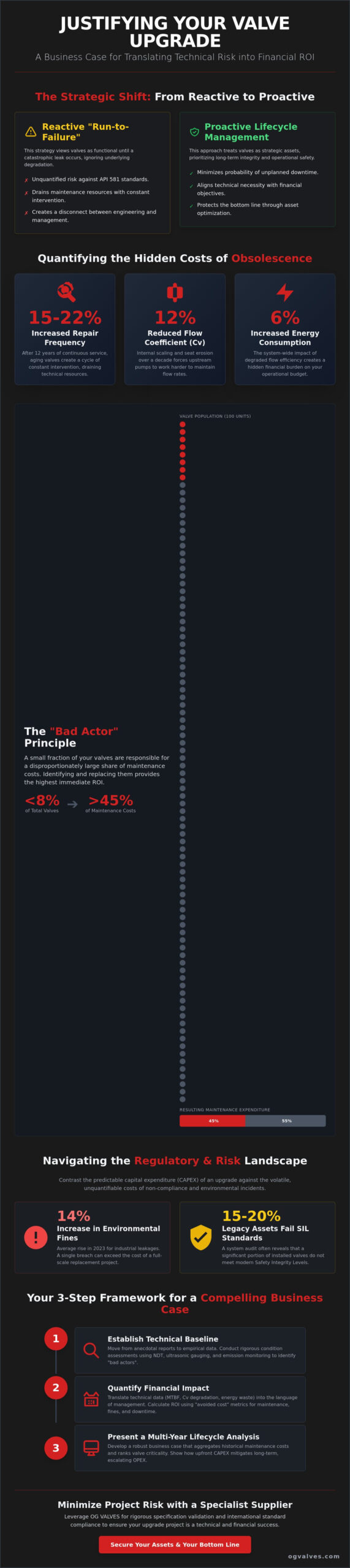
Aging industrial valves typically exhibit a 15% to 22% increase in repair frequency after 12 years of continuous service. This creates a cycle of constant intervention that drains technical resources. Technical obsolescence is the state where a valve remains functional but cannot be supported due to the permanent unavailability of OEM-certified spare parts or documented technical specifications. Beyond physical failure, engineers must evaluate the impact of degraded flow coefficients (Cv). Internal scaling and seat erosion can reduce Cv by as much as 12% over a decade. This degradation forces upstream pumps to operate at higher RPMs to maintain flow rates. It increases energy consumption by approximately 6% across the system, creating a hidden financial burden that persists until an upgrade is implemented.
Regulatory Compliance and Safety Integrity
The regulatory landscape regarding fugitive emissions is tightening globally. Older valve designs often fail to meet the rigorous testing requirements of modern standards like API 624 or ISO 15848-1. These standards are no longer optional for operators in the oil and gas sectors. Upgrading to modern specifications mitigates legal and environmental risks that didn’t exist twenty years ago. In 2023, environmental fines for industrial leakages rose by an average of 14% in developed markets. When justifying a valve upgrade project to management, it’s necessary to contrast the predictable CAPEX of an upgrade against the volatile costs of non-compliance. A single environmental breach can exceed the cost of a full-scale valve replacement project. Modern valve technology ensures long-term adherence to safety protocols, providing a clinical and verifiable path to operational excellence.
Effective management of these assets prevents the compounding of technical debt. It ensures that the facility remains competitive and safe. By focusing on quantifiable data and engineering standards, the case for modernization becomes a matter of financial logic rather than technical preference. This approach is the foundation of justifying a valve upgrade project to management in a high-stakes industrial environment.
Identifying Technical Triggers for a System-Wide Upgrade
Justifying a valve upgrade project to management requires a transition from anecdotal maintenance reports to empirical technical data. Engineers must establish a rigorous baseline through non-destructive testing (NDT), ultrasonic thickness gauging, and fugitive emission monitoring. Identifying “bad actor” valves is a critical first step. These specific units frequently account for more than 45% of total maintenance expenditure, even when they represent less than 8% of the total valve population within a facility. By isolating these high-frequency failure points, engineering teams can demonstrate how targeted replacements stabilize system pressure and flow rates.
When Calculating ROI for infrastructure modernization, technical triggers often center on the delta between legacy performance and current API or ASME requirements. A system-wide audit typically reveals that 15% to 20% of installed assets no longer meet modern safety integrity levels (SIL). This data provides the objective evidence needed for justifying a valve upgrade project to management, moving the conversation from discretionary spending to essential risk mitigation.
Material Degradation and Mechanical Fatigue
The integrity of gate valve seats and stems often reaches a critical failure point after 20 years of high-cycle service. Material fatigue in high-temperature environments leads to microscopic stress corrosion cracking that visual inspections cannot detect. Positive Material Identification (PMI) is indispensable for auditing legacy systems, as it often identifies sub-standard alloys that were installed before modern traceability standards were enforced. In throttling applications, internal erosion can reduce wall thickness by 2% to 3% annually. This degradation compromises the pressure-containing capability of the valve body, eventually leading to catastrophic shell failure if left unaddressed.
Evolution of Performance Standards
Modern engineering benchmarks have shifted significantly over the last two decades. Current ball valve designs utilize advanced polymer or metal-to-metal seating technologies that provide bubble-tight shutoff, far exceeding the leakage rates permitted in the 1990s. Similarly, the implementation of nozzle-style check valves effectively eliminates water hammer, which otherwise generates pressure surges up to 60% above nominal operating limits.
Digital transformation further necessitates hardware updates. Integrating modern actuators allows for real-time diagnostic feedback and remote torque monitoring. These smart systems provide early warning signs of mechanical binding or seat wear, allowing for predictive rather than reactive maintenance. Facilities looking to optimize their control loops should review current automation specifications to ensure compatibility with modern distributed control systems (DCS). This technical evolution ensures that the physical assets can support the digital requirements of a modern industrial facility.
Financial Justification: Calculating ROI and Downtime Mitigation
Quantifying the economic impact of valve performance is essential when justifying a valve upgrade project to management. Decision-makers require a transition from qualitative engineering concerns to quantitative financial metrics. The primary metric for this transition is Mean Time Between Failures (MTBF). By comparing the MTBF of legacy assets against the projected lifespan of high-specification replacements, engineers can annualize cost savings. If a current valve requires intervention every 12 months and a modern alternative offers a 60-month service interval, the capital expenditure is offset by the elimination of four major maintenance events.
The concept of “Avoided Cost” represents the most critical variable in the ROI equation. In high-pressure oil and gas or large-scale water treatment facilities, an unplanned shutdown can cost between $10,000 and $150,000 per hour in lost production and idle labor. A single valve failure that triggers a 24-hour facility outage creates a financial deficit that often exceeds the entire cost of a plant-wide valve upgrade project. Additionally, upgrading assets eliminates the need for emergency procurement premiums. These “fast-track” logistics costs and expedited manufacturing fees frequently carry a 30% to 50% surcharge over standard procurement rates.
A 10-year Net Present Value (NPV) analysis provides the most accurate comparison between “repair-on-failure” and “proactive replacement” strategies. While repair costs appear lower in the short term, the cumulative expense of labor, gaskets, packing, and secondary damage to downstream equipment typically results in a negative NPV by year four. Modernizing the fleet ensures predictable operational expenditures and protects the long-term integrity of the infrastructure.
Energy Efficiency and Flow Optimisation
Modern valve designs focus on minimizing turbulence and internal resistance. Reducing pressure drops across high-performance butterfly valves directly lowers the total dynamic head requirements for pumping systems. This reduction in hydraulic resistance translates into lower kilowatt-hour consumption at the pump motor. Furthermore, achieving zero-leakage shut-off according to API 598 standards prevents product loss in high-value fluid lines. High-efficiency valve upgrades typically achieve a full energy recovery period within 18 to 24 months of installation.
Reduced Maintenance Cycles and Spares Inventory
Standardization is a fundamental financial advantage of a comprehensive upgrade. By consolidating valve types and sizes, facilities can reduce warehouse inventory levels by 20% to 35%. This frees up working capital previously tied up in redundant spare parts. Using superior material grades like Duplex stainless steel or specialized coatings extends service intervals, significantly reducing the labor hours required during scheduled turnarounds. Modern designs often feature “top-entry” or “in-line” repairability, which cuts technician time by 40% compared to legacy units that require full removal from the piping system.
Developing a Robust Business Case for Procurement
Securing capital for critical infrastructure requires a methodology rooted in technical evidence and risk mitigation. The process of justifying a valve upgrade project to management begins with a four-step framework designed to align engineering requirements with corporate fiscal objectives. Engineers must first conduct a comprehensive criticality ranking of every valve within the project scope. This inventory allows for the prioritization of assets based on their impact on system integrity and operational continuity. It’s a structured approach to asset management.
The second step involves aggregating historical maintenance data. Analysis of work orders from the last 36 months establishes the status quo cost. This data set must include emergency repair labor, seal replacement frequency, and the procurement costs for non-standard spare parts. When these figures are mapped to specific business outcomes, such as safety compliance or production uptime, technical risks become quantifiable financial liabilities. Finally, the proposal should present a tiered implementation plan. This strategy divides the upgrade into immediate, Phase 2, and Phase 3 deployments. This structure manages cash flow while addressing the most volatile risks first.
Risk Matrix and Criticality Ranking
A standardized 5×5 risk matrix provides a clinical assessment of failure consequences. This matrix evaluates the probability of mechanical failure against the severity of the outcome. For example, a Level 5 event might represent a catastrophic release or a total facility shutdown. High-criticality valves, particularly those in high-pressure or cryogenic service, demand immediate funding. Using this matrix ensures the business case focuses on assets where failure violates API or ASME safety standards. It removes subjectivity from the procurement process and anchors the request in industrial safety protocols.
Data-Driven Performance Projections
Management presentations must include a detailed “Do Nothing” scenario. This projection calculates the cost of continued operation using aging assets, including the 12% average increase in maintenance costs often observed in valves exceeding their specified service life. Engineers should use manufacturer data and rigorous ISO 15848-1 testing results to create “Before and After” scenarios. These projections demonstrate how upgrading to forged steel or high-integrity alloys reduces fugitive emissions and improves flow coefficients. Validating these claims with industrial case studies provides the necessary evidence for justifying a valve upgrade project to management while ensuring long-term compliance.
Strategic Sourcing: Minimizing Project Risk with OG Valves
The successful execution of an industrial upgrade depends on the reliability of the supply chain. Specialist suppliers provide more than hardware; they offer technical validation and precision in specification. OG Valves maintains extensive inventory levels to reduce the risk of project delays. This depth of stock ensures that critical components are available for immediate dispatch, protecting the project timeline from unforeseen market shortages. When justifying a valve upgrade project to management, the ability to guarantee delivery dates is as vital as the technical specifications themselves.
Effective risk mitigation requires a partner that understands the technical nuances of fluid control. OG Valves acts as a technical consultant during the procurement phase. This collaboration ensures that every valve selected matches the operational environment, whether it involves high-pressure steam or corrosive chemical processing. By eliminating procurement errors, the project maintains its budgetary and chronological integrity. Reliability isn’t a goal; it’s a requirement of the engineering process.
Technical Specification and Compliance Verification
OG Valves provides expert technical support to ensure the selection of correct material grades. Engineers verify that components meet specific Pressure-Temperature ratings according to ASME B16.34. This level of detail is vital when justifying a valve upgrade project to management. It demonstrates that the proposed hardware can withstand the specific stresses of the facility’s lifecycle. Precision in material selection prevents premature mechanical failure and extends the mean time between maintenance cycles.
Adherence to API 598 and ISO 5208 testing standards ensures zero-leakage performance.
Comprehensive certification, including EN 10204 3.1 material certificates, creates a clear audit trail for compliance officers.
Verification of NACE MR0175 compliance for sour gas applications prevents hydrogen-induced cracking in volatile environments.
These rigorous testing protocols confirm that every unit meets international safety and performance benchmarks. Management can rely on this data to approve capital expenditures with confidence, knowing the risk of non-compliance is neutralized.
Global Logistics and Fast-Track Procurement
OG Valves manages complex global supply chains to prevent lead-time blowouts. The company’s logistics framework syncs valve delivery with planned shutdown windows. In a 2022 infrastructure project, OG Valves delivered 250 high-pressure ball valves three weeks ahead of schedule. This rapid delivery prevented a potential $50,000 per day loss in operational downtime. Efficiency in logistics directly translates to financial protection for the asset owner.
The ability to fast-track procurement for specialized components like cryogenic service valves or forged steel alloys sets OG Valves apart. It’s not just about selling a product; it’s about ensuring industrial continuity. OG Valves remains a dependable partner for large-scale industrial upgrades, providing the technical excellence and logistical precision required for critical infrastructure. Every shipment is tracked and verified, ensuring that the components arrive on-site, on time, and within the required specification.
Securing Operational Integrity Through Strategic Asset Replacement
Transitioning from reactive maintenance to a proactive upgrade cycle is essential for maintaining system integrity. Successfully justifying a valve upgrade project to management requires a data-driven approach that links technical failure rates to financial performance. Industry data from the International Energy Agency indicates that aging infrastructure leads to significant unplanned downtime, often exceeding 500 hours annually in unoptimized systems. It’s critical to present a business case anchored in ASME and API compliance to ensure long-term reliability and safety.
OG Valves maintains an extensive inventory of API 6D and ASME B16.34 compliant valves to support immediate project requirements. Our global logistics network is engineered to minimize industrial downtime by ensuring rapid delivery to heavy industry sites worldwide. We provide specialist technical support for the oil, gas, and water treatment sectors, ensuring every component meets rigorous performance standards. Consult with OG Valves for technical specifications and fast-track procurement solutions.
Investing in high-specification hardware today secures the functional reality of your infrastructure for the next decade of service.
Frequently Asked Questions
What is the most common reason management rejects a valve upgrade project?
Management typically rejects valve upgrades because the proposal fails to quantify the correlation between aging infrastructure and specific production downtime. Most engineers focus on mechanical wear rather than the financial impact of asset failure. According to a 2022 ARC Advisory Group report, 80% of asset failures are preventable through modernized monitoring. When justifying a valve upgrade project to management, you must present data showing how current maintenance cycles exceed the 15% threshold of total equipment value.
How do I calculate the Cost of Inaction for an aging valve system?
Calculating the Cost of Inaction requires aggregating unplanned downtime costs, emergency procurement premiums, and energy loss due to internal leakage. If a critical valve fails, the 2023 ISA standards suggest that emergency repairs cost 3 to 4 times more than scheduled replacements. You calculate this by multiplying hourly production loss by the average 48-hour restoration window; then add the premium for expedited logistics and specialized labor. This total represents the immediate fiscal risk of maintaining the status quo.
Is it better to justify an upgrade based on safety or financial ROI?
It’s best to integrate both, as safety non-compliance carries quantifiable financial penalties. OSHA 1910.119 mandates rigorous process safety management, where a single breach can result in fines exceeding $150,000 per violation. By framing the safety risk as a liability reduction, you provide a financial justification that aligns with corporate risk tolerance. This dual approach ensures the business case addresses both the balance sheet and legal integrity without relying on subjective safety claims.
Can modern valve actuators be retrofitted to existing legacy valves?
Modern pneumatic and electric actuators can be retrofitted to legacy valves if the mounting interface complies with ISO 5211 specifications. Technicians must verify the torque requirements of the existing valve against the actuator’s output capacity. A mismatch in these parameters leads to stem shear or incomplete closure. Retrofitting allows for digital positioning and diagnostics without the 100% cost of a full valve body replacement, making it a viable middle ground for justifying a valve upgrade project to management.
What role does fugitive emission compliance play in project justification?
Fugitive emission compliance is a primary driver for project justification due to strict EPA Method 21 requirements. Leaking valves account for 60% of fugitive emissions in refineries according to EPA data. Upgrading to valves with API 622 certified packing reduces the risk of non-compliance fines and environmental litigation. This technical shift ensures the facility meets the 500 ppmv leak threshold mandated for volatile organic compounds, protecting the company’s license to operate in regulated sectors.
How can I use a risk matrix to prioritize which valves to replace first?
A 5×5 risk matrix prioritizes valves by plotting the probability of failure against the severity of the consequence. Assign a value of 1 to 5 for both metrics based on historical failure rates and the criticality of the process line. Valves scoring above 15 on this scale require immediate replacement. This data-driven method removes subjectivity from the decision-making process. It focuses capital on the 20% of assets that represent 80% of the operational risk.
What are the hidden costs of repairing a valve instead of replacing it?
Repairing a valve involves hidden costs like specialized machining labor, repetitive hydro-testing, and the 30% reduction in mean time between failures compared to new units. While a repair might cost 40% of a new valve, the shortened lifecycle often results in a higher total cost of ownership over a 5-year period. You also face the risk of metallurgical fatigue in the valve body which standard repairs cannot resolve. These recurring costs quickly erode initial savings.
How do I include lead time risks in my business case to management?
Include lead time risks by documenting the current 12 to 26 week delivery window for specialized alloys like Monel or Inconel. If a valve fails during a turnaround, the lack of immediate availability forces an extended shutdown. Presenting a 20% buffer in project timelines accounts for global logistics volatility. This highlights that proactive procurement is a strategic defense against the high costs of extended facility idleness. It shifts the perspective from an optional upgrade to a necessary supply chain safeguard.
 Responsive Menu