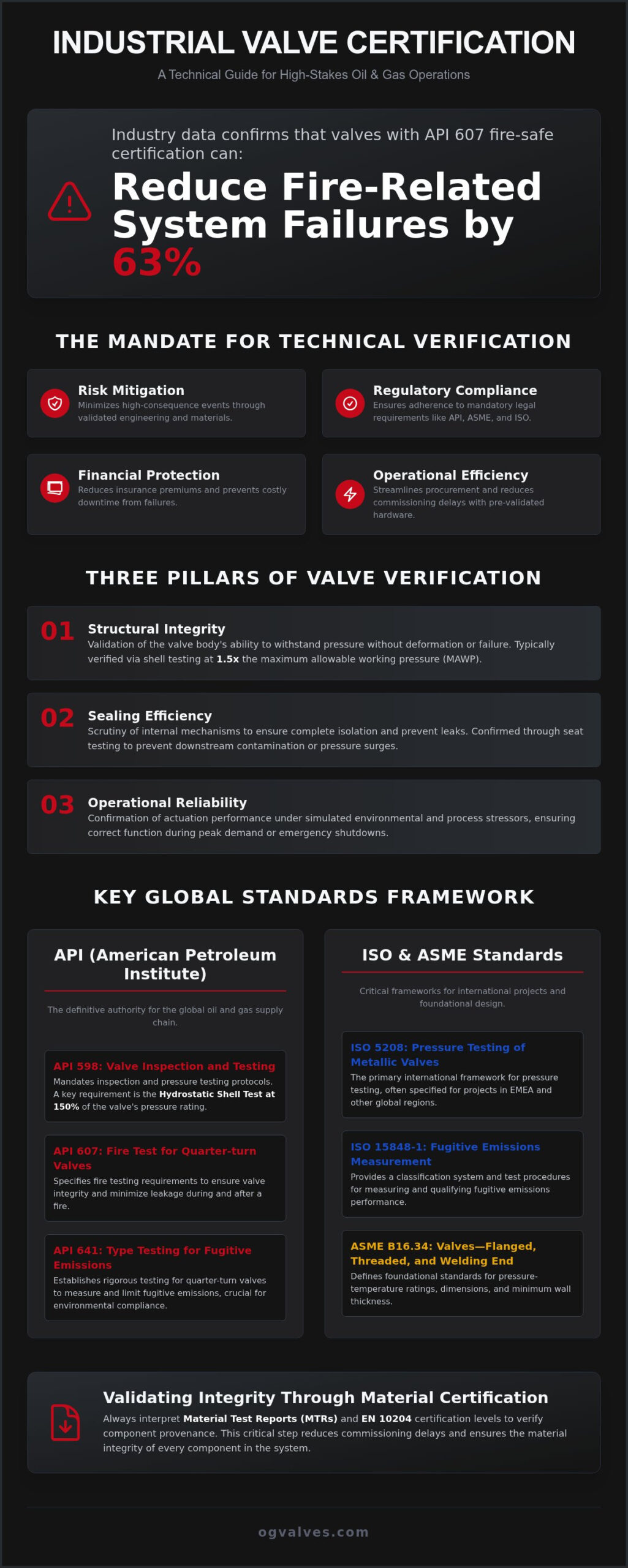
A single failure in a high-pressure hydrocarbon system often originates from a marginal deviation in material integrity or a non-compliant pressure test. Industry data confirms that valves with API 607 certification reduce fire-related system failures by 63%, yet procurement specialists frequently face the challenge of reconciling conflicting international protocols. You likely recognise that managing valve certification for oil and gas is not merely a bureaucratic exercise; it’s a fundamental safety mandate where the cost of error is measured in catastrophic environmental impact and total system downtime.
This article provides a clinical breakdown of the current industrial valve certification landscape, pressure testing protocols, and the regulatory frameworks required for high-stakes operations in 2026. We will examine the specific requirements of the API 598 11th Edition, the classification systems of ISO 5208, and the rigorous fugitive emission type testing mandated by ISO 15848-1 and API 641. This technical overview ensures your assets meet the structural integrity standards necessary for successful regulatory compliance audits and long-term operational safety.
Key Takeaways
- Understand how rigorous valve certification for oil and gas serves as the primary technical barrier against catastrophic system failures and environmental leaks.
- Distinguish between hydrostatic shell testing for structural integrity and pneumatic seat testing for precision low-pressure leak detection.
- Evaluate the critical differences between API 598 and ISO 5208 to ensure compliance with regional project specifications and global petroleum standards.
- Identify the specific testing requirements for fugitive emissions and fire safety, including API 607 and ISO 15848-1, to protect assets in volatile environments.
- Learn to interpret Material Test Reports and EN 10204 certification levels to verify component provenance and reduce commissioning delays.
The Critical Role of Valve Certification in Oil and Gas Safety
Valve certification for oil and gas represents the formal process of technical verification, ensuring every component adheres to specific design, material, and testing benchmarks. In volatile environments, the structural soundness of a valve isn’t a variable but a prerequisite for operational continuity. Certified components act as the primary defence against catastrophic failures, preventing hazardous leaks and unplanned facility shutdowns. By adhering to rigorous ASME, API, and ISO frameworks, operators safeguard high-pressure petrochemical assets against the inherent risks of fluid dynamics and thermal stress. This systematic approach to quality assurance ensures that various types of industrial valves perform predictably within their specified service limits.
The economic implications of choosing certified hardware extend beyond immediate safety. Pre-certified components streamline the procurement process and significantly reduce commissioning delays, which are often caused by inadequate technical documentation. Industry stakeholders rely on these certifications to achieve the following outcomes:
- Risk Mitigation: Minimising the probability of high-consequence events through validated engineering.
- Regulatory Compliance: Meeting mandatory legal requirements for high-pressure equipment in global jurisdictions.
- Financial Protection: Reducing insurance premiums by demonstrating adherence to international safety benchmarks.
- Operational Efficiency: Eliminating the need for redundant site-level testing by sourcing pre-validated inventory.
Primary Objectives of Technical Verification
The verification process focuses on three critical engineering pillars. First, structural integrity is validated through shell testing, ensuring the valve body can withstand 1.5 times the maximum allowable working pressure (MAWP) without permanent deformation or leakage. Second, sealing efficiency is scrutinised to confirm that internal mechanisms provide complete isolation in high-pressure scenarios, preventing downstream contamination or dangerous pressure surges. Finally, operational reliability is confirmed by testing actuation performance under simulated environmental stressors, verifying that the valve functions correctly during peak demand or emergency shutdown sequences.
Overview of Global Regulatory Governing Bodies
Adherence to international benchmarks ensures global interoperability and safety. The American Petroleum Institute (API) remains the definitive authority for oil and gas valve design, establishing the testing protocols used across the global supply chain. ASME B16.34 provides the foundational standards for pressure-temperature ratings and minimum wall thickness, which are essential for maintaining structural safety in forged and cast valves. For projects requiring international standardisation, particularly in EMEA regions, ISO 5208 serves as the primary framework for pressure testing metallic valves. These standards collectively ensure that valve certification for oil and gas remains a robust, data-driven process that eliminates technical ambiguity during the procurement phase.
Primary Pressure Testing Protocols: Hydrostatic and Pneumatic Methodologies
Validation of structural integrity and sealing performance constitutes the technical core of valve certification for oil and gas. Testing is categorised into hydrostatic and pneumatic methodologies, each designed to isolate specific failure modes in the pressure-retaining envelope. The operational sequence is mandatory; shell testing must always precede seat leakage verification. This ensures the valve body and bonnet joints are structurally sound before the internal sealing mechanisms are subjected to pressure. This hierarchy is a vital safety measure to mitigate risks associated with high-pressure gas testing, where the release of stored energy can be catastrophic.
Hydrostatic Shell and Seat Pressure Testing
Hydrostatic testing uses water or treated fluids to verify the integrity of cast and forged components. Standard protocols defined by the American Petroleum Institute (API) standards, specifically the 11th Edition of API 598, mandate shell tests at 150% of the rated pressure. Hold times are strictly regulated based on the nominal pipe size (NPS) and pressure class, allowing for thorough visual verification of the component. Inspectors monitor for weeping, porosity, or structural defects in the valve body, ensuring the casting remains within elastic deformation limits. It’s often necessary to review technical documentation to verify these hold times were maintained during factory acceptance testing.
Pneumatic Testing for Precision Sealing
Pneumatic methodologies offer a high-sensitivity alternative for detecting micro-leaks in resilient seated ball valves and other isolation components. Low-pressure seat tests generally implement 4 to 7 bar of air or nitrogen to confirm “bubble-tight” sealing. This “Zero Leakage” requirement is essential for high-performance industrial seals where downstream fluid migration poses environmental risks or operational hazards. Nitrogen is frequently specified for oxygen-sensitive or high-purity applications to prevent oxidation during the testing phase. Because compressed gas contains significant stored energy, safety protocols must include remote testing areas and pressure relief systems to protect personnel from potential component failure. Precise calibration of testing equipment is non-negotiable to maintain the accuracy of these low-pressure observations.
Comparison Analysis: API 598 vs ISO 5208 Frameworks
Selecting the correct framework for valve certification for oil and gas requires a precise understanding of the technical divergence between API 598 and ISO 5208. While API 598 remains the dominant benchmark in the global petroleum sector, ISO 5208 provides the international standard for pressure testing, particularly within EMEA projects. These frameworks aren’t interchangeable due to their distinct approaches to leakage rate classification and test duration protocols. Engineers must distinguish between these standards to ensure the hardware meets the specific risk profile of the intended application.
API 598: Inspection and Sealing Requirements
API 598 (11th Edition, February 2023) mandates shell, backseat, and closure tests for every unit. For metal-seated valves, such as gate valves, the standard defines allowable leakage in drops per minute. This quantitative metric provides a binary pass/fail result that is essential for high-stakes industrial isolation. Backseat testing is particularly critical for verifying stem seal integrity in gate and globe designs, ensuring the packing can be replaced under pressure without leakage. For check valves, the allowable leakage rates are strictly defined by bore size and pressure class, leaving no room for subjective interpretation during factory audits.
ISO 5208: Industrial Valve Pressure Testing Standards
ISO 5208:2015 uses a tiered classification system ranging from Rate A to Rate G. Rate A signifies no visible leakage, which is typically mandated for soft-seated components or high-performance butterfly valve specifications. As bore sizes increase, the allowable leakage rate shifts through the alphabetical categories, requiring procurement specialists to specify the exact rate based on the medium’s volatility. Test duration protocols in ISO 5208 can exceed API 598 requirements for large-scale procurement, necessitating careful alignment of factory testing schedules with project timelines.
Technical standardisation nuances often centre on the definition of “zero leakage.” While API 598 provides fixed criteria for metal-seated valves that allow for minimal weeping, ISO 5208 Rate A is strictly bubble-tight. This distinction is vital when specifying valves for hazardous gas services where even minimal seepage is unacceptable. Furthermore, the 2023 updates to API 598 have refined the leakage rate allowances for metal-seated valves, bringing certain categories closer to ISO benchmarks while maintaining the traditional petroleum-centric focus on durability. Understanding these subtle variations ensures that valve certification for oil and gas remains a reliable indicator of field performance.
Advanced Testing for Critical Environments: Emissions and Fire Safety
Standard pressure testing establishes basic structural integrity, but advanced valve certification for oil and gas focuses on extreme environmental variables. In modern petrochemical facilities, components must withstand aggressive thermal cycles and mitigate the release of volatile organic compounds. These specialised protocols, including fugitive emission validation and fire-safe certification, are now mandatory for projects targeting 2026 ESG compliance. Technical experts prioritise these tests to ensure that industrial valves maintain their sealing capacity during high-consequence events.
Fugitive Emission Certification (API 624/641)
Stem seal integrity is verified through rigorous fugitive emission testing, categorised by mechanical motion. API 624 applies to rising stem valves, while API 641 covers quarter-turn designs. The “sniffing” methodology utilises helium or methane as a tracer gas, with mass spectrometry detecting leaks at the stem packing interface. For 2026, the industry benchmark for “Low-E” certification requires leakage levels to remain below 100 parts per million (PPM) throughout specified thermal and mechanical cycles. This validation is a critical component of corporate sustainability reporting, as it directly quantifies a facility’s success in reducing greenhouse gas emissions. Technical documentation must confirm these thresholds to satisfy environmental auditors and procurement specialists.
Fire Safety and High-Temperature Performance Validation
Fire-safe certification under API 607 or ISO 10497 is essential for refinery isolation. The testing process involves intense burn cycles where the valve is exposed to flames between 750°C and 1000°C for a duration of 30 minutes. This is followed by rapid quench cooling to simulate emergency fire-fighting efforts. Engineers evaluate post-burn leakage limits to ensure the secondary metal-to-metal seals remain effective after the primary soft seals are destroyed. While internal leakage is expected, it must remain within the tight volumetric limits defined by the standard to prevent fueling a fire further. To ensure your facility meets these rigorous safety benchmarks, you can source certified valve inventory that has undergone documented fire-safe validation.
Beyond thermal and emission testing, critical environments often require Positive Material Identification (PMI). This non-destructive process uses X-ray fluorescence to verify the exact chemical composition of high-alloy steels, preventing the accidental installation of incorrect material grades. Similarly, cryogenic testing assesses performance at temperatures as low as -196°C. This is a prerequisite for Liquefied Natural Gas (LNG) applications, where thermal contraction can cause standard seals to fail. These advanced testing layers provide the technical certainty required for the industry’s most demanding operational envelopes.
Procurement Strategy: Validating Integrity through Material Certification
Effective procurement strategy for high-stakes petrochemical assets hinges on the absolute traceability of every component. In the context of valve certification for oil and gas, the material paper trail is as critical as the physical hardware. Standards such as EN 10204 provide the framework for this verification. While EN 10204 3.1 is the industry standard for primary components, requiring the manufacturer’s authorised representative to validate compliance, EN 10204 3.2 mandates a third-party witness inspection. This higher level of certification is typically reserved for critical-service applications where independent verification of the heat number and material properties is non-negotiable.
Traceability protocols link each valve body, bonnet, and stem back to a specific foundry heat number. This ensures that if a material defect is identified in the field, every other component from that specific batch can be isolated. Before global fast-track shipment, a final visual and dimensional inspection acts as the ultimate quality gate. This step confirms that the physical dimensions, flange facings, and wall thicknesses align with the approved engineering drawings and ASME B16.34 requirements. It’s the final technical barrier that ensures the hardware delivered matches the specification ordered.
The Engineer’s Checklist for Auditing Test Certificates
Auditing a Material Test Report (MTR) requires a clinical eye for technical discrepancies. Procurement and QA specialists shouldn’t just check for the presence of a document; they must scrutinise the data. Use this structured checklist to ensure documentation accuracy:
- Pressure and Hold Times: Verify that the actual test pressures and durations recorded match the purchase order and the specific edition of API 598 or ISO 5208.
- Material Properties: Confirm that the chemical composition, including Carbon, Manganese, and Sulphur levels, and mechanical properties like Yield and Tensile strength align with the relevant ASTM or ASME material specifications.
- Traceability: Ensure the heat number on the MTR matches the permanent marking cast or forged into the valve body.
- Signatures and Stamps: Validate the presence of the authorised inspector’s signature and, for 3.2 certification, the official third-party witness stamp from bodies like Lloyd’s Register or DNV.
OG VALVES LTD.: Ensuring Global Regulatory Compliance
OG VALVES LTD. operates as a technical authority in the global supply chain, ensuring every component meets the most rigorous standards before it leaves the facility. We provide a comprehensive documentation package, including full MTRs and test certifications, as a standard part of every order. Our technical support team assists procurement departments in navigating complex project testing addendums, ensuring that valve certification for oil and gas requirements are met without ambiguity. By maintaining an extensive inventory of pre-certified valves, we reduce site commissioning times and mitigate the financial risks associated with project delays. This commitment to engineering excellence and documentation integrity makes us a dependable partner for critical infrastructure projects worldwide.
Advancing Operational Safety Through Technical Compliance
Ensuring system integrity in 2026 demands more than surface-level adherence to legacy standards. It requires a clinical understanding of the 11th Edition of API 598, the specific leakage rates of ISO 5208, and the rigorous fugitive emission thresholds defined by API 641. These frameworks provide the technical certainty needed to prevent catastrophic failures in high-pressure environments. Maintaining rigorous valve certification for oil and gas is the primary method for safeguarding critical infrastructure against environmental and operational risks.
OG VALVES LTD. maintains an extensive inventory of API and ISO compliant valves, supported by specialist expertise in heavy industry procurement. We provide comprehensive technical documentation, including full MTRs, with every order to ensure total project compliance and minimise commissioning delays. Our global logistics capability ensures that certified components reach your facility precisely when needed. Request a Technical Specification and Quote from OG VALVES LTD. to secure the structural integrity of your next project. Achieving zero-leakage performance begins with verified engineering excellence.
Frequently Asked Questions
What is the primary difference between a shell test and a seat test?
A shell test validates the structural integrity of the entire pressure-retaining envelope, including the body, bonnet, and joints. It’s typically performed at 150% of the maximum allowable working pressure to ensure the casting or forging doesn’t fail under stress. In contrast, a seat test specifically evaluates the sealing performance of the internal closure mechanism. While the shell test ensures the valve won’t burst, the seat test confirms the valve prevents downstream fluid migration during isolation.
Does API 598 certification cover fire-safe requirements?
API 598 doesn’t address fire-safe performance; it focuses strictly on inspection and pressure testing protocols for general service. Fire safety is governed by separate standards, such as API 607 for valves with non-metallic seats or API 6FA for 6D valves. Obtaining valve certification for oil and gas often requires combining these standards to ensure a component is both pressure-tight under normal conditions and capable of maintaining a seal during a high-temperature thermal event.
What is the technical definition of “Zero Leakage” in 2026 industrial standards?
“Zero Leakage” is technically defined as ISO 5208 Rate A or the resilient-seated criteria in API 598. This classification means no visible leakage of water or bubbles of air are detected during the specified test duration. In 2026, this standard is mandatory for high-performance seals in hazardous gas services. Metal-seated valves often have a different allowable leakage rate, defined by drops per minute, which doesn’t qualify as a bubble-tight “Zero Leakage” result.
When should an engineer specify EN 10204 3.2 certification over 3.1?
An engineer should specify EN 10204 3.2 certification when the project involves high-risk environments or requires independent verification of material provenance. While 3.1 is validated by the manufacturer’s own quality department, 3.2 requires a third-party inspector to witness the testing and stamp the Material Test Report. This provides an additional layer of technical certainty for critical infrastructure assets where the cost of material failure or a documentation error is entirely unacceptable.
What is the standard hold time for a hydrostatic shell test on a 12-inch valve?
For a 12-inch nominal pipe size (NPS) valve, the API 598 11th Edition mandates a minimum hydrostatic shell test hold time of 300 seconds. This five-minute duration allows for a thorough visual inspection of the cast or forged body to detect any weeping or structural deformation. Larger valves require longer hold times to ensure the pressure has stabilised and any potential defects in the material or joints become clearly apparent to the authorised inspector.
Why is Positive Material Identification (PMI) required for duplex and super duplex valves?
Positive Material Identification (PMI) is mandatory for duplex and super duplex valves to verify that the chemical composition meets the required Pitting Resistance Equivalent Number (PREN). Because these high-alloy steels are chosen for their extreme corrosion resistance in sour gas or subsea environments, any material mix-up during manufacturing could lead to rapid stress corrosion cracking. PMI ensures that the chromium, molybdenum, and nitrogen levels align with the correct ASTM specification before global shipment.
How does API 624 fugitive emission testing differ from ISO 15848-1?
API 624 is a specific type test for rising stem valves equipped with graphite packing, focusing on a fixed number of mechanical and thermal cycles. ISO 15848-1 is a broader classification system that allows engineers to specify different endurance classes and temperature ranges. While API 624 provides a binary pass/fail for stem seals, ISO 15848-1 offers a tiered classification, enabling more precise alignment with the fugitive emission requirements of a specific petrochemical facility.
Can a valve be re-certified to API 598 after field maintenance or repair?
A valve can be re-certified to API 598 following maintenance, provided the work is performed according to industry-recognised repair standards like ASME PCC-2. The unit must undergo the full suite of hydrostatic shell and seat tests to confirm its pressure-retaining capabilities are fully restored. This process is essential for maintaining valve certification for oil and gas throughout the asset’s lifecycle, ensuring that repaired components meet the same safety benchmarks as new inventory.
 Responsive Menu