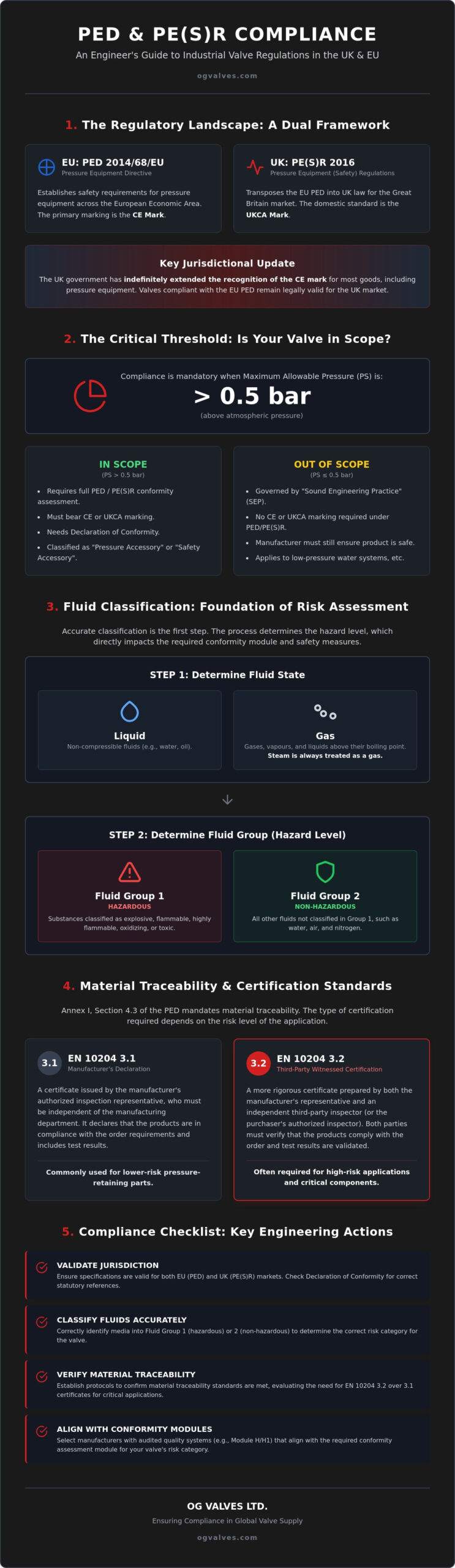
The indefinite recognition of the CE mark alongside the UKCA mandate has created a dual-track regulatory environment that many engineering teams still fail to navigate with precision. You’ve likely encountered the friction caused by misaligned fluid group classifications or ambiguous risk category assessments during high-stakes procurement. This regulatory complexity often results in costly project delays and documentation gaps that compromise the integrity of critical pressure systems. Achieving absolute PED compliance for industrial valves uk requires a clinical understanding of how the Pressure Equipment (Safety) Regulations 2016 (PE(S)R) and the EU Pressure Equipment Directive 2014/68/EU intersect in 2026.
This technical guide serves as your definitive engineering resource for navigating these requirements without error. It’s designed to eliminate ambiguity surrounding fluid groups and conformity assessment modules, ensuring your valve selections meet rigorous safety benchmarks. We’ll provide a methodical breakdown of risk categories, material traceability protocols, and the specific technical documentation needed to maintain operational output and regulatory adherence for gate, ball, and globe valves. This analysis ensures that every component, from needle valves to large-scale butterfly valves, aligns with the latest UK and international standards.
- Differentiate between PED 2014/68/EU and UK PE(S)R 2016 statutory requirements to ensure engineering specifications remain valid across both European and British jurisdictions.
- Identify the precise classification of media into Fluid Groups 1 or 2 to accurately determine the mandatory risk category for gate, ball, and globe valves.
- Establish rigorous protocols for PED compliance for industrial valves uk by verifying mandatory material traceability standards under Annex I, Section 4.3.
- Evaluate the necessity of third-party witnessed material certifications (EN 10204 3.2) versus manufacturer declarations (3.1) for high-risk industrial applications.
- Streamline procurement by selecting manufacturers with audited quality systems that align with specific conformity assessment modules ranging from A2 to H1.
The technical regulation of industrial valves within the United Kingdom is governed by a dual-framework system that demands absolute precision in documentation. Central to this is the Pressure Equipment Directive (PED) 2014/68/EU, which establishes the legal requirements for pressure equipment across the European Economic Area. In Great Britain, these requirements are transposed through the Pressure Equipment (Safety) Regulations 2016 (PE(S)R). Both frameworks apply to any valve where the maximum allowable pressure (PS) exceeds 0.5 bar. This 0.5 bar threshold is the clinical trigger for mandatory compliance, necessitating a rigorous assessment of material integrity and structural soundness for all pressure-bearing components.
For 2026, the regulatory status of conformity markings remains a point of technical focus for procurement specialists. While the UKCA (UK Conformity Assessed) mark is the domestic standard for the GB market, the UK government has indefinitely extended the recognition of the CE mark for pressure equipment. This means that industrial valves compliant with the EU PED and bearing the CE mark remain legally permissible for placement on the UK market. This stability allows engineering teams to maintain global supply chain continuity without immediate redesign of documentation protocols. However, ensuring absolute PED compliance for industrial valves uk requires that the Declaration of Conformity specifically references the relevant statutory instruments for the intended market to avoid customs or site-entry delays.
Harmonised Standards and Essential Safety Requirements (ESRs)
The core of both PED and PE(S)R lies in the Essential Safety Requirements (ESRs) defined in Annex I. These requirements dictate the design and manufacture of pressure-retaining housings for gate, ball, and globe valves. Manufacturers achieve a “presumption of conformity” by adhering to harmonised standards (EN) or UK designated standards. These standards provide the quantifiable data needed to validate wall thickness, bolt loading, and stress analysis. The Declaration of Conformity serves as the primary legal document in the supply chain, certifying that the valve housing meets these rigorous safety benchmarks under specified operating conditions. It’s the manufacturer’s formal assertion that the product’s design and production align with global safety benchmarks.
Scope of Application for Industrial Valves
Industrial valves are typically classified as “pressure accessories” under the directive, meaning they have an operational function and a pressure-bearing housing. If a valve is designed to prevent pressure limits from being exceeded, it’s reclassified as a “safety accessory,” triggering more stringent conformity assessment modules. Systems operating below the 0.5 bar threshold, such as low-pressure water distribution, fall outside the scope of PED/PE(S)R and are governed by “Sound Engineering Practice” (SEP). For a broader technical overview of valve types and their specific engineering applications, consult Industrial Valves: The Engineer’s Comprehensive Guide. Understanding these distinctions is fundamental to maintaining PED compliance for industrial valves uk across diverse infrastructure projects.
Accurate classification is the foundation of structural safety and regulatory adherence. Under The Pressure Equipment (Safety) Regulations 2016, manufacturers must first identify the physical state of the fluid and its associated hazard level. Fluids are categorised as either gases or liquids. This distinction is vital because compressed gases store significantly more potential energy than non-compressible liquids. Steam is always treated as a gas in these calculations due to its thermodynamic properties. Once the state is determined, the media is assigned to a Fluid Group based on its chemical properties and potential risk to personnel and the environment.
Fluid Group 1 includes substances classified as explosive, extremely flammable, highly flammable, flammable, very toxic, toxic, or oxidising. This group is a critical consideration for the Oil & Gas and chemical processing sectors where the cost of failure is absolute. Fluid Group 2 encompasses all other media, including steam, water, and standard industrial gases. The final risk category is determined by the intersection of the valve’s Nominal Size (DN) and its Maximum Allowable Pressure (PS). This methodical approach to classification is the only way to guarantee PED compliance for industrial valves uk in high-risk infrastructure. Engineers requiring precise data on material suitability for hazardous media can view our technical specifications for compliant hardware.
The Four PED Categories (I to IV)
Valves fall into one of four categories based on their stored energy. Category I represents the lowest risk, allowing for manufacturer self-certification. As the DN and PS increase, the valve moves into Categories II, III, or IV. These higher tiers require increasing levels of intervention from a UK Approved Body, covering design examination and production surveillance. Equipment falling below Category I thresholds is governed by Sound Engineering Practice (SEP). SEP items must be designed for safety but cannot bear the UKCA or CE mark, as they don’t meet the minimum energy thresholds for formal certification.
Practical Classification for Gate and Ball Valves
The application of these rules varies significantly by valve architecture. For instance, high-pressure API 600 gate valves used in steam service (Group 2 Gas) often exceed the thresholds for Category III. Similarly, large-bore trunnion-mounted ball valves handling Group 1 hazardous gases almost always necessitate Category IV certification. Procurement teams must consult the specific tables in Annex II of the Directive to verify the required conformity path. Ensuring PED compliance for industrial valves uk requires a rigorous cross-referencing of these tables against the intended service conditions to prevent the procurement of under-certified components.

The selection of a conformity assessment module is a strategic decision that depends on the valve’s risk category and the manufacturer’s production volume. This modular system provides a structured framework for proving compliance with the Essential Safety Requirements. For Category I equipment, Module A (Internal Production Control) is the standard path. It places the entire responsibility for design and manufacturing verification on the manufacturer. While cost-effective for low-risk applications, it lacks the external validation required for critical infrastructure. In contrast, Module H and H1 represent the benchmark for high-specification suppliers. Module H involves Full Quality Assurance, where an external body audits the manufacturer’s quality system. Module H1 extends this to include a formal design examination, providing the highest level of technical assurance for complex pressure systems.
For 2026, the distinction between regulatory bodies remains critical for PED compliance for industrial valves uk. Manufacturers seeking the UKCA mark must engage a UK Approved Body. Those targeting the European market with the CE mark must use an EU Notified Body. Each body is assigned a unique four-digit identification number, which must be clearly stamped on the valve nameplate alongside the relevant conformity mark. This traceability ensures that every component in the supply chain has been verified by a competent authority.
Which Module Suits Your Procurement Strategy?
High-volume procurement typically favors a combination of Module B (EU-Type Examination) and Module D (Production Quality Assurance). This path allows the manufacturer to certify a “type” or design once, while the QA module ensures every subsequent unit meets that standard. For bespoke, large-bore industrial valves used in unique project environments, Module G (Unit Verification) is more appropriate. It involves a clinical, one-off inspection of a single valve unit by the Approved Body. This ensures that unique engineering specifications are met without the need for a pre-approved type design.
The Role of the Manufacturer vs. the Authorized Representative
The manufacturer is legally obligated to compile and maintain the Technical File for a minimum of 10 years after the valve is placed on the market. This file must contain design drawings, material certifications, and test reports. In 2026, UK-based importers and distributors must verify that the manufacturer has fulfilled these obligations before the hardware enters the site. This verification is particularly vital for butterfly valves in the power generation sector. These valves face extreme thermal stress and high flow velocities, making PED compliance for industrial valves uk a non-negotiable requirement for operational safety and long-term performance.
Material integrity is a statutory obligation under PED Annex I, Section 4.3. This regulation mandates that manufacturers of pressure equipment ensure the suitability of all materials used in pressure-bearing parts through rigorous certification and verification. PED compliance for industrial valves uk requires a clinical audit trail that links every finished component back to its original material heat. This traceability is verified through EN 10204 certificates. A 3.1 certificate is a declaration issued by the manufacturer’s quality department, which must remain independent of the production unit. For high-risk Category III and IV applications, an EN 10204 3.2 certificate is often required. This document necessitates that an independent third-party inspector witnesses the material testing to provide an unbiased verification of mechanical and chemical properties.
When engineering specifications require materials not defined by harmonised standards, a Particular Material Appraisal (PMA) must be conducted. This appraisal is a formal technical document that proves the material meets the Essential Safety Requirements (ESRs) of the directive. It’s a critical step for valves operating in extreme temperatures or corrosive environments where standard alloys are insufficient. All these documents, alongside design calculations and test reports, form the Technical File. This file must be retained for 10 years and serves as the primary evidence of engineering excellence during regulatory audits. For procurement support on high-specification projects, you can request a technical consultation for PED-certified valves.
Traceability of Pressure-Retaining Parts
Technical verification focuses primarily on the valve body, bonnet, and pressure-retaining bolting. These components must withstand the full operational pressure of the system without risk of catastrophic failure. Forgings and castings undergo different testing protocols under PE(S)R. Castings often require more extensive Non-Destructive Testing (NDT), such as radiographic or magnetic particle inspection, to identify internal defects. For Category III and IV hardware, NDT personnel must be approved by a recognised third-party organisation to ensure testing accuracy meets global safety benchmarks.
Nameplate Marking and Operating Instructions
The valve nameplate is the final point of technical validation. It must contain quantifiable data including the manufacturer’s name, unique serial number, Maximum Allowable Pressure (PS), Allowable Temperature (TS), and Nominal Size (DN). In 2026, valves placed on the UK market may bear both the CE and UKCA marks to ensure cross-border regulatory acceptance. Legal compliance is not complete without the provision of safety instructions and maintenance manuals. these documents must provide clear, technical guidance on the safe installation, operation, and decommissioning of the pressure accessory to prevent operational failure.
OG Valves operates as a technical entity focused on the precision of pressure system components. We ensure PED compliance for industrial valves uk by maintaining a verified supply chain of manufacturers audited under Module H and H1 quality systems. This strategic alignment allows for the procurement of gate, ball, and globe valves that meet the highest regulatory benchmarks without the need for repetitive unit-by-unit verification. Our clinical approach to material integrity ensures that every component is backed by a robust Technical File, ready for immediate deployment in petrochemical or power generation sectors. It’s a level of technical oversight that prioritizes long-term performance and safety in high-stakes environments.
Managing international logistics for pressure equipment requires a comprehensive understanding of both UK PE(S)R 2016 and EU PED 2014/68/EU. We facilitate the movement of certified hardware to global sites, ensuring that all documentation, from Declarations of Conformity to detailed test reports, is present and accurate. This meticulous attention to detail prevents project delays at customs or during site inspections. Our technical experts provide the necessary oversight to ensure that PED compliance for industrial valves uk remains intact across diverse jurisdictions and complex supply routes.
Rigorous Testing and Quality Assurance
We implement internal protocols for the verification of EN 10204 3.1 and 3.2 material certifications. This process involves a line-by-line audit of chemical and mechanical properties against the relevant harmonised or designated standards. It’s a non-negotiable step in maintaining the safety of high-pressure systems. Our experience includes the provision of check valves for critical infrastructure where backflow prevention is essential for operational safety. We manage fast-track delivery schedules by utilizing pre-vetted stock that already meets stringent regulatory adherence protocols without compromising on structural soundness.
Technical Consultation for Project Procurement
Engineering teams often face ambiguity during the initial stages of procurement regarding fluid group determination and category selection. We act as a dependable partner, assisting engineers in navigating the complexities of Annex II tables and fluid hazard classifications. Our knowledge extends across API, ASME, and EN standards, allowing us to harmonise diverse technical requirements into a single, compliant specification. This expert consultation mitigates the risk of procuring under-specified or non-compliant hardware. For project-specific guidance, Contact OG Valves for technical consultation or a formal quote to ensure your pressure systems meet all 2026 statutory requirements.
Securing absolute safety in high-pressure environments requires a clinical adherence to the intersection of PE(S)R 2016 and PED 2014/68/EU. The successful determination of fluid groups and risk categories is the only path to ensuring structural integrity in critical infrastructure. Maintaining a comprehensive Technical File and verifying EN 10204 3.2 material traceability protocols are essential safeguards against project delays and operational failure. Achieving PED compliance for industrial valves uk isn’t just a regulatory hurdle; it’s a fundamental engineering requirement for 2026.
OG Valves provides the specialist technical expertise in API and EN standards needed to navigate these complex specifications. Our rigorous material traceability protocols and global fast-track delivery capabilities ensure your projects remain on schedule without compromising on safety benchmarks. We act as a reliable partner in your procurement strategy, delivering hardware that meets every statutory requirement. Request a Technical Quote for Compliant Industrial Valves to secure the precision your infrastructure demands. It’s time to elevate your engineering standards with hardware built for long-term performance.
What is the difference between PED and PE(S)R for UK projects?
The Pressure Equipment Directive (PED) 2014/68/EU is the regulatory framework for the European Union, while the Pressure Equipment (Safety) Regulations 2016 (PE(S)R) is the equivalent statutory instrument for the United Kingdom. Although they share identical technical requirements and Essential Safety Requirements (ESRs), PE(S)R is the specific legal basis for compliance in Great Britain. Technical files must reference the correct domestic legislation to ensure legal validity for UK infrastructure projects.
Do all industrial valves require a CE or UKCA mark?
Conformity marking is only mandatory for valves that exceed the 0.5 bar pressure threshold and fall into Categories I, II, III, or IV. These marks signify that the hardware meets rigorous safety standards. Valves operating below these thresholds are classified under Sound Engineering Practice (SEP). It’s a violation of the regulations to apply a CE or UKCA mark to SEP-rated equipment, as they don’t meet the minimum energy risk criteria.
What are the fluid groups in PED 2014/68/EU?
Fluids are classified into two distinct groups based on their hazardous properties. Group 1 comprises dangerous media, including explosive, extremely flammable, toxic, or oxidising substances. Group 2 includes all other fluids, such as steam, water, and non-hazardous gases. Accurate group assignment is the first step in determining the risk category and ensuring PED compliance for industrial valves uk, as Group 1 media triggers more stringent assessment modules at lower pressure-volume thresholds.
When is an EN 10204 3.2 certificate mandatory for a valve?
An EN 10204 3.2 certificate becomes mandatory when a valve is classified in Category III or IV and the project specification requires third-party witnessed material testing. This level of certification provides an independent audit trail for pressure-retaining parts like the body and bonnet. It’s the highest form of material validation, ensuring that the chemical and mechanical properties of the steel meet the quantifiable data required for high-risk industrial applications.
What happens if a valve is classified under Sound Engineering Practice (SEP)?
Valves classified as SEP must be designed and manufactured in accordance with the safe engineering standards of a member state or the UK. While they don’t require a formal conformity mark or the involvement of an Approved Body, they must be safe for their intended use. Manufacturers must provide adequate instructions for use and ensure the valve bears clear identification. This classification typically applies to small-bore or low-pressure hardware where the stored energy risk is minimal.
Can a valve carry both CE and UKCA markings simultaneously?
Dual marking is a standard practice for 2026 to facilitate seamless supply chain movement between the UK and EU markets. A valve can carry both marks provided it satisfies the legal requirements and conformity assessment procedures for both jurisdictions. This often involves the manufacturer maintaining technical documentation that references both the EU Directive and the UK statutory instruments. It ensures that PED compliance for industrial valves uk is maintained without restricting the hardware’s use in European projects.
What is a Notified Body’s role in valve compliance?
A Notified Body in the EU or an Approved Body in the UK acts as an independent third-party auditor for valves in Categories II, III, and IV. They perform design examinations, type testing, and quality system audits to verify that the manufacturer’s processes align with the Essential Safety Requirements. Their unique identification number must appear on the valve nameplate. This intervention provides the technical assurance necessary for hardware used in critical infrastructure where the cost of failure is high.
How do I determine the PED category for a gate valve in a steam system?
Steam is treated as a Group 2 gas because of its thermodynamic properties and potential for rapid expansion. To find the category, you must use Table 7 in Annex II of the directive or the equivalent UK regulation. By plotting the gate valve’s Nominal Size (DN) against its Maximum Allowable Pressure (PS), you’ll identify if the valve falls into Category I, II, or III. This clinical calculation is vital for selecting the correct conformity assessment module and ensuring structural soundness.
 Responsive Menu