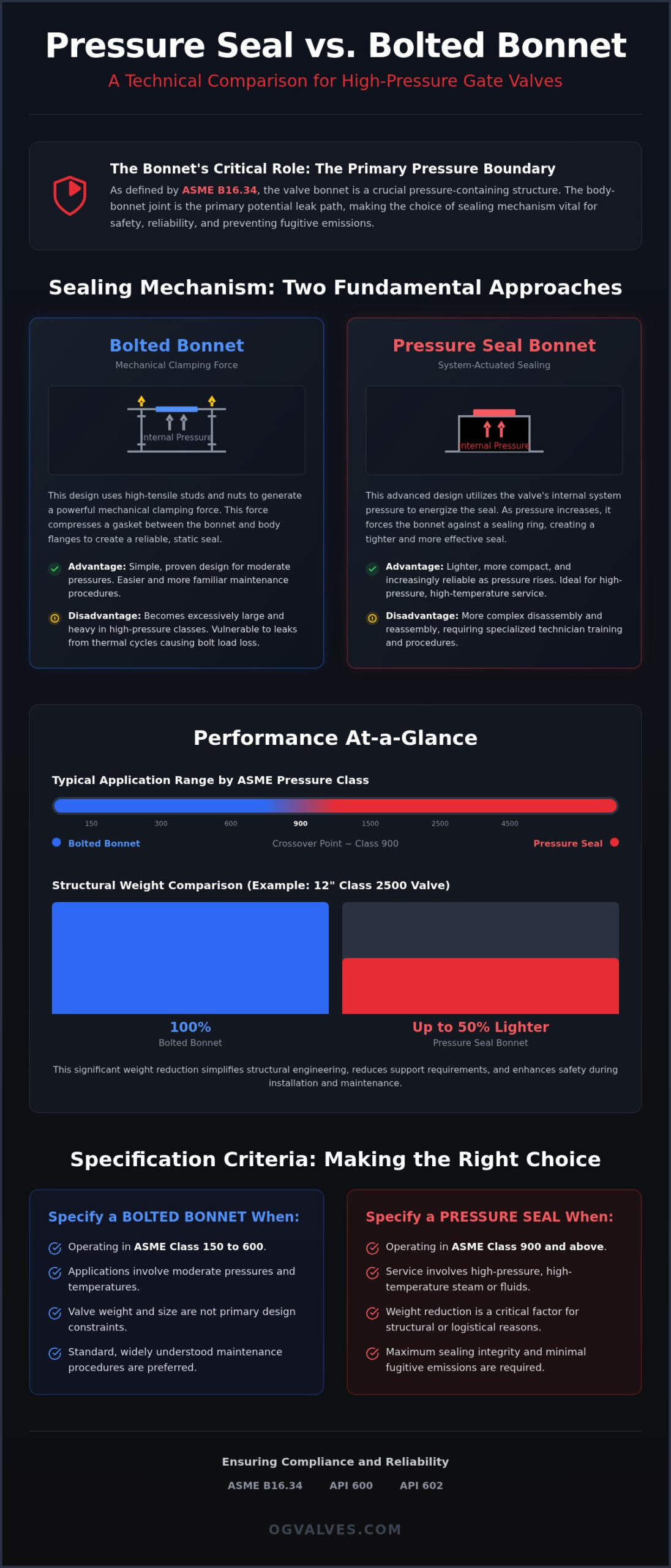
For a 12-inch Class 2500 valve, a pressure seal bonnet design can be up to 50% lighter than a bolted bonnet equivalent. This weight differential isn’t merely a logistical convenience; it represents a fundamental shift in structural engineering requirements for high-pressure piping systems. Engineers often face the persistent challenge of frequent gasket leaks in high-temperature steam lines when traditional sealing methods are pushed beyond their design limits. Selecting the correct pressure seal bonnet vs bolted bonnet gate valve requires a clinical understanding of how internal fluid pressure interacts with the sealing interface.
This technical analysis provides a comprehensive comparison of bonnet sealing mechanisms to assist engineers in selecting the optimal gate valve for high-pressure industrial applications. It’s essential to minimize fugitive emissions and ensure strict compliance with ASME B16.34 and API 600 standards to maintain operational integrity. We will examine the mechanical advantages of self-energizing seals, evaluate the total cost of ownership across different pressure classes, and define the specific thresholds where one design becomes technically superior to the other.
Key Takeaways
- Define the critical role of the valve bonnet as a primary pressure-containing boundary according to ASME B16.34 structural standards.
- Differentiate between the mechanical seating stress required for bolted flange joints and the self-energizing sealing principles utilized in high-pressure configurations.
- Identify the specific temperature and pressure thresholds, typically Class 900 and above, that dictate the technical superiority of a pressure seal bonnet vs bolted bonnet gate valve.
- Evaluate the operational trade-offs regarding structural weight reduction and maintenance complexity to optimize the total cost of ownership in heavy industrial sectors.
- Ensure adherence to API 600 and API 602 specifications to mitigate fugitive emissions and maintain high-stakes reliability in critical infrastructure.
The Role of the Valve Bonnet in Pressure Containment
The valve bonnet serves as a static pressure-containing boundary that encloses the internal moving components, specifically the stem and the wedge assembly. According to ASME B16.34, the bonnet must be engineered to the same rigorous pressure-temperature ratings as the valve body to ensure structural integrity under maximum operating conditions. It’s not merely a cover. It is a critical component that manages internal fluid forces while providing a stable pathway for the stem. The interface between the body and the bonnet represents the primary potential leak path for fugitive emissions, making the choice between a pressure seal bonnet vs bolted bonnet gate valve a vital decision for plant safety and environmental compliance.
Engineers distinguish these designs by their sealing logic. Bolted bonnets rely on external mechanical force provided by studs and nuts to compress a gasket. Conversely, pressure seal designs utilize the internal system pressure to energize the seal. This fundamental difference dictates the valve’s performance during thermal cycles and high-pressure transients. Accurate specification ensures that the chosen sealing method aligns with the specific tensile and compressive loads present in the piping system.
The Pressure-Containing Boundary and Safety
The bonnet-to-body joint is subjected to complex stress profiles, including internal hydrostatic pressure and external piping loads. Because this joint is a non-welded connection, it’s often the most vulnerable point for external leakage in a high-pressure system. Failure to maintain sufficient gasket stress leads to fugitive emissions, which can result in significant regulatory penalties and safety hazards. For a broader analysis of these components, technical specialists should consult our comprehensive guide to industrial valves. Maintaining seal integrity is paramount to preventing catastrophic failure in heavy industrial sectors.
Historical Evolution of Sealing Technologies
Early valve designs utilized simple threaded bonnets, but these were limited by low pressure ratings and susceptibility to vibration-induced loosening. As industrial requirements advanced, the bolted bonnet became the global standard for Class 150 through Class 600 applications. However, the increasing demands of power plant steam cycles necessitated a more efficient solution. This led to the development of the self-energizing pressure seal. Modern Gate valve construction now incorporates advanced material science, such as flexible graphite and pressure-enhanced metallic gaskets, to improve the reliability of both designs in extreme environments. These innovations ensure that the pressure seal bonnet vs bolted bonnet gate valve comparison remains a focal point of modern piping specification for high-stakes infrastructure.
Engineering Principles of Bolted Bonnet Gate Valves
The bolted bonnet is the most common assembly for industrial gate valves in ASME Class 150 to Class 600 service. Its design relies on a mechanical clamping force generated by a series of studs and nuts that secure the bonnet flange to the body flange. This arrangement creates a static seal by compressing a gasket between the two machined surfaces. While effective for moderate pressures, the structural weight of the flanges and the quantity of high-tensile bolting increase significantly as the pressure rating rises. This physical bulk is a primary driver in the technical debate regarding a pressure seal bonnet vs bolted bonnet gate valve for larger diameter pipelines.
Standard gasket selections for these valves typically include spiral wound gaskets with internal rings or solid metal Ring Type Joints (RTJ). RTJ gaskets are preferred for higher pressure classes because they utilize a “wedge effect” within a precision-machined groove. However, even with premium materials, the integrity of the joint is entirely dependent on maintaining constant bolt load. If you’re managing high-stakes infrastructure, you can contact our technical team for specific torque requirements and material certifications.
Mechanical Clamping and Gasket Compression
The efficiency of a bolted joint depends on the precise application of bolt torque to achieve a specific gasket load. If the torque is insufficient, the internal fluid pressure will overcome the mechanical seal, resulting in a leak. Gasket seating stress is the minimum compressive force required to prevent fluid bypass. In high-pressure bolted bonnets, the RTJ design provides a more robust metal-to-metal interface compared to flat gaskets. Despite these reinforcements, the mechanical limitations of the design become apparent in Class 900 and Class 1500 service, where the required bolt diameter and flange thickness become impractical. For a comparison of how these forces differ in other valve types, engineers may review our guide on industrial ball valves.
Challenges: Thermal Cycling and Bolt Relaxation
Steam applications and high-temperature petrochemical processes introduce thermal transients that challenge bolted joints. Extreme temperature changes cause differential expansion between the alloy steel bolts and the heavier valve flanges. Because the bolts often have a smaller mass and different thermal expansion coefficient than the body, they may expand faster or slower than the components they are securing. This leads to bolt relaxation, where the initial tension is lost, reducing the compressive force on the gasket.
Unlike The Self-Energizing Mechanism of Pressure Seal Bonnets, which improves its seal as pressure increases, a bolted bonnet’s sealing capability decreases if the mechanical load is compromised. This vulnerability necessitates frequent maintenance and re-torquing in systems with fluctuating temperatures. This is a critical consideration when evaluating a pressure seal bonnet vs bolted bonnet gate valve for steam headers where thermal cycling is a daily operational reality.
The Self-Energizing Mechanism of Pressure Seal Bonnets
The pressure seal design utilizes a unique internal configuration consisting of a gasket, a spacer ring, and a segment ring assembly. Unlike the external mechanical clamping of a bolted joint, this architecture relies on the internal fluid pressure of the system to maintain seal integrity. This “self-energizing” principle means that as the internal line pressure increases, it forces the bonnet upward, compressing the gasket against the body’s internal bore. This relationship makes the design the industry standard for high-pressure service, specifically Class 1500 and Class 2500 applications, where a pressure seal bonnet vs bolted bonnet gate valve comparison favors the former for its superior performance under extreme hydrostatic loads.
How Internal Pressure Enhances Seal Integrity
The physics of the pressure seal are straightforward: higher system pressure translates directly into higher contact stress at the gasket interface. In a bolted design, internal pressure acts against the bolts, attempting to separate the body and bonnet. In contrast, the pressure seal design leverages this force to enhance the seal. This eliminates the risk of bolt relaxation and gasket bypass during sudden pressure surges. For a detailed breakdown of these design specifics, consult our technical guide to industrial gate valves. Most modern high-pressure valves utilize flexible graphite or metal-to-metal seals to ensure long-term durability in high-temperature steam applications.
Critical Components: The Segment Ring and Gasket
The segment ring is a vital component that transfers the upward load from the bonnet directly to the valve body. It fits into a precision-machined groove within the body bore, acting as a structural stop for the internal assembly. Achieving a successful seal requires extreme precision in machining the bonnet bore and the segment ring groove; even minor deviations can lead to uneven gasket loading. Following the Specification Criteria for Selecting Bonnet Design as defined by MSS-SP-144 and API 600 ensures that the assembly meets rigorous safety benchmarks for high-stakes infrastructure.
Gasket material selection is equally critical. While flexible graphite is common for its resilience, many Class 2500 valves employ silver-plated metallic gaskets. The silver plating acts as a soft lubricant that flows into microscopic surface irregularities during the initial seating process, creating a gas-tight, metal-to-metal seal. This configuration is particularly effective in preventing the gasket from “freezing” to the body bore, which facilitates easier maintenance during planned outages. It’s a clinical approach to sealing that prioritizes operational output and structural soundness over mechanical simplicity.
Technical Comparison: Performance, Weight, and Maintenance
The technical differentiation between a pressure seal bonnet vs bolted bonnet gate valve is most evident when analyzing structural mass and physical dimensions. For a 12-inch Class 1500 valve, the bolted bonnet design is significantly heavier due to the massive body and bonnet flanges required to withstand internal pressure. These flanges, along with the high-tensile studs, account for a substantial portion of the valve’s total weight. In contrast, the pressure seal design utilizes a compact body bore configuration that eliminates the need for external clamping hardware, resulting in a streamlined profile that’s ideal for restricted piping galleries.
Weight Savings and Piping Stress
Eliminating heavy flanges typically results in a 30% to 50% reduction in total valve weight. This structural efficiency significantly lowers the load on piping supports and spring hangers, reducing the overall complexity of the piping system’s stress analysis. Such weight considerations are equally critical when specifying industrial check valves for high-pressure headers. A lighter valve assembly also facilitates faster installation and reduces the structural requirements for the surrounding infrastructure.
Maintenance Cycles and Disassembly Challenges
Bolted bonnets offer straightforward access for routine maintenance. Disassembly only requires the removal of nuts and studs using standard industrial tools. However, these joints require a rigorous inspection checklist during scheduled shutdowns to ensure long-term reliability:
- Verify stud tension and check for thread deformation or fatigue.
- Inspect flange faces for steam cutting, wire drawing, or pitting.
- Replace all gaskets with new API-certified spiral wound or RTJ components.
Pressure seal valves present a different set of operational challenges. While they’re engineered for minimal leakage in high-pressure service, they’re susceptible to “freezing” or galling after long-term exposure to high-temperature steam. The “bonnet take-up” procedure is a necessary commissioning step to compensate for gasket set and ensure the initial seal is established. If the internal components coke or gall, specialized hydraulic pullers may be required for disassembly, increasing the duration of maintenance outages.
The decision between these designs often hinges on the balance of initial CAPEX and long-term OPEX. Bolted designs usually have a lower initial purchase cost but incur higher maintenance expenses due to thermal cycling and bolt relaxation. Pressure seals demand higher initial investment and precision machining but offer superior reliability in critical service. For expert guidance on valve specification, consult the OG VALVES LTD. technical team to ensure your project meets all regulatory benchmarks and safety standards.
Specification Criteria: Selecting the Right Bonnet Design
The final selection between a pressure seal bonnet vs bolted bonnet gate valve is dictated by a clinical assessment of system pressure and temperature. ASME Class 900 represents the technical crossover point where the self-energizing gasket becomes more efficient than mechanical bolting. At temperatures exceeding 600°F (315°C), the risk of bolt relaxation in bolted designs makes the pressure seal the safer engineering choice for critical infrastructure. These thresholds ensure that the sealing mechanism remains energized even during the most severe thermal transients.
Fluid chemistry and maintenance frequency are secondary but vital factors in the specification process. While high-pressure steam favors the pressure seal architecture, corrosive chemicals or abrasive slurries often necessitate a bolted bonnet. This allows for frequent internal inspections and easier maintenance if the wedge or seat rings require replacement. If a process requires the valve to be opened annually for regulatory inspections, the mechanical simplicity of a bolted joint provides a clear operational advantage over the complex disassembly of a pressure seal.
Regulatory Standards and Compliance
Compliance with global benchmarks ensures that the valve’s pressure-containing boundary meets minimum thickness and material strength requirements. API 600 defines the specifications for heavy-duty bolted bonnet steel gate valves, prioritizing structural robustness for refinery and petrochemical service. Conversely, API 603 covers corrosion-resistant valves, which often utilize bolted designs to facilitate frequent cleaning in chemical processing. ASME B16.34 provides the overarching pressure-temperature ratings that dictate material groups. It’s also vital to consider actuator selection early in the design phase. High-pressure gate valves require significant torque to overcome differential pressure, and the chosen bonnet design influences the mounting and stem-load characteristics of the automation package.
Application-Specific Recommendations
Pressure seal bonnets are the standard recommendation for main steam isolation and high-pressure feedwater systems where Class 1500 or Class 2500 ratings are common. Their self-energizing gaskets provide the necessary reliability for critical infrastructure. Bolted bonnets remain the preferred choice for lower-pressure refinery services and general industrial use where pressures don’t exceed Class 600. These valves offer a lower initial CAPEX and simplified maintenance protocols for non-critical lines. For complex international projects requiring fast-track delivery of high-specification valves, consulting a technical specialist like OG VALVES LTD. ensures that the selected specification meets all API and ASME requirements while minimizing the total cost of ownership.
Optimizing Valve Specification for High-Pressure Infrastructure
The engineering decision regarding a pressure seal bonnet vs bolted bonnet gate valve extends beyond simple pressure ratings to encompass the total lifecycle of the piping system. While bolted joints provide necessary accessibility for frequent inspection in low-pressure petrochemical service, the self-energizing capabilities of pressure seal designs are non-negotiable for high-temperature steam headers. Proper specification reduces the risk of fugitive emissions and ensures that the pressure-containing boundary remains compliant with ASME B16.34 and API 600 standards throughout its operational life.
OG VALVES LTD. serves as a dependable partner for critical infrastructure, offering an extensive inventory and technical support for high-stakes projects. Our expertise in high-pressure steam applications ensures that every valve is specified to minimize the cost of failure and ensure long-term durability. Request a Technical Quote for High-Pressure Gate Valves to leverage our fast-track delivery and global logistics capabilities for your next international project. We are prepared to assist in your technical specification process.
Frequently Asked Questions
At what pressure rating should I switch from a bolted bonnet to a pressure seal valve?
You should typically transition from a bolted bonnet to a pressure seal design at ASME Class 900 and above. In applications where pressures exceed 1500 psi (103 bar) and temperatures surpass 600°F, the self-energizing seal provides superior reliability. While bolted bonnets are the standard for Class 150 to 600 service, the technical debate regarding a pressure seal bonnet vs bolted bonnet gate valve favors the former for high-pressure steam and feedwater isolation.
Can a pressure seal valve leak at low pressures?
Yes, pressure seal valves are susceptible to leakage at very low pressures because the sealing force is directly proportional to internal system pressure. Without sufficient hydrostatic load to compress the gasket against the body bore, the joint may weep. This is why a bonnet take-up procedure is performed during commissioning. If your system operates with frequent low-pressure cycles, a bolted bonnet might be more technically appropriate to ensure constant gasket stress.
Why are pressure seal valves lighter than bolted bonnet valves?
Pressure seal valves are lighter because they eliminate the massive body and bonnet flanges required for bolted joints. For a 12-inch Class 1500 valve, this design can reduce total weight by 30% to 50%. By utilizing an internal segment ring and spacer assembly instead of a circle of heavy high-tensile studs, the valve achieves a compact profile. This reduction in mass simplifies piping stress analysis and lowers the requirements for structural supports.
What are the main maintenance challenges with pressure seal bonnets?
The primary maintenance challenges include component “freezing” or galling caused by high-temperature steam exposure over long service intervals. Unlike bolted bonnets that use standard wrenches, pressure seal valves may require specialized hydraulic pullers for disassembly if the gasket bonds to the body bore. Additionally, maintenance teams must perform a bonnet take-up procedure after the initial heat cycle to compensate for gasket set and ensure the seal remains energized during pressure transients.
Which API standards govern the design of bolted and pressure seal gate valves?
API 600 is the primary standard governing heavy-duty bolted bonnet steel gate valves, specifying wall thicknesses and structural requirements. API 602 applies to smaller, compact steel gate valves used in refinery service. For pressure seal designs, engineers refer to MSS-SP-144 alongside ASME B16.34, which defines pressure-temperature ratings. Adherence to these global benchmarks ensures the valve meets rigorous safety requirements for critical infrastructure and high-pressure steam headers.
Is a pressure seal bonnet suitable for cryogenic applications?
Pressure seal bonnets are generally not recommended for cryogenic service. Extreme cold causes material contraction that can unload the self-energizing gasket, leading to external leakage. Bolted bonnets with extended stems are the industry standard for cryogenic applications because they allow for constant mechanical loading of the seal. Additionally, the risk of components “freezing” at sub-zero temperatures makes the disassembly of a pressure seal joint significantly more complex during maintenance outages.
What gasket materials are typically used in high-temperature pressure seal valves?
High-temperature pressure seal valves typically utilize flexible graphite or silver-plated metallic gaskets. Silver plating is particularly effective because the soft metal flows into microscopic surface irregularities of the body bore, creating a gas-tight, metal-to-metal seal. In Class 2500 service, stainless steel or specialized alloy gaskets are common. These materials are selected for their resilience and ability to maintain structural soundness under extreme hydrostatic loads without succumbing to thermal degradation.
How does thermal cycling affect bolted bonnet valve performance?
Thermal cycling causes differential expansion between the alloy steel studs and the heavier valve flanges. Because bolts have less mass, they may expand or contract at different rates than the body, leading to bolt relaxation. This loss of tension reduces the compressive force on the gasket, often resulting in leaks during startup or shutdown phases. This vulnerability is a key factor when comparing a pressure seal bonnet vs bolted bonnet gate valve for fluctuating steam cycles.
 Responsive Menu