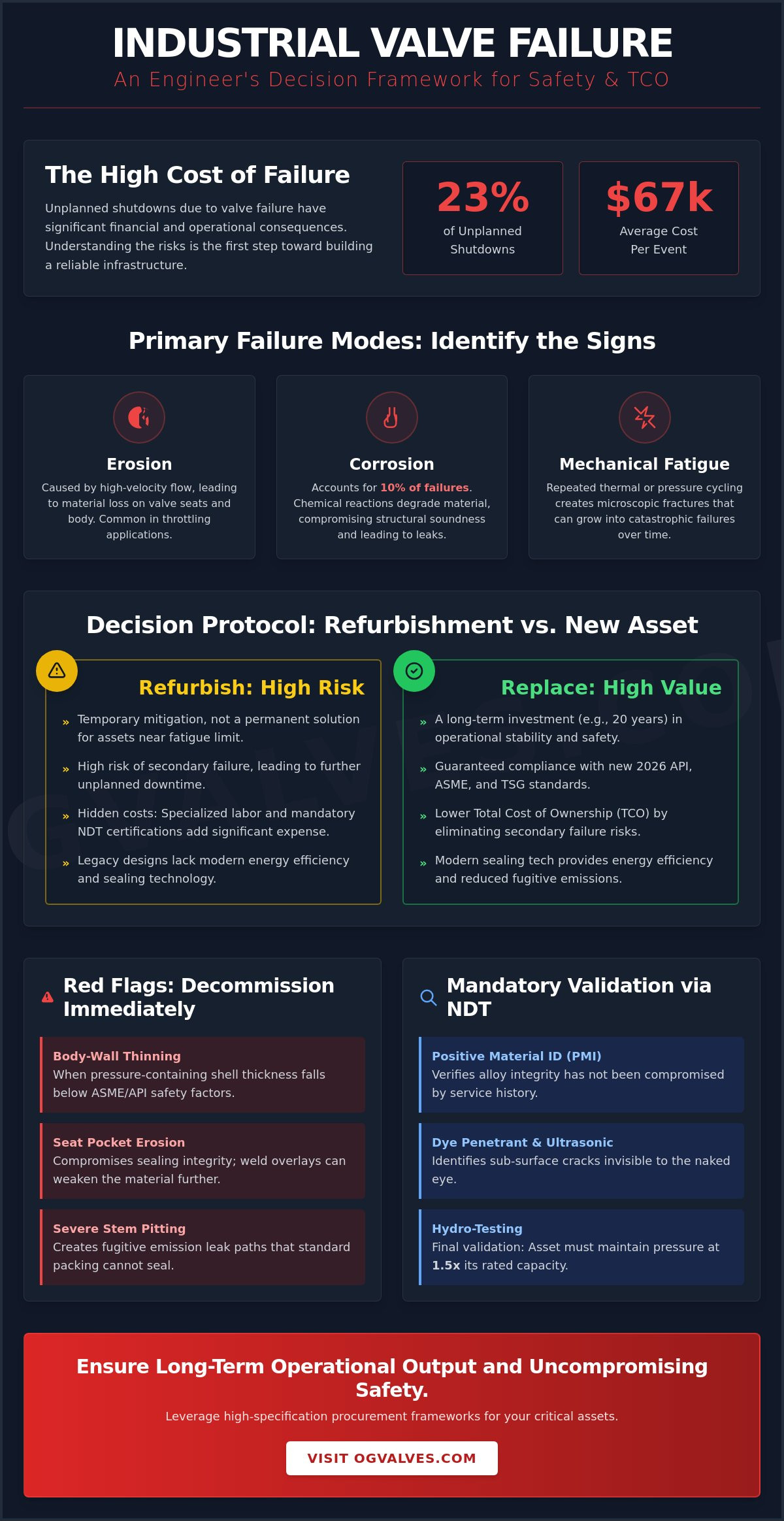
Industrial valve failures trigger 23% of unplanned manufacturing shutdowns, resulting in average costs of $67,000 per event when factoring in lost output and emergency parts. While the pressure to bypass long lead times often favors refurbishment, identifying the specific signs of industrial valve failure requires a rigorous technical evaluation of metallurgical fatigue. You understand that the secondary failure of a refurbished asset isn’t merely a financial setback; it’s a compromise of infrastructure integrity that risks non-compliance with 2026 safety mandates.
This analysis provides a clinical engineering framework to determine when valve refurbishment is a viable strategy and when replacement is mandatory for operational safety. We’ll examine how the 25th edition of API Specification 6D and the new TSG 92-2026 standards redefine the criteria for asset retirement. By establishing a quantifiable decision matrix, you can effectively minimize Total Cost of Ownership (TCO) and verify that every Gate, Ball, or Globe valve meets current international benchmarks. We’ll move from identifying failure modes to applying rigorous quality assurance protocols for your high-spec assets.
Key Takeaways
- Identify critical indicators and the signs of industrial valve failure that mandate immediate decommissioning to prevent catastrophic infrastructure loss.
- Quantify the Total Cost of Ownership (TCO) by calculating the hidden risks of secondary failure in refurbished assets versus the reliability of new, certified equipment.
- Evaluate facility adherence to the updated 2026 API and ASME standards, specifically regarding fugitive emission requirements for legacy valve infrastructure.
- Implement a strategic two-step decision protocol that assesses process criticality and metallurgical fatigue to determine the technical viability of refurbishment.
- Leverage high-specification procurement frameworks for Gate, Ball, and Butterfly valves to ensure long-term operational output and uncompromising safety.
Technical Criteria for Evaluating Industrial Valve Integrity
Visual inspection is a baseline protocol, but it often fails to identify the most critical signs of industrial valve failure in high-pressure environments. Surface-level examinations cannot detect sub-surface metallurgical fatigue or stress corrosion cracking. These internal defects represent a significant liability for heavy industrial sectors where operational safety is paramount. Relying solely on external condition ignores the reality of internal wear that occurs during standard operational cycles.
Primary failure modes include erosion, corrosion, and mechanical fatigue. Erosion typically occurs in high-velocity flow environments, leading to material loss on the valve seat or body. Corrosion, which accounts for 10% of valve failures according to 2026 industry statistics, can compromise structural soundness. Mechanical fatigue results from repeated thermal or pressure cycling, creating microscopic fractures that eventually lead to catastrophic failure. The service history of an asset dictates its remaining life; a valve that’s been subjected to frequent cycling or corrosive media requires a more clinical assessment than one in a stable environment.
Body-wall thinning and seat pocket erosion are often non-repairable. When the pressure-containing shell loses its specified thickness, it no longer complies with ASME or API safety factors. Attempting to weld-overlay these areas often introduces heat-affected zones that further weaken the material. If the structural integrity of the body is compromised, the asset must be decommissioned to ensure regulatory adherence.
Assessment of Gate and Globe Valve Internal Wear
Evaluating internal components requires precision. In industrial gate valves, wedge and seat alignment must be verified to ensure a bubble-tight seal. Stem pitting is another critical indicator; it compromises the packing seal integrity and leads to fugitive emissions. When seat-ring replacement costs approach the price of a new asset, the decision to replace becomes economically and technically logical. Stem pitting specifically creates leak paths that standard packing cannot seal, necessitating a complete stem replacement or new unit.
Non-Destructive Testing (NDT) in Decision Making
NDT provides the data necessary for a definitive engineering analysis. Positive Material Identification (PMI) verifies that the alloy integrity hasn’t been compromised by service history. Dye penetrant and ultrasonic testing identify sub-surface cracks that are invisible to the eye. For a complex control valve or high-spec asset, hydro-testing is the final validation. If a refurbished valve fails to maintain pressure under 1.5 times its rated capacity, it’s unfit for service. These rigorous testing protocols ensure that the decision between repair and replacement is based on quantifiable data rather than visual assumptions.
Financial Analysis: Repair Costs vs. Total Cost of Ownership
Economic viability in valve maintenance is determined by the total lifecycle expenditure rather than the initial repair quote. While refurbishment might appear to be a cost-saving measure, it frequently ignores the high cost of specialized labor and the mandatory certification of internal components. When analyzing the signs of industrial valve failure, procurement officers must account for the high probability of a secondary failure in an aged asset. If a valve has already reached its fatigue limit, any repair is merely a temporary mitigation of an inevitable system breach. The cumulative cost of Non-Destructive Testing (NDT) certification, including ultrasonic and dye penetrant testing, adds a significant premium to the repair invoice that many facilities fail to forecast.
Adherence to Process Safety Management standards requires that all pressure-containing equipment maintains its rated integrity throughout its service life. A new valve represents a 20-year investment in operational stability. Modern sealing technologies provide energy efficiency gains that refurbished legacy designs cannot match. These gains are realized through reduced fugitive emissions and lower actuation torque requirements, which decrease the load on control systems and lower long-term utility costs. When these expenses are coupled with the risk of unplanned downtime, the financial argument for replacement becomes definitive.
The Economics of Ball Valve Replacement
Replacing a trunnion ball valve often proves more economical than attempting to resurface a degraded ball and seat interface. Soft-seated designs are particularly prone to rapid degradation once the primary seal is compromised. The cost of sourcing high-spec polymer inserts and performing the necessary machining often approaches the price of a new unit. For facilities prioritizing safety and performance, procuring new industrial assets from OG VALVES LTD. provides a guaranteed return on investment through verified material integrity and compliance with 2026 environmental mandates.
Hidden Costs of Refurbishment
Refurbishment introduces significant operational risks that are often absent from the initial maintenance budget. The logistical expense of transporting heavy assets to specialized shops, combined with the extended downtime required for precision machining, can exceed the cost of a fast-track replacement. Manufacturer guarantees on new assets offer a level of protection that 90-day repair warranties don’t provide. These factors contribute to a Total Cost of Ownership (TCO) that favors the acquisition of new, certified hardware over the continued maintenance of obsolete infrastructure. Assets from OG VALVES LTD. are supplied with full material traceability, ensuring that the investment is protected by comprehensive engineering data.
Regulatory Compliance and Engineering Standards (2026)
The regulatory landscape for pressure-containing equipment is undergoing a significant transition in 2026. While legacy assets may still function according to their original design, they often fail to meet the enhanced safety and environmental criteria mandated by recent updates. One of the clearest signs of industrial valve failure in a regulatory context is the inability of a refurbished unit to pass modern fugitive emission testing. Packing systems designed a decade ago rarely comply with the 2026 EPA standards or the new international ISO requirements for low-leakage performance. If an asset cannot meet these benchmarks, it’s technically obsolete regardless of its mechanical state.
Operating non-compliant infrastructure in high-risk sectors creates substantial legal liability. Procurement specialists must prioritize material traceability through comprehensive Mill Test Reports (MTRs). These documents provide the necessary verification of chemical composition and mechanical properties that refurbished assets frequently lack. Without a verifiable paper trail, an asset cannot be certified as safe for high-pressure or hazardous chemical service under 2026 oversight frameworks. The enforcement of the new TSG 92-2026 code further emphasizes that safety accessories must meet current technical specifications to remain in service.
API 600 and ASME B16.34 Compliance
Modern revisions to API 600 have introduced stricter requirements for gate valve wall thickness to account for long-term corrosion allowances. Aged materials often suffer from pressure-temperature rating downgrades that aren’t visible during a standard refurbishment. Adherence to ASME requirements ensures that the pressure-containing shell maintains its integrity under extreme thermal cycling. Meeting API 607 fire-safe standards is now a mandatory baseline for butterfly valves used in hydrocarbon processing. Refurbishing an older butterfly valve often fails to restore the specific sealing geometry required to pass these rigorous fire-safety tests.
Certification Requirements for Critical Service
The integration of automation adds another layer of regulatory complexity. Safety Integrity Level (SIL) ratings for automated valve assemblies are based on the statistical probability of failure on demand. Attempting to repair an actuator often voids its original safety certification because the internal spring rates or torque outputs can no longer be guaranteed to match the manufacturer’s original data. For new installations, compliance with the Pressure Equipment Directive (PED) and the 2026 PHMSA adoption of API Spec 6D is essential. These standards mandate that every component in the assembly, from the body to the control system, meets the highest benchmarks for operational reliability.
Strategic Selection: A Replacement Decision Protocol
Technical decision-making must transition from reactive maintenance to a structured protocol. This clinical approach ensures that the signs of industrial valve failure are addressed before they result in catastrophic downtime or regulatory non-compliance. Engineers should utilize a five-step evaluation matrix to determine the most technically sound path forward for each asset. This protocol prioritizes infrastructure integrity over short-term budgetary convenience.
- Step 1: Process Criticality. Define the valve’s impact on the overall process flow. Assets located in high-pressure or hazardous chemical lines require a lower threshold for replacement due to the high stakes of secondary failure.
- Step 2: Metallurgical Assessment. Evaluate the pressure-containing shell and internal components for fatigue, body-wall thinning, or stress corrosion cracking. Surface wear is often repairable, but structural degradation is not.
- Step 3: Lead Time Comparison. Compare the projected duration of complex machining and NDT certification against the delivery schedules of fast-track procurement. In many cases, the downtime cost of a long repair exceeds the price of a new asset.
- Step 4: Compliance Verification. Ensure the asset meets current 2026 environmental and safety standards. If a refurbished unit cannot be certified to meet 2026 fugitive emission mandates, it must be replaced.
- Step 5: Procurement Execution. If the total cost of repair, including labor, parts, and certification, exceeds 60% of the procurement cost for a new unit, replacement is the mandatory engineering choice.
Managing Lead Times for Critical Check Valves
Emergency shutdowns demand rapid asset recovery. When signs of industrial valve failure appear in check valves, the risk of backflow can compromise entire pumping systems. Utilizing fast-track supply chains allows facilities to source high-spec replacements without the delays typically associated with custom manufacturing. Stockpiling critical spares for high-wear applications remains a valid strategy, but for unexpected failures, a dependable global procurement partner is essential for reducing unplanned downtime.
Standardisation as a Replacement Driver
Modernising a facility provides an opportunity for SKU rationalisation. Replacing diverse legacy assets with a unified fleet of modern industrial valves simplifies long-term maintenance and reduces inventory carrying costs. Obsolete designs often lack the precision and material traceability of current API-certified hardware. By standardising on a single high-performance design, procurement specialists can ensure consistent operational output and simplified training for maintenance personnel. To secure your infrastructure with certified, high-specification assets, view the OG VALVES LTD. inventory of API and ASME compliant solutions.
OG VALVES LTD.: Precision Supply for Industrial Asset Replacement
Once the decision framework confirms that an asset is no longer technically viable, the priority shifts to high-specification procurement that eliminates engineering risk. OG VALVES LTD. operates as a specialized technical partner for heavy industrial sectors, focusing on the supply of Gate, Ball, and Butterfly valves that exceed standard performance benchmarks. When the signs of industrial valve failure indicate metallurgical fatigue or non-compliance with 2026 safety standards, facilities require more than a vendor; they need a partner capable of verifying material integrity and ensuring long-term operational output. Our inventory is strictly composed of API and ASME certified components, specifically selected for their durability in high-pressure and high-temperature process flows.
Material selection is the foundation of our procurement strategy. For corrosive environments or extreme thermal applications, OG VALVES LTD. provides clinical expertise in identifying the optimal alloy classifications to prevent premature degradation. This specialized approach ensures that the replacement asset is not merely a functional equivalent of the legacy valve, but an upgrade designed for the practicalities of modern industrial service. By anchoring our supply chain in rigorous testing and global quality control processes, we act as a dependable benchmark for industrial safety and engineering excellence in the manufacturing sector.
Technical Support and Material Verification
Engineering precision at OG VALVES LTD. is supported by comprehensive documentation and 100% material traceability. We provide Mill Test Reports (MTRs) for every asset, ensuring that procurement specialists and technical experts have verifiable data on chemical composition and mechanical properties. This documentation is critical for maintaining regulatory adherence and building high-stakes trust in critical infrastructure projects. We assist in upgrading legacy specifications to meet the 2026 standards discussed previously, ensuring that every valve provided is capable of passing the most stringent fugitive emission and fire-safe tests.
Fast-Track Procurement Solutions
Lead times are a critical variable in the replacement decision protocol. OG VALVES LTD. leverages a global supply network to provide fast-track delivery options, bypassing traditional manufacturing bottlenecks that often lead to extended unplanned downtime. By identifying the signs of industrial valve failure early, facilities can utilize our rapid logistics capabilities to replace assets before a catastrophic breach occurs. This proactive procurement model ensures operational continuity and maintains the structural soundness of the overall system through the steady supply of certified industrial assets.
Consult with OG VALVES LTD. for technical specifications and fast-track quotes to secure your facility with precision-engineered valve solutions.
Optimising Infrastructure Integrity Through Strategic Asset Replacement
Technical experts must prioritize structural soundness and regulatory adherence over the perceived economy of refurbishment. Identifying the clinical signs of industrial valve failure serves as the primary trigger for a data-driven replacement protocol. The 2026 benchmarks for fugitive emissions and metallurgical integrity leave no room for the ambiguity inherent in repaired legacy assets. It’s essential to move beyond visual inspections to a clinical engineering analysis to protect your facility from the high costs of secondary failure and unplanned downtime.
Securing your infrastructure with API and ASME compliant hardware ensures operational output remains steady under extreme conditions. Our global logistics network and commitment to 100% material traceability provide a dependable path for rapid asset replacement. Request a Technical Quote for Industrial Valve Replacement to leverage our fast-track delivery expertise and comprehensive MTR documentation. You can confidently maintain the highest safety standards across your entire process flow.
Frequently Asked Questions
What is the typical cost threshold for repairing vs replacing a valve?
The established industry benchmark for valve replacement is reached when the total cost of repair exceeds 60% of the procurement price for a new asset. This calculation must include labor, specialized machining, NDT certification, and the cost of replacement internal components. For critical infrastructure, the risk of secondary failure often lowers this threshold, as the financial impact of a second unplanned shutdown outweighs any marginal savings from refurbishment.
Can a repaired valve meet the same safety certifications as a new one?
Repaired valves frequently struggle to meet the same safety certifications as new equipment, particularly when standards evolve. While a refurbished unit may meet its original manufacturing specifications, it often fails to comply with the 2026 revisions of API Spec 6D or the latest ISO safety requirements. New assets provide full material traceability and manufacturer guarantees that refurbished units cannot replicate, ensuring compliance with current global safety benchmarks.
How do fugitive emission standards in 2026 impact the repair decision?
Stricter 2026 fugitive emission regulations mandate lower leakage rates that legacy packing systems and refurbished seals often cannot achieve. Refurbishing an older valve body with modern packing doesn’t always guarantee compliance if the stuffing box or stem has suffered even minor metallurgical degradation. Replacement is often the only technically sound method to ensure a facility meets the updated EPA and ISO environmental performance standards for low-leakage operations.
What are the risks of using refurbished valves in high-pressure steam service?
High-pressure steam service subjects valves to extreme thermal cycling and pressure stresses that accelerate metallurgical fatigue. Refurbished valves may contain microscopic sub-surface cracks or wall thinning that visual inspections miss, leading to catastrophic shell failure. These signs of industrial valve failure are particularly dangerous in steam applications where structural integrity is the primary defense against hazardous energy releases and infrastructure damage.
How can I reduce the lead time for specialised alloy replacement valves?
Reducing lead times for specialized alloys requires utilizing global fast-track procurement networks that bypass traditional manufacturing bottlenecks. Procurement specialists should focus on suppliers with established inventory of API-certified assets in high-spec materials like Duplex or Inconel. Standardizing valve specifications across a facility also allows for more efficient stockpiling of critical spares, ensuring that replacement assets are available immediately when technical indicators mandate decommissioning.
Does repairing a valve actuator void its safety integrity level (SIL) rating?
Repairing an actuator often voids its original SIL rating because the repair process alters the statistical probability of failure data. Safety Integrity Level certifications are based on rigorous testing of specific OEM components and spring rates. Utilizing non-OEM parts or unauthorized machining during a repair compromises the assembly’s reliability data, making it impossible to guarantee the SIL rating required for automated safety instrumented systems (SIS).
What NDT methods are mandatory before deciding to repair an industrial valve?
Mandatory Non-Destructive Testing (NDT) includes Positive Material Identification (PMI), Ultrasonic Testing (UT), and Dye Penetrant (DP) inspection. These methods are essential for detecting the hidden signs of industrial valve failure, such as intergranular corrosion or stress cracks within the valve body. Without these quantifiable data points, an engineering decision to repair is based on incomplete information, which introduces significant risk to the pressure-containing shell’s integrity.
How does material fatigue affect the lifespan of a refurbished gate valve?
Material fatigue creates microscopic structural degradation that limits the secondary lifecycle of a refurbished gate valve. While the seating surfaces can be lapped or replaced, the valve body itself retains the cumulative stress of its previous service history. This fatigue reduces the asset’s ability to withstand future pressure surges or thermal shocks, often resulting in a significantly shorter operational lifespan compared to a new, certified asset with zero service hours.
 Responsive Menu