Sourcing Replacements for Obsolete Industrial Valves: A Technical Procurement Guide
May 02, 2026
Home+Sourcing Replacements for Obsolete Industrial Valves: A Technical Procurement Guide
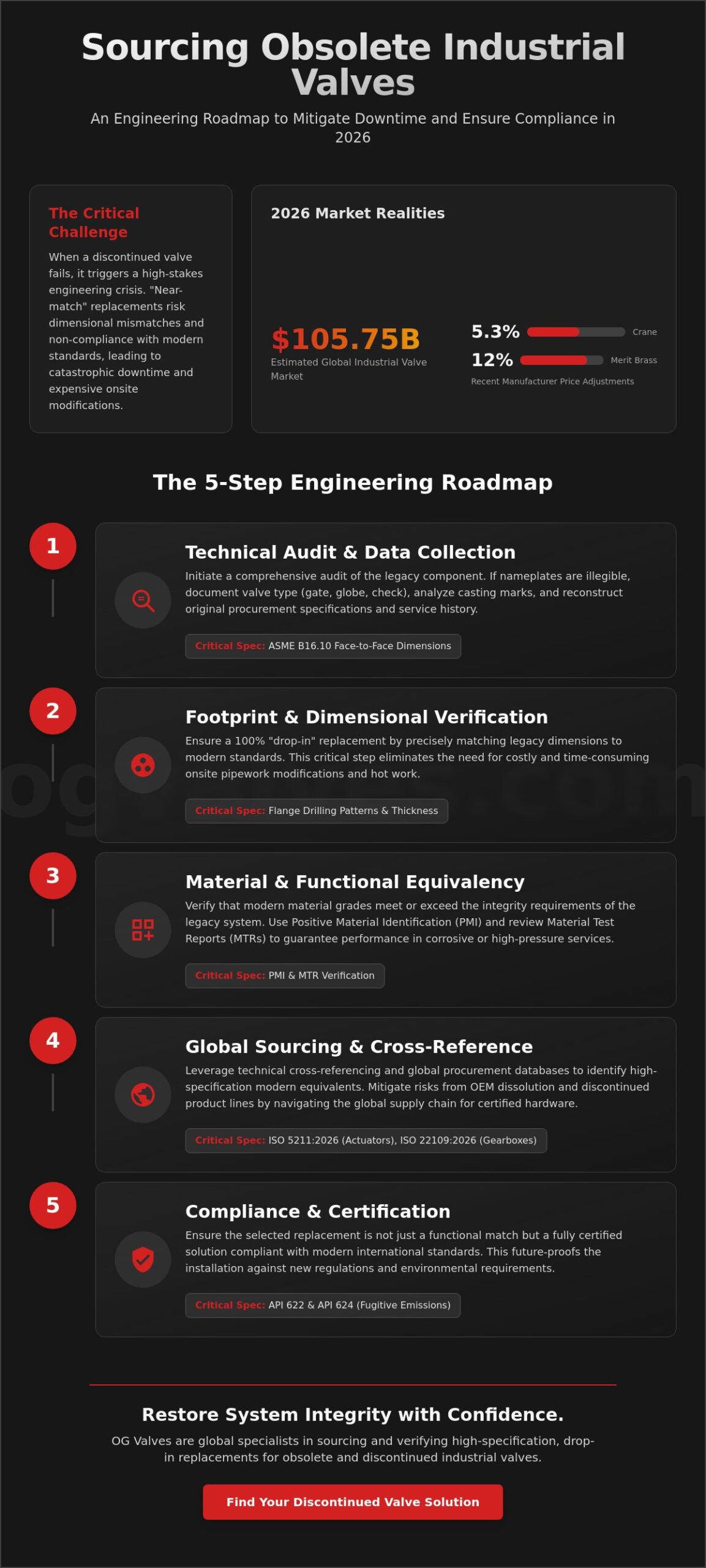
The global industrial valve market is estimated to reach $105.75 billion in 2026, yet procurement specialists still face catastrophic downtime when a single discontinued component fails. You’ve likely experienced the technical strain of dimensional mismatches or the compliance risks associated with “near-match” alternatives that ignore new 2026 standards like ISO 5210 or ISO 5211. Sourcing replacement for obsolete industrial valves is not a simple procurement task; it’s a rigorous engineering challenge where any deviation in material integrity or footprint precision necessitates expensive onsite modifications.
This technical guide outlines the methodologies required to identify and verify high-specification replacements that meet or exceed original API and ASME requirements. You’ll learn how to navigate a volatile market where manufacturers like Crane have implemented 5.3% price adjustments as of April 2026, while ensuring your new hardware functions as a certified, drop-in solution. We’ll analyze the protocols for matching original footprints, selecting specific material grades for cryogenic or high-pressure service, and utilizing the latest ISO 22109:2026 gearbox specifications to restore system integrity with minimal lead times.
Key Takeaways
Identify critical dimensional data points, such as ASME B16.10 face-to-face measurements, to ensure a drop-in footprint match that eliminates the need for onsite pipework modifications.
Execute a structured 5-step engineering roadmap for sourcing replacement for obsolete industrial valves, bridging the gap between legacy specifications and modern high-performance equivalents.
Utilize Positive Material Identification (PMI) and rigorous functional equivalency analysis to verify that modern material grades meet the integrity requirements of corrosive or high-pressure services.
Mitigate the operational risks of OEM dissolution and discontinued product lines by leveraging technical cross-referencing and global procurement databases.
Minimize procurement lead times for discontinued gate, globe, and check valves by conducting comprehensive technical audits of legacy service conditions and flange drilling patterns.
The Challenge of Obsolete Industrial Valve Procurement in 2026
Procurement of industrial valves in April 2026 faces a critical bottleneck caused by the rapid obsolescence of heritage infrastructure. Obsolescence isn’t merely a logistical delay; it’s a technical state where the Original Equipment Manufacturer (OEM) no longer supports a product line due to dissolution, acquisition, or shifting production priorities. For engineers in the oil and gas or water treatment sectors, this creates a high-stakes gap. Standard distribution channels prioritize high-volume, current-production units, often leaving legacy systems without viable spares. When a discontinued component fails, the absence of an immediate match forces a choice between an unverified “near-match” or a total system redesign.
The operational risks of forced redesigns are substantial. Modifying existing pipework to accommodate modern dimensions requires hot work, updated stress analysis, and extended downtime. Sourcing replacement for obsolete industrial valves requires a clinical focus on dimensional and material integrity to avoid these expensive onsite modifications. As of April 2026, the intersection of modern safety compliance and legacy hardware dimensions has become more complex. New standards like ISO 5211:2026 for part-turn actuators and ISO 22109:2026 for gearboxes mean that even if a valve body is found, its automation interface might be fundamentally incompatible with modern hardware without technical intervention.
Root Causes of Valve Discontinuation
Market consolidation remains a primary driver of obsolescence. When heritage manufacturers are absorbed by global conglomerates, low-margin legacy lines are frequently axed to streamline production. Additionally, advancements in material science have rendered older alloys, such as specific grades of cast iron or early forged steels, technically obsolete. Regulatory shifts regarding fugitive emissions, specifically API 622 and API 624, have also forced the discontinuation of older valve designs that cannot meet the rigorous sealing requirements demanded by modern environmental standards.
The Economic Impact of Improper Sourcing
Technical Identification and Footprint Matching Methodologies
Footprint matching is the alignment of legacy dimensions with modern ASME B16.10 standards. This technical process is fundamental to sourcing replacement for obsolete industrial valves, as it guarantees that the new hardware fits the existing flange-to-flange gap without requiring structural modifications. Without precise footprint verification, facilities face the high cost of piping adjustments and extended shutdowns. Initial identification typically begins with nameplate data and legacy P&IDs, but decades of environmental degradation often render these physical marks illegible. In such instances, engineers must follow the international standard for obsolescence management to systematically reconstruct the technical profile of the asset.
The identification process requires a methodical audit of the legacy valve’s service history and original procurement specifications. If the nameplate is missing, the procurement team must document the valve type, such as gate, globe, or check, and analyze the casting marks for clues regarding the original manufacturer and material grade. This data serves as the baseline for cross-referencing against modern equivalents in a global supply chain that frequently updates its product lines to meet 2026 standards.
Dimensional Verification Protocols
Verification begins with the precise measurement of the Face-to-Face (FTF) length. This dimension must strictly adhere to ASME B16.10 to ensure compatibility with existing spools. Flange ratings, ranging from Class 150 to Class 2500, require confirmation of the bolt circle diameter, the number of bolt holes, and the flange thickness. Discrepancies in these patterns prevent secure sealing and compromise the integrity of the pressure boundary. Additionally, the assessment of stem height and orientation is critical for existing actuator compatibility. If the top-work dimensions deviate from the legacy design, custom mounting kits or transition plates become necessary, which can significantly extend procurement lead times.
Reverse Engineering from Physical Assets
When documentation is entirely absent, reverse engineering via 3D scanning or manual precision measurement with calibrated calipers is required. This clinical approach allows for the recreation of the valve’s internal and external geometry, including port configurations and seating arrangements. Determining whether the original was a full bore or reduced bore design is essential for maintaining the system’s flow coefficients (Cv) and pressure drop calculations. Precise measurement of the bore diameter ensures that the replacement does not introduce unintended turbulence or cavitation risks. For specialists seeking technical assurance, consulting with a dependable partner in critical infrastructure provides the specific data points required for a successful drop-in replacement that meets modern performance benchmarks.
Material Specification and Functional Equivalency Analysis
Sourcing replacement for obsolete industrial valves requires a clinical focus on metallurgical integrity and functional parity. While a modern forging such as ASTM A105 is the standard equivalent for many legacy carbon steel grades, the specific chemical composition and mechanical properties must be strictly vetted against the original design basis. Procurement teams cannot assume that a modern “near-match” will perform identically under specific service conditions, particularly in high-temperature or high-pressure environments where creep and thermal fatigue are factors. The objective is to secure a component that maintains the pressure boundary integrity without introducing new failure modes into the system.
Metallurgical Verification and PMI Testing
Positive Material Identification (PMI) serves as the primary verification protocol when documentation for legacy assets is incomplete or unreliable. Utilizing X-ray fluorescence (XRF) technology allows technicians to identify the elemental composition of legacy castings without destructive testing. This process is critical for corrosive environments where minor deviations in chromium, nickel, or molybdenum content can lead to accelerated pitting or stress corrosion cracking. Engineers must cross-reference defunct material standards with current ASTM or ASME equivalents to ensure the replacement valve meets the rigorous demands of the application. Special attention is required for trim materials; for instance, ensuring that hard-facing like Stellite 6 is utilized where the original service required specific erosion resistance.
Pressure-Temperature Rating Alignment
Evaluating functional equivalency necessitates a detailed analysis of Pressure-Temperature (P-T) ratings as defined by ASME B16.34. Modern replacements must handle legacy process conditions without compromise, yet engineers must also account for the “over-spec” trap. This occurs when a modern valve, designed to meet higher pressure classes, is significantly heavier than the original unit. Such weight discrepancies can exceed the load-bearing capacity of legacy pipe supports, leading to structural strain. Verification of sealing technologies is equally vital. Transitioning from older packing materials to high-performance graphite or PTFE seals ensures the valve meets 2026 standards for fugitive emissions while maintaining performance in high-temperature service.
Upgrading legacy assets to modern industrial valves standards provides a strategic opportunity to enhance system longevity. Modern manufacturing processes yield higher material purity and more consistent wall thicknesses than the methods used 40 years ago. By conducting a thorough functional equivalency analysis, procurement specialists ensure that sourcing replacement for obsolete industrial valves results in a technically superior installation that adheres to the latest international safety benchmarks.
The 5-Step Roadmap for Sourcing Obsolete Valves
Execution of sourcing replacement for obsolete industrial valves requires a methodical, five-stage procurement protocol. This roadmap ensures that technical specifications are not compromised for the sake of availability, maintaining the integrity of critical infrastructure. The process moves from data acquisition to rigorous verification, ensuring a drop-in solution that adheres to modern safety benchmarks.
Step 1: Technical Audit – Procurement begins with the compilation of legacy data. This includes original manufacturer nameplates, P&IDs, and service conditions such as pressure, temperature, and media composition.
Step 2: Cross-Reference Search – Utilizing global databases, engineers identify modern equivalents that match the functional requirements. This stage accounts for 2026 market dynamics, where consolidation has shifted product availability.
Step 3: Engineering Modification – If a standard valve does not match legacy Face-to-Face (FTF) dimensions, engineers determine if modifications to the valve body or the fabrication of transition spools are necessary to ensure a precise fit.
Step 4: Quality Assurance – All documentation, including Material Test Reports (MTRs) and certification compliance, undergoes a clinical review to verify that the replacement meets the original design basis.
Step 5: Logistics and Installation Prep – Planning for fast-track delivery is essential to minimize downtime. This includes coordinating global supply chain assets to ensure the hardware arrives with all necessary installation gaskets and bolting.
Criteria for Selecting a Sourcing Partner
Selecting a partner requires evaluating technical expertise over simple brokerage capabilities. A qualified partner must demonstrate a deep understanding of gate valve and ball valve failure modes to anticipate how a modern replacement will interact with legacy systems. The requirement for global logistics reach and established connections for “fast-track” manufacturing is non-negotiable for critical service applications. This ensures that the procurement specialist acts as a dependable partner in infrastructure management rather than a mere vendor of hardware. For organizations facing immediate technical gaps, consulting an industrial valve specialist provides the necessary assurance of engineering excellence.
Verification of Certification and Compliance
All sourced replacements must carry EN 10204 3.1 or 3.2 certification to provide a transparent audit trail of material integrity. In sour gas applications, verifying NACE MR0175/ISO 15156 compliance is a clinical necessity to prevent sulfide stress cracking and ensure long-term performance. All sourced replacements must undergo rigorous hydrostatic and pneumatic testing per API 598 before site delivery. This final verification stage ensures that the replacement valve maintains the pressure boundary integrity and operational safety of the entire system without deviation from international standards.
OG Valves: Global Specialists in Discontinued Valve Solutions
OG Valves operates at the intersection of technical engineering and global procurement to resolve the critical challenges of legacy infrastructure. While many vendors offer simple refurbishment or “grey market” surplus, our methodology focuses on the high-specification sourcing of new, modern equivalents that adhere to current API and ASME benchmarks. We leverage an extensive global inventory of gate, globe, check valves, and butterfly valves to ensure that critical service operations remain online. Sourcing replacement for obsolete industrial valves through OG Valves involves a clinical verification of all technical parameters, from metallurgy to seat leakage rates, ensuring that every component functions as a certified drop-in solution.
Our technical support team provides precise cross-referencing for components where the original manufacturer has dissolved or discontinued specific product lines. We prioritize fast-track delivery capabilities to mitigate the high costs of industrial downtime, which often exceed the value of the hardware itself. Each procurement project follows a rigorous quality control protocol, including hydrostatic testing and material certification review, to maintain the integrity of high-stakes infrastructure in the oil, gas, and water treatment sectors. This methodical approach ensures that technical data is communicated without ambiguity, providing engineers with the assurance required for high-pressure applications.
Our Approach to Legacy Valve Challenges
Bridging the gap between defunct OEM specifications and modern manufacturing requires deep metallurgical knowledge and dimensional precision. We recently executed a project involving the replacement of large-diameter butterfly valves in a power generation facility where the original face-to-face dimensions were no longer industry standard. By engineering a solution that matched the legacy footprint while utilizing modern corrosion-resistant alloys, we eliminated the need for expensive piping modifications and hot work. Our commitment to zero-defect procurement ensures that every valve meets the exact service requirements of the application, regardless of the age of the original system design.
Secure Your Supply Chain Against Obsolescence
Proactive risk management is essential for facilities operating with aging hardware. OG Valves offers strategic stocking programs designed to secure critical legacy components before a failure occurs. We assist procurement specialists in the proactive identification of “at-risk” valves within their current inventory, providing a technical roadmap for phased replacement. This strategy minimizes lead times and prevents the emergency procurement of unverified stock that may lack proper Material Test Reports (MTRs). For complex technical enquiries, engineers have direct access to our specialists to discuss specific material grades, pressure-temperature ratings, and compliance with updated 2026 standards. Sourcing replacement for obsolete industrial valves is a matter of technical assurance and long-term performance, positioning OG Valves as a dependable partner in global industrial safety.
Securing Infrastructure Integrity through Technical Procurement
Effective obsolescence management requires a transition from reactive sourcing to rigorous engineering verification. We’ve established that footprint matching according to ASME B16.10 and Positive Material Identification are non-negotiable for maintaining pressure boundary integrity. Adherence to 2026 updates for ISO 5211 and ISO 22109 ensures that modern replacements integrate seamlessly with legacy automation systems. These protocols eliminate the dimensional mismatches that lead to expensive onsite modifications and technical non-compliance.
Sourcing replacement for obsolete industrial valves doesn’t have to result in extended facility downtime or the risk of unverified alternatives. By utilizing a structured 5-step roadmap, procurement specialists can verify material equivalents and functional parity before site delivery. OG Valves provides the technical expertise in API and ASME standards required to navigate these complex specifications. Our global fast-track delivery capabilities and comprehensive inventory of high-spec hardware ensure your critical systems remain operational. Restore your facility’s safety and performance benchmarks with a partner who understands the clinical necessity of engineering excellence.
What is the most critical dimension when replacing an obsolete valve?
The Face-to-Face (FTF) dimension, governed by ASME B16.10, is the most critical measurement for ensuring a drop-in replacement. This dimension determines if the valve fits within the existing pipe gap without necessitating structural modifications. Secondary measurements include the bolt circle diameter and the number of flange holes. These must align perfectly to maintain the integrity of the pressure boundary and prevent hazardous leaks in high-stakes environments.
Can a modern API 600 valve replace an older, discontinued gate valve?
A modern API 600 valve can replace a discontinued gate valve if the dimensional footprint and pressure-temperature ratings are verified. The API 600 standard defines heavy-wall thickness and robust construction suitable for oil and gas service. When sourcing replacement for obsolete industrial valves, engineers must ensure the modern stem height and top-work dimensions are compatible with existing automation hardware. This prevents the need for custom mounting kits.
What happens if the face-to-face dimension of the new valve does not match the old one?
A mismatch in the face-to-face dimension necessitates expensive onsite modifications, such as the fabrication of transition spools or the relocation of existing flanges. These adjustments require hot work, updated stress analysis, and extended system downtime. If the new valve is shorter than the legacy unit, spacer rings may be utilized; however, this introduces additional potential leak paths. Precision in initial measurement is the only way to ensure a zero-modification installation.
Is it better to refurbish an obsolete valve or source a replacement?
Sourcing a new replacement is technically superior to refurbishment for critical service applications. Modern valves are manufactured to meet 2026 fugitive emissions standards, such as API 622, which older designs often fail to achieve. While refurbishment might seem cost-effective initially, the long-term reliability and material integrity of a new, certified component provide better technical assurance. New valves also carry updated warranties and full material traceability via EN 10204 3.1 certification.
How do you verify the material of a valve when the documentation is lost?
Positive Material Identification (PMI) is the industry-standard method for verifying metallurgy when documentation is unavailable. Technicians use handheld X-ray fluorescence (XRF) analyzers to determine the elemental composition of the valve body and trim without damaging the asset. This process identifies specific alloy grades, such as 316 stainless steel or Chrome-Moly, ensuring that the replacement matches the original’s corrosion resistance and thermal properties. Accurate PMI testing is essential for maintaining safety.
What certifications should I demand for an obsolete valve replacement?
Procurement specialists must demand EN 10204 3.1 or 3.2 material certificates and API 598 pressure test reports for every replacement. For sour gas service, NACE MR0175/ISO 15156 compliance is mandatory to prevent sulfide stress cracking. Additionally, verify that the valve meets the latest 2026 standards for its specific type, such as ISO 5211 for actuator interfaces. These certifications provide a transparent audit trail and confirm the hardware meets international safety benchmarks.
Does OG Valves provide custom-fabricated valves to match legacy footprints?
OG Valves provides technical modifications and bespoke sourcing to ensure modern hardware matches legacy footprints. We specialize in sourcing replacement for obsolete industrial valves by leveraging a global supply chain to find or adapt valves that meet non-standard dimensions. Our team provides engineering support to modify face-to-face lengths or flange drilling patterns as required. This approach ensures that even difficult-to-find components are replaced with high-specification, certified hardware that fits your existing infrastructure.
 Responsive Menu