Swing vs Lift Check Valve: A Technical Comparison for Industrial Applications
March 28, 2026
Home+Swing vs Lift Check Valve: A Technical Comparison for Industrial Applications
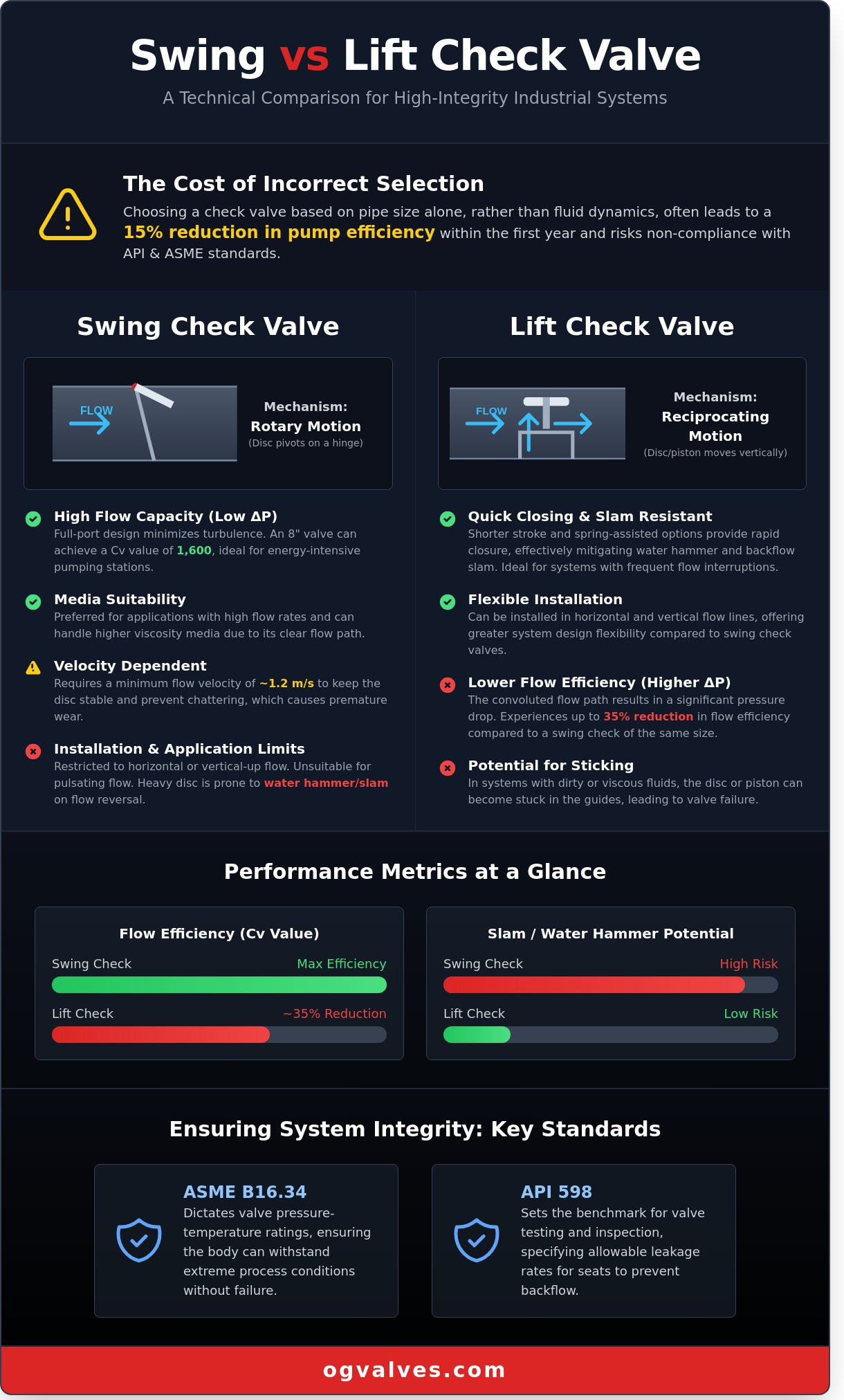
Selecting a check valve based solely on nominal pipe size rather than specific fluid dynamics often leads to a 15% reduction in pump efficiency within the first 12 months of operation. You recognize that in high-pressure infrastructure, the technical distinction of a **swing vs lift check valve** is a critical factor for maintaining system integrity and avoiding unplanned downtime. Improper valve orientation or incorrect spring tensioning frequently results in non-compliance with ASME B16.34 standards; this leads to seat leakage that exceeds API 598 allowable limits during routine testing.
This article provides a clinical analysis of the mechanical differences, performance metrics, and rigorous selection criteria required for heavy industrial applications. We’ll examine how disc geometry directly influences Delta P calculations and evaluate the durability of forged steel components under high-velocity flow conditions. You’ll find the specific engineering data necessary to prevent backflow-related damage and ensure your system meets international safety specifications. This technical breakdown serves as a definitive guide for procurement specialists and engineers who prioritize long-term reliability over short-term cost savings.
Key Takeaways
Identify how self-actuated check valves maintain unidirectional flow integrity to protect critical infrastructure like high-value pumps and compressors.
Analyze the mechanical dynamics of hinge pin and disc configurations to determine the specific fluid velocity requirements for maintaining an open valve position.
Evaluate the technical performance metrics of the swing vs lift check valve to select the optimal architecture for high-pressure industrial systems.
Compare pressure drop profiles and seating material options to ensure long-term sealing performance and operational efficiency in rigorous environments.
Integrate material traceability and Material Test Reports (MTRs) into procurement strategies to minimize life-cycle costs and ensure adherence to ASME and API standards.
Fundamental Mechanisms of Industrial Check Valves
Industrial piping systems rely on check valves as primary, self-actuated safety components designed to maintain unidirectional flow. These valves operate without external actuation, relying entirely on the kinetic energy and pressure differentials of the process media. The selection between a swing vs lift check valve depends on the specific mechanical requirements of the application, particularly when protecting high-value assets like 500 HP centrifugal pumps or reciprocating compressors from the catastrophic effects of backflow. Engineers distinguish the swing vs lift check valve based on the internal closure movement. Lift check valves employ a reciprocating motion where a disc or piston moves vertically from the seat, whereas swing check valves utilize a rotary motion around a fixed hinge pin.
Operational efficiency in 2026 requires a clinical focus on cracking pressure to ensure system stability. This variable influences how a valve responds to low-flow conditions and dictates the pressure drop across the component. If the upstream pressure isn’t sufficient to maintain the disc in the open position, the valve will chatter, leading to premature wear of the seating surfaces and potential mechanical failure of the hinge or guides.
The Engineering Purpose of Non-Return Valves
Non-return valves serve as the first line of defense against reverse flow in critical infrastructure. They mitigate pressure surges that lead to pipe bursts and prevent system contamination in multi-stream processes. Proper sizing ensures the valve remains fully open during normal operation to minimize energy loss. Cracking pressure is the minimum upstream pressure required to unseat the disc and initiate flow. It’s a vital metric for engineers designing low-pressure fluid transport systems where every PSI of head loss impacts the bottom line.
Regulatory Frameworks for Valve Design
Industrial integrity depends on strict adherence to international standards that govern material thickness and pressure containment. ASME B16.34 dictates the pressure-temperature ratings for valve bodies, ensuring they withstand the extreme conditions of petrochemical processing. API 598 serves as the benchmark for leakage testing protocols, specifying the allowable leakage rates for both high-pressure and low-pressure closures. Compliance with these frameworks is mandatory for operations in the oil and gas sectors. A single valve failure in these environments results in millions of dollars in downtime or environmental remediation. Standardized testing ensures that forged steel and cast iron components meet the rigorous safety benchmarks required for global supply chain acceptance.
Mechanical Analysis of the Swing Check Valve
The swing check valve utilizes a disc suspended from a hinge pin to control unidirectional flow. When fluid pressure exceeds the cracking pressure, the disc pivots away from the inclined seat. This creates a clear path for the media. It’s a design that relies on flow velocity and gravity. In a swing vs lift check valve comparison, the swing variant is preferred for systems where maintaining high flow rates is the priority. If the fluid velocity isn’t maintained at a minimum of 1.2 meters per second, the disc won’t remain stable. This leads to seat chattering and mechanical fatigue. Engineers don’t recommend these for pulsating flow applications.
Flow Efficiency and Pressure Loss
Swing check valves provide the highest flow capacity among standard non-return valves. Their full-port design ensures the disc stays out of the flow stream, minimizing turbulence. This results in a low Delta P (differential pressure). For example, a standard 8-inch swing check valve can achieve a Cv value of 1,600. In contrast, lift check valves of the same size often see a 35% reduction in flow efficiency due to the convoluted path the fluid must take. This makes the swing design essential for energy-intensive pumping stations where head loss directly impacts operational costs.
Installation and Maintenance Constraints
When evaluating a swing vs lift check valve for high-viscosity media, orientation and mechanical wear become primary factors. These valves are restricted to horizontal or vertical-up positions. Vertical-down installation prevents the disc from reaching the seat via gravity, rendering the valve useless. Maintenance focus centers on the following technical points:
Hinge Pin Integrity: The hinge pin and bushings are susceptible to erosion. A 0.5mm deviation in the pin can cause the disc to strike the seat at an angle, ruining the metal-to-metal seal.
Slam Mitigation: The heavy disc can slam during sudden pump shutdowns. To mitigate this, engineers specify valves with external counterweights or hydraulic dashpots. In high-velocity systems where disc inertia poses a surge risk, specifying a non-slam check valve with spring-assisted closure ensures the disc reaches the seat before flow reversal occurs.
Seat Alignment: Stellite-faced seats are often required in high-pressure steam to prevent wire-drawing and ensure long-term integrity.
Standardization under API 594 and ASME B16.34 ensures these components meet rigorous safety thresholds. For specific project requirements, you can access our engineering data sheets to verify material compatibility and pressure-temperature ratings. High-velocity gas systems often reveal the limitations of this design. The disc’s inertia makes it slow to react to backflow, which increases the risk of surge-related pipe failure in systems operating above 15 bar.
Operational Profile of the Lift Check Valve
The lift check valve utilizes a globe-style body architecture where a guided piston or disc travels in a reciprocating motion perpendicular to the pipe axis. This internal design relies on fluid velocity to lift the seating element off the seat ring. Unlike the swing vs lift check valve comparison where the swing disc rotates on a hinge, the lift disc moves vertically along a central guide. This movement is often assisted by a heavy-duty 316 stainless steel spring to ensure rapid closure and prevent backflow. The internal geometry forces the media through a tortuous flow path, resulting in a pressure drop that is often 2 to 3 times higher than that of a swing check valve. This makes the design ideal for high-pressure systems where flow resistance is a secondary concern to sealing performance.
Internal Geometry: Globe-pattern body with integrated guides for the piston or disc.
Closing Mechanism: Gravity-dependent or spring-assisted reciprocating action.
Flow Characteristics: High turbulence and significant pressure loss across the valve orifice.
Sealing Integrity and High-Pressure Performance
Lift check valves are the standard choice for steam, high-pressure air, and gas services where leak prevention is paramount. The guide pin ensures the disc maintains a precise alignment with the seat, typically within a 0.002-inch tolerance. This precision prevents the seat from uneven wear under ASME Class 1500 or Class 2500 conditions. It’s the most reliable configuration for high-temperature applications exceeding 450°C. In these environments, backpressure reinforces the seal by pressing the disc firmly into the seat, providing a tighter shutoff than a hinged swing mechanism can achieve.
Suitability for Vertical Installations
Spring-loaded lift checks provide a distinct mechanical advantage in vertical pipelines where gravity would otherwise cause a swing valve to hang open. Piston-type variants are preferred for gas and steam, while ball-type lift checks are used for viscous liquids. These valves don’t tolerate media with high particulate counts or solids larger than 100 microns. Debris often lodges in the guide assembly, causing the valve to stick or fail. For systems with 98% or higher fluid purity, the lift check offers a compact and durable solution for vertical flow orientations. When evaluating the swing vs lift check valve for vertical lines, the spring-assisted lift design is the only choice that ensures a positive seal when flow stops.
Swing vs Lift Check Valve: Technical Comparison
Engineering teams must evaluate the fundamental architectural differences between these two designs. A swing vs lift check valve selection often hinges on the permissible pressure drop and the installation orientation. Selection isn’t just about cost; it’s about system longevity. While both prevent backflow, their internal geometries dictate how they react to fluid dynamics and mechanical stress over time.
Hydraulic Performance Comparison
Lift check valves utilize a globe-style body. This forces media through a 90-degree turn, creating high flow resistance. The pressure loss in a lift check is typically 2.8 times higher than a swing check of equivalent size. This resistance is a byproduct of the tortuous flow path required to move the poppet or piston vertically.
Swing check valves require a minimum flow velocity of 3.5 feet per second to ensure the disc remains fully open. Below this threshold, the disc oscillates. This chatter leads to premature pin wear and hinge failure. In pipelines exceeding 12 inches in diameter, the risk of water hammer increases. Closing times for swing discs are slower, allowing backflow velocity to peak before closure occurs. This results in a high-impact “slam” that can damage seat integrity and surrounding pipe supports. Engineers managing large-diameter pipelines should evaluate non-slam check valve technology to eliminate these pressure surges and protect high-value infrastructure from surge-induced joint failure.
ASME B16.10 Compliance: Face-to-face dimensions for lift checks are often more compact in sizes under 2 inches.
Sealing: Metal-to-metal seats, often Stellite 6 overlays, provide durability in 425°C environments.
Resilient Options: Viton or PTFE inserts ensure zero-leakage performance in gas applications but fail at temperatures exceeding 200°C.
Application-Specific Selection Criteria
Steam systems favor lift check valves. Their piston or poppet design handles the rapid cycling and thermal expansion inherent in high-pressure steam headers. The gravity-assisted closure in vertical lines ensures a tighter seal compared to swing designs, which may hang partially open if the flow is insufficient to seat the disc.
Liquid hydrocarbon transport utilizes swing check valves to maximize throughput. The straight-through flow path minimizes turbulence. This is critical for maintaining laminar flow in crude oil pipelines where pumping costs are tied directly to pressure recovery. For cryogenic services reaching -196°C, we specify ASTM A351 CF8M stainless steel to maintain material toughness and prevent brittle fracture under thermal shock.
Procurement excellence in heavy industry requires a transition from initial capital expenditure focus to total system life-cycle cost analysis. Forged steel valves often represent only 15% of the total cost of ownership over a 20-year operational span. It’s essential that engineers evaluate the swing vs lift check valve selection based on Mean Time Between Failure (MTBF) and the specific maintenance intervals required by API 570 inspection codes.
OG VALVES LTD. mandates 100% material traceability. Every component is backed by Material Test Reports (MTRs) compliant with EN 10204 3.1 standards. This rigorous documentation ensures that the metallurgical composition aligns with ASME B16.34 specifications. It prevents premature mechanical failure in high-pressure environments by verifying that chemical and mechanical properties meet the design intent.
Material Integrity for Corrosive Environments
Selecting between ASTM A105 forged carbon steel and 316L stainless steel depends on the fluid’s chloride concentration and pH levels. In sour gas applications, compliance with NACE MR0175/ISO 15156 is mandatory to prevent sulfide stress cracking. OG VALVES LTD. doesn’t compromise on safety; we utilize Positive Material Identification (PMI) testing on high-alloy valve orders to verify chemical integrity before dispatch.
Optimizing Lead Times for Global Projects
Project schedules often depend on the availability of long-lead items. OG VALVES LTD. maintains a strategic inventory of standard API 602 and API 594 valves to support a 98% on-time delivery rate for fast-track infrastructure projects. Our technical team provides 24-hour turnaround on custom testing specifications, including high-pressure gas testing or cryogenic validation at -196°C.
Final Engineering Checklist for Procurement:
Pressure Class: Verification of ASME Class 150 through Class 2500 ratings.
Temperature Range: Confirmation of seal material stability for the specific thermal profile.
Media Analysis: Assessment of viscosity and abrasive particulate content.
Orientation: Determining if the swing vs lift check valve design matches the intended horizontal or vertical up-flow piping layout.
Precision in procurement eliminates the risk of catastrophic system failure. By adhering to these technical benchmarks, specialists ensure long-term operational safety and regulatory compliance. OG VALVES LTD. remains a dependable partner in critical infrastructure, providing the engineering excellence required for high-stakes industrial applications.
Optimizing Pipeline Integrity through Precise Valve Selection
Selecting the correct check valve architecture is a critical requirement for maintaining system integrity and preventing backflow-induced failures. The technical decision in the swing vs lift check valve comparison depends on specific flow dynamics and piping orientation. Swing check valves provide a full-port flow path ideal for low-velocity systems. Lift check valves offer superior sealing performance in high-pressure steam or air applications where vertical orientation is common. It’s vital that engineering specifications align with ASME B16.34 and API 6D standards to ensure long-term operational safety in high-stakes environments.
OG VALVES LTD maintains a comprehensive inventory of ASME and API compliant valves to support critical infrastructure projects. Our team provides specialist technical support to ensure your specifications meet the rigorous demands of heavy industry. We utilize a centralized distribution hub to facilitate fast-track global logistics, reducing lead times for time-sensitive installations. Our 100% inspection protocol ensures every unit meets the highest quality benchmarks before dispatch. Rely on our engineering expertise to secure your flow control systems and minimize maintenance downtime.
What is the primary difference between a swing and a lift check valve?
The primary difference between a swing vs lift check valve lies in the closure mechanism’s movement and the resulting flow path. A swing check valve utilizes a disc that pivots on a hinge, providing a straight-through flow with low resistance. Conversely, a lift check valve employs a piston or ball that rises vertically from the seat, requiring the fluid to change direction twice. This architectural distinction makes swing valves suitable for high-volume, low-velocity systems.
Can a swing check valve be installed in a vertical pipeline?
Swing check valves can be installed in vertical pipelines only if the flow direction is upward. Gravity must be able to pull the disc back to the seated position when flow ceases. If installed in a vertical-down configuration, the disc won’t close, leading to a 100% failure rate in backflow prevention. For vertical-up lines, engineers must ensure the flow velocity exceeds 1.5 meters per second to keep the disc fully open.
Which valve type is more susceptible to water hammer?
Swing check valves are more susceptible to water hammer because the disc must travel a longer arc to close. In systems where flow reverses in under 0.5 seconds, the disc slams against the seat with high kinetic energy. This creates pressure surges that can exceed 200% of the system’s rated operating pressure. Lift check valves, especially spring-assisted models, close more rapidly and mitigate these hydraulic shocks effectively.
Why do lift check valves have a higher pressure drop than swing check valves?
Lift check valves exhibit a higher pressure drop because the internal body design forces the media through a tortuous, S-shaped path. This configuration results in a flow coefficient (Cv) that’s often 30% to 50% lower than a comparable swing check valve. In a swing vs lift check valve comparison, the swing design offers a nearly unobstructed bore. This reduces turbulence and maintains system efficiency in high-flow industrial applications.
What are the common standards governing check valve design in 2026?
Industrial check valves designs in 2026 are governed by API Standard 6D for pipeline service and API 594 for wafer-type valves. Pressure-temperature ratings must comply with ASME B16.34 specifications. For global offshore projects, ISO 14313:2026 provides the rigorous framework for materials and testing protocols. These standards ensure that forged steel and cast alloy components maintain 100% integrity under extreme operating conditions.
When should a spring-loaded lift check valve be specified over a standard model?
Specifying a spring-loaded lift check valve is necessary when the installation requires a horizontal or vertical-down orientation. The internal spring provides a mechanical force that ensures the piston returns to the seat regardless of gravity. This is critical in high-cycling applications where the valve must close within 0.1 seconds of flow cessation. Standard gravity-reliant models aren’t reliable in these high-speed operational environments.
Are swing check valves suitable for high-pressure steam applications?
Lift check valves are the preferred specification for high-pressure steam applications exceeding 600 PSI. Their design allows for a tighter metal-to-metal seal and better resistance to the erosive effects of high-velocity vapor. Swing check valves often suffer from hinge pin wear and disc fluttering in steam service. This leads to premature mechanical failure and compromised system safety within 12 months of continuous operation.
How does cracking pressure affect the selection between swing and lift designs?
Cracking pressure determines the minimum upstream force needed to initiate flow, which is typically under 0.5 PSI for swing designs. Lift check valves require higher cracking pressures, especially when utilizing heavy springs for rapid closure. If your system operates at low differential pressures, a lift design might not fully open. This restriction causes a permanent 20% reduction in flow capacity and increases pump energy consumption.
 Responsive Menu