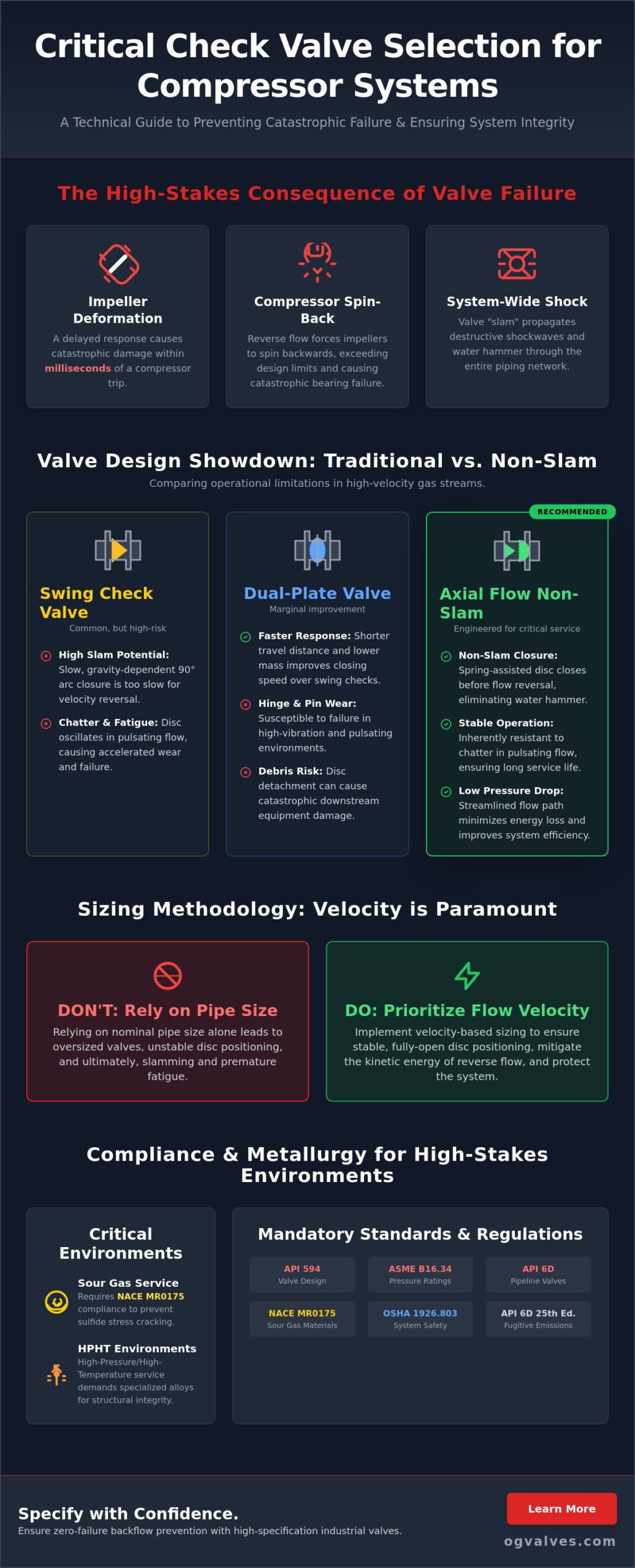
A single delayed check valve response in a high-pressure circuit can cause catastrophic impeller deformation within milliseconds of a compressor trip. While static pressure ratings are fundamental, effective check valve selection for compressor systems requires a primary focus on dynamic response and velocity-based sizing to mitigate the kinetic energy of reverse flow. Technical experts understand that relying on nominal pipe size alone often leads to valve slamming and premature fatigue in pulsating flow environments.
This analysis details the engineering criteria necessary for zero-failure backflow prevention, specifically adhering to API 594 and ASME B16.34 standards. You’ll gain a comprehensive understanding of how metallurgy impacts Mean Time Between Maintenance (MTBM) in sour gas environments and why current OSHA 1926.803 regulations mandate specific check valve placements for system safety. We also address the implications of the API 6D 25th Edition regarding fugitive emission performance and more stringent validation requirements. The following sections provide a clinical roadmap for specifying components that ensure long-term structural soundness and operational reliability in critical infrastructure.
Key Takeaways
- Understand how check valves function as the primary mechanical barrier to prevent centrifugal compressor spin-back and catastrophic bearing failure.
- Compare the operational limitations of traditional swing check valves against the non-slam advantages of axial flow nozzle designs in high-velocity gas streams.
- Implement a sizing methodology for check valve selection for compressor systems that prioritizes stable disc positioning through precise flow velocity calculations.
- Identify critical metallurgical specifications and NACE MR0175 compliance requirements for maintaining structural integrity in sour gas and HPHT environments.
- Gain insights into strategic procurement strategies that utilize specialized inventory solutions to mitigate long lead times for high-specification industrial valves.
The Critical Role of Check Valves in Compressor Integrity and Safety
In industrial compressor circuits, the check valve functions as the primary mechanical barrier against uncontrolled reverse flow. Proper check valve selection for compressor systems isn’t merely a secondary piping requirement; it’s a critical safety protocol for protecting high-capital assets from catastrophic failure. While many systems rely on automated control logic, the check valve provides the final physical line of defense when power fails or control systems lag. This foundational Check valve overview highlights how these components must operate autonomously to maintain pressure boundaries under extreme conditions.
The distinction between basic air compressor check valves and industrial process gas valves is significant. While air systems often utilize lighter, standard-duty components, process gas applications require valves compliant with API 594 and ASME B16.34. These industrial-grade valves are engineered to withstand the corrosive nature of specific gases and the high-pressure differentials found in multi-stage compression. Failure to specify a valve with the correct dynamic response can lead to a high-energy “slam” that shatters internal components and propagates shockwaves through the piping network.
Closure speed is directly linked to compressor surge protection. If a check valve doesn’t close before the flow reverses, the kinetic energy of the returning gas increases exponentially. This delay forces the valve to close against a high-velocity stream, resulting in water hammer and mechanical stress. Precise check valve selection for compressor systems ensures that the valve’s closing characteristic matches the deceleration rate of the gas, effectively isolating the compressor before surge cycles can initiate.
Preventing Reverse Flow and Mechanical Spin-Back
When a centrifugal compressor shuts down, high-pressure gas in the discharge line attempts to return to the lower-pressure suction side. This backflow triggers “spin-back,” where the impeller is forced to rotate in reverse at high speeds, often exceeding design limits. This counter-rotation places immense stress on thrust bearings and mechanical seals, which aren’t designed for reverse torque or backward rotation. Reverse flow damage in high-speed centrifugal compressors is the mechanical degradation of rotating components caused by the instantaneous application of counter-rotational torque from high-pressure discharge gas.
Mitigating Pressure Pulsations in Reciprocating Systems
Reciprocating compressors create constant high-frequency pressure pulsations during discharge cycles. Standard valves often suffer from “chatter” in these environments, where the valve disc oscillates rapidly without reaching a stable, fully open position. This oscillation leads to accelerated spring fatigue and seat wear. Industrial check valves designed for pulsating flow utilize dampened internals or specific spring tensions to stabilize the disc, protecting downstream piping from the destructive energy of unfiltered pulsations.
Comparative Analysis: Axial Flow vs. Traditional Check Valve Designs
Effective check valve selection for compressor systems hinges on the mechanical ability of the internal disc to close before the fluid column reverses direction. Traditional swing check valves, while common in general utility service, present significant risks when deployed in high-velocity gas streams. The fundamental design of a swing check requires the disc to travel through a wide 90-degree arc. In a compressor trip scenario, the gas velocity reverses faster than the gravity-dependent or slow-moving disc can seat. This lag causes the disc to slam into the seat with extreme kinetic energy, often resulting in cracked valve bodies or damage to upstream compressor internals.
Dual-plate check valves offer a marginal improvement by reducing the mass of the individual closing elements and shortening the travel distance. These designs are often favored for their compact face-to-face dimensions and reduced weight. However, in high-vibration compressor discharge lines, dual-plate designs are susceptible to pin wear and hinge failure. The constant turbulence of pulsating gas flow can lead to disc detachment, which poses a secondary risk of downstream debris ingestion. Adhering to OSHA safety standards for compressed air requires the maintenance of functional pressure-containing components, yet selecting an inadequate valve geometry can compromise this compliance through mechanical fatigue.
Axial Flow Designs and Non-Slam Characteristics
Axial flow or nozzle check valves represent the gold standard for compressor protection. These valves utilize a spring-assisted disc that moves along a central shaft, requiring a very short stroke to achieve full closure. This geometry allows the valve to respond almost instantaneously to changes in flow velocity. By closing at the precise moment of zero velocity, the valve prevents backflow from gaining the momentum necessary to cause a “slam.” To better understand the internal mechanics and flow paths of these components, engineers should review our detailed guide on Understanding Industrial Check Valves.
The streamlined internal profile of an axial flow valve also reduces pressure drop (Delta P) across the component. In high-pressure compressor circuits, minimizing parasitic pressure loss is essential for maintaining overall system efficiency. Procurement teams seeking to optimize system reliability can consult the OG Valves inventory to identify specific non-slam solutions that meet these rigorous technical requirements.
Swing and Dual-Plate Limitations in Gas Service
Analyzing deceleration curves reveals why traditional designs fail in gas service. Gas is highly compressible and moves at much higher velocities than liquids, meaning the rate of deceleration during a trip is exceptionally steep. Swing and dual-plate valves typically have a response time that sits well outside the safe zone of these curves. This mismatch ensures that reverse flow is already established before the valve reaches the closed position. Spring-assisted closure is mandatory for any check valve selection for compressor systems to counteract these rapid deceleration rates and ensure the valve remains in a stable, chatter-free position during normal operation.
Sizing Methodology: Flow Velocity and Minimum Pressure Drop
Engineering precision in check valve selection for compressor systems moves beyond simple pipe-matching. Many procurement specifications mistakenly mandate line-sizing, where the valve diameter matches the nominal pipe size. This practice often results in oversized valves that fail to reach a fully open position during standard operation. When the gas flow velocity is insufficient to hold the disc against its internal stop, the disc enters a state of high-frequency oscillation known as chatter. This mechanical instability leads to rapid hinge pin wear and spring fatigue, compromising the valve’s integrity before its first scheduled maintenance interval.
The implementation of precise check valve selection for compressor systems necessitates a shift from dimensional matching to dynamic velocity analysis. Engineers must calculate the minimum flow velocity required for a full lift, a value determined by the valve’s specific flow coefficient (Cv) and the fluid density at operating pressure. A properly sized valve ensures the disc remains stable throughout the compressor’s entire turndown range. In high-pressure bypass or discharge lines, managing high Mach numbers is equally vital. If gas velocities approach sonic levels, the resulting turbulence and noise can cause severe vibration-induced stress on the valve internals and the surrounding pressure envelope.
The Risk of Over-Sizing and Valve Chatter
Over-sizing creates a mismatch between the available kinetic energy of the gas and the mechanical force required to keep the valve open. If the flow doesn’t provide enough lift, the disc remains in the flow stream, causing turbulence and mechanical wear. Selecting a valve size involves a rigorous comparison of the compressor’s minimum flow rate against the valve’s lift-off requirements. It’s often necessary to install a valve one or two sizes smaller than the surrounding piping, using concentric reducers to maintain stable operation and prevent premature internal failure.
Optimising Pressure Drop for System Efficiency
Every pound per square inch (psi) of pressure drop across a check valve represents a direct increase in the compressor’s power consumption. In large-scale industrial plants, these energy losses translate into significant annual operational costs. Nozzle-style check valves typically offer superior flow recovery compared to swing or dual-plate designs, minimizing the permanent pressure loss. Optimizing for rapid closure speed inevitably necessitates a mechanical architecture that produces a measurable pressure differential across the valve seat during forward flow cycles. Engineers must prioritize a design that achieves the necessary non-slam characteristics while maintaining the lowest possible parasitic energy loss for the overall system.
Industrial compressor circuits often operate at High-Pressure High-Temperature (HPHT) extremes that challenge the structural integrity of standard piping components. Effective check valve selection for compressor systems must account for the mechanical degradation of materials under these specific thermal and pressure stressors. ASME B16.34 provides the mandatory framework for pressure-temperature ratings, defining the maximum allowable working pressure for specific material groups across the entire operating spectrum. Utilizing an incorrect alloy in an HPHT circuit risks structural failure or loss of containment during a thermal excursion, making compliance with these ratings a non-negotiable safety requirement.
Advanced metallurgy is required when handling process gases that contain corrosive contaminants. Super Duplex and Inconel alloys are frequently specified for their superior resistance to pitting and stress corrosion cracking. These materials maintain their mechanical properties in aggressive environments where standard carbon steel would suffer rapid wall loss. API 594 governs the design and testing of these valves, ensuring that the selected metallurgy matches the dimensional and pressure requirements of the system. Adhering to these international benchmarks provides the clinical assurance necessary for long-term operational output in heavy industrial sectors.
Material Selection for Sour Gas and Petrochemical Service
In sour gas applications, compliance with NACE MR0175/ISO 15156 is mandatory to prevent sulfide stress cracking. Engineering teams must evaluate the suitability of 316SS, Duplex, and Monel based on the partial pressure of Hydrogen Sulphide (H2S) and the presence of chlorides. High-velocity gas streams also necessitate the use of Stellite-faced seats. These cobalt-based alloys provide a hard-facing layer that resists the erosive effects of particulate matter and high-frequency cycling. For a deeper technical analysis of these material requirements and their application in various sectors, consult our Industrial Valves Guide.
Quality Assurance and Regulatory Certification
Reliability in critical infrastructure depends on rigorous quality control protocols that go beyond visual inspection. Positive Material Identification (PMI) is an essential step in verifying that the chemical composition of the valve body and internals matches the procurement specification. This process prevents the accidental installation of sub-standard materials in high-stakes environments. Material traceability is further confirmed through EN 10204 3.1 or 3.2 certification, which provides a documented link from the finished valve back to the original melt of the steel.
Final validation involves hydrostatic and seat leakage testing to ensure the valve meets zero-leakage requirements. This is particularly vital in gas service to prevent the accumulation of flammable or toxic gases in isolated pipe sections. Testing protocols should follow the 25th Edition of API 6D, which introduced more stringent documentation and validation requirements for fugitive emission performance as of November 2022. For organizations requiring high-specification components, sourcing industrial check valves from a specialized inventory ensures strict adherence to these evolving global benchmarks.
Strategic Procurement and OG Valves Inventory Solutions
Industrial operators face a critical challenge when lead times for high-specification components exceed planned maintenance windows. Strategic check valve selection for compressor systems is often hindered by the scarcity of specialized alloys or unique pressure ratings in standard supply chains. OG VALVES LTD. addresses this bottleneck by maintaining a comprehensive inventory of industrial valves, including Gate, Ball, Globe, and Check Valves, specifically curated for high-stakes applications. By bridging the gap between engineering requirements and availability, we ensure that critical infrastructure remains operational without the compromises associated with generic substitutes.
Our role as a specialized partner involves more than simple product fulfillment. We provide the technical depth required to navigate the complexities of API and ASME compliance in heavy industrial sectors. This clinical focus on durability and regulatory adherence allows procurement specialists to source components with unwavering reliability. Every valve in our inventory undergoes rigorous quality control, ensuring that the structural soundness and operational output meet the benchmarks established in the previous sections of this guide.
Fast-Track Delivery for Maintenance and Turnarounds
Minimizing downtime during scheduled turnarounds or emergency shutdowns requires a robust logistics framework. Our operations, managed from Northern Ireland, leverage global supply chains to facilitate rapid delivery to international project sites. We maintain a significant stock of specialized components, including high-performance butterfly valves and non-slam check valves, to support comprehensive system overhauls. This strategic positioning allows for the immediate dispatch of components that meet the rigorous standards of the petrochemical and energy sectors, effectively mitigating the financial impact of extended outages.
Technical Specification and Consultation Services
Technical accuracy in procurement is essential for ensuring long-term system reliability. Our team provides detailed consultation to match check valve performance characteristics with specific compressor discharge curves, preventing the sizing errors that lead to valve chatter. This collaborative approach extends to working with Engineering, Procurement, and Construction (EPC) firms to specify automated actuator systems for complex bypass lines. We provide full documentation and compliance packs, ensuring that every component meets the traceability and testing standards required for heavy industry.
Precise check valve selection for compressor systems involves evaluating dynamic response and material compatibility against the unique stressors of the application. OG VALVES LTD. acts as a dependable partner in this process, providing the clinical expertise and high-specification inventory needed for zero-failure performance. Contact OG VALVES LTD. for a technical consultation on compressor check valve selection to ensure your facility adheres to the highest engineering standards.
Optimizing System Reliability through Engineering Precision
Technical integrity in high-pressure industrial circuits depends on the precise alignment of valve mechanics with compressor dynamics. Engineering precision is the primary safeguard for asset longevity. Effective check valve selection for compressor systems requires prioritizing axial flow geometries and velocity-based sizing over nominal pipe dimensions. These decisions directly mitigate the risks of impeller spin-back and mechanical fatigue in pulsating flow environments. Adhering to API 594 and NACE MR0175 standards isn’t just a regulatory requirement; it’s a fundamental necessity for zero-failure backflow prevention in HPHT or sour gas service.
OG Valves supports these critical infrastructure needs through an ISO 9001:2015 certified supply chain and deep expertise in NACE-compliant metallurgy. Our global fast-track logistics capabilities ensure that high-specification components reach your facility precisely when needed, reducing the risk of extended maintenance downtime. By integrating clinical technical analysis with robust procurement strategies, engineers maintain the highest benchmarks of industrial safety. Request a Technical Quote for Industrial Compressor Check Valves today to secure the structural soundness of your critical systems.
Frequently Asked Questions
What is the primary function of a check valve in a compressor system?
The primary function is to serve as an autonomous mechanical barrier that prevents the backflow of high-pressure process gas during a compressor trip or planned shutdown. This isolation protects the impeller from reverse rotation and prevents the loss of system pressure. Proper check valve selection for compressor systems ensures that the valve remains stable during normal operation while providing instantaneous closure when the forward flow velocity drops to zero.
Why is an axial flow check valve preferred over a swing check for compressors?
Axial flow check valves are preferred due to their short-stroke disc and spring-assisted closure mechanism. This design allows the valve to reach the seated position before the gas column reverses direction, effectively eliminating the kinetic energy required for a slam event. Traditional swing check valves rely on a 90-degree arc and gravity, which are often too slow to respond to the rapid deceleration rates found in centrifugal compressor discharge lines.
How do I prevent “slam” in a high-pressure gas check valve?
Preventing slam requires selecting a valve with a dynamic response that matches the deceleration characteristic of the gas stream. Non-slam performance is achieved by using spring-assisted axial flow designs where the disc moves only a fraction of the pipe diameter. This ensures the valve is closed at the precise moment of zero velocity, preventing the backflow from accelerating and causing high-impact energy transfer upon seat contact during a surge or trip.
What API standards apply to industrial compressor check valves?
The primary standards are API 594, which covers design and testing for flanged, lug, and wafer check valves, and API 6D for pipeline service. Additionally, ASME B16.34 is utilized to define the pressure-temperature ratings for the valve body. Compliance with these standards is essential for ensuring the structural soundness and safety of the pressure-containing components within a high-pressure compressor circuit and maintaining regulatory adherence.
Can I use a dual-plate check valve in a pulsating flow environment?
Dual-plate check valves are generally unsuitable for pulsating flow environments common in reciprocating compressor systems. The constant pressure fluctuations cause the plates to oscillate rapidly, leading to accelerated wear on the hinge pins and springs. This mechanical fatigue often results in disc detachment or internal failure. For these applications, axial flow check valves with dampened internals provide a more stable and durable solution for long-term operational output.
What materials are recommended for check valves in sour gas service?
Recommended materials include alloys that comply with NACE MR0175/ISO 15156 to resist sulfide stress cracking. Common selections include Super Duplex, Inconel, and Monel, depending on the concentration of H2S and chlorides. Additionally, seats should be hard-faced with cobalt-based alloys like Stellite to provide erosion resistance against high-velocity gas and particulates. This ensures the long-term integrity of the sealing surfaces in aggressive petrochemical environments where material failure is a significant risk.
How does over-sizing a check valve lead to premature failure?
Over-sizing leads to premature failure because the gas velocity is insufficient to keep the disc in a stable, fully open position. This causes the disc to float or chatter within the flow stream, creating high-frequency vibrations that destroy the spring and hinge mechanisms. Accurate check valve selection for compressor systems involves sizing the valve based on minimum flow velocity and Cv requirements rather than simply matching the nominal pipe diameter to the surrounding piping.
Is a spring-loaded check valve necessary for vertical compressor discharge lines?
Spring-loaded mechanisms are mandatory for vertical discharge lines to ensure reliable closure regardless of gravitational forces. The spring force provides the necessary assistance to return the disc to the seat as soon as the forward flow ceases, preventing the fluid column from gaining reverse momentum. Without a spring, the valve may remain partially open or close too late, significantly increasing the risk of mechanical damage to the compressor internals during a shutdown event.
 Responsive Menu