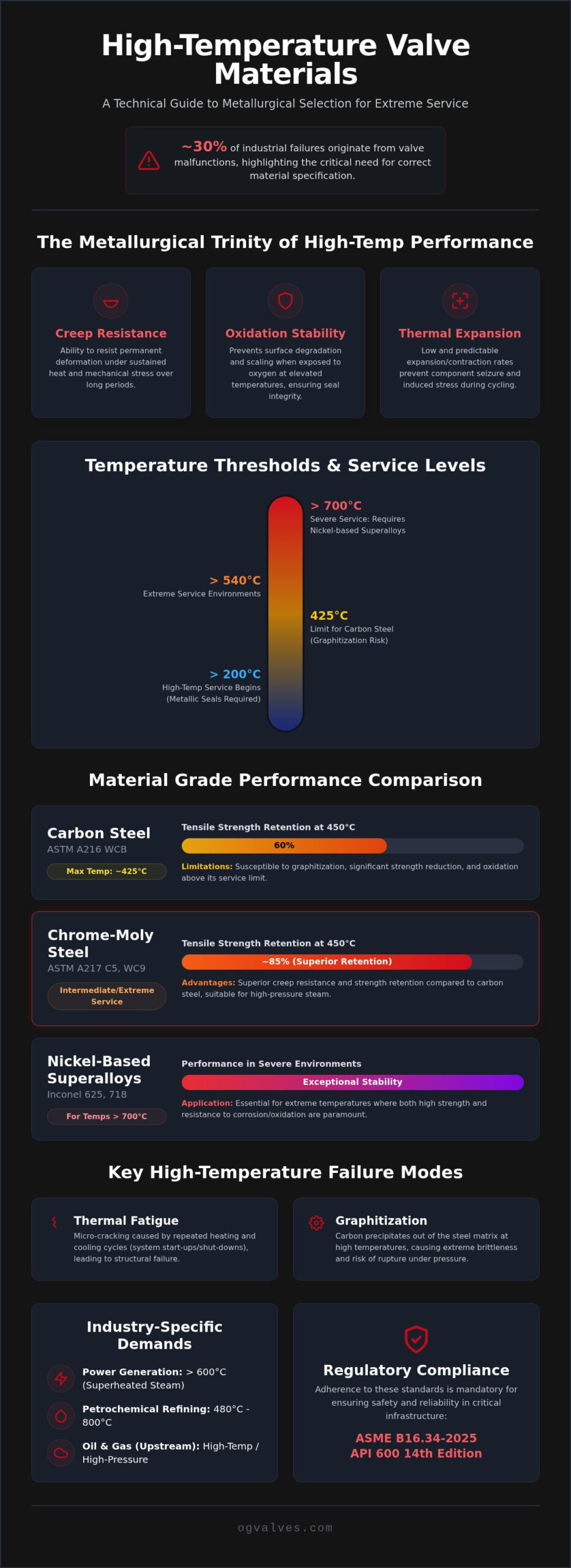
According to the International Society of Automation, nearly 30% of industrial failures originate from valve malfunctions, a statistic that underscores the critical nature of metallurgical integrity in extreme thermal environments. Engineering experts recognize that selecting high temperature valve materials involves more than evaluating basic melting points. It requires a clinical assessment of the metallurgical trinity consisting of creep resistance, oxidation stability, and thermal expansion. You’re likely aware that a single miscalculation in alloy selection leads to catastrophic thermal fatigue and costly regulatory non-compliance.
This analysis provides the technical data necessary to identify the correct ASTM material grade for specific temperature ranges, ensuring your critical infrastructure meets the rigorous demands of the ASME B16.34-2025 and API 600 14th Edition standards. We’ll examine the performance characteristics of specialized alloys and provide a structured framework for minimizing operational downtime through precise metallurgical specification. This guide serves as an authoritative resource for procurement specialists who can’t afford the risks associated with inaccurate lead times or material failure.
Key Takeaways
- Define critical temperature thresholds to distinguish between intermediate service (up to 425°C) and extreme thermal environments exceeding 540°C.
- Evaluate the performance limitations of ASTM A216 WCB compared to the superior creep resistance of Chrome-Moly steels like ASTM A217 C5 and WC9.
- Identify the operational requirements for nickel-based superalloys, including Inconel 625 and 718, in applications where temperatures surpass 700°C.
- Analyze how creep and thermal fatigue impact high temperature valve materials to prevent permanent deformation and ensure long-term structural reliability.
- Verify adherence to current ASME B16.34-2025 and API 600 standards to maintain regulatory compliance and safety in critical industrial infrastructure.
Defining High-Temperature Parameters in Industrial Valve Service
Industrial valve engineering classifies high-temperature service as any application where the process media exceeds a 200°C (400°F) baseline, a threshold that triggers critical changes in metallurgical selection and pressure-rating calculations. While standard carbon steels perform reliably at lower temperatures, exceeding this benchmark necessitates the use of specialized high temperature valve materials to prevent structural instability. This specific 200°C threshold serves as the primary industry benchmark for transitioning from standard elastomeric seals to metallic or high-performance composite configurations.
Categorization of these environments is essential for procurement precision and safety. Intermediate service environments generally range from 200°C up to 425°C. In this bracket, alloy steels often provide sufficient resistance to thermal loads. Extreme service environments, however, encompass temperatures above 540°C. These conditions demand advanced metallurgical solutions, such as high-nickel superalloys or specialized chrome-moly configurations, to withstand sustained thermal stress without compromising the valve’s pressure-containing capability.
The physical state of the media significantly influences heat transfer rates within the valve body and internal components. Gaseous media, such as superheated steam or dry gas, typically exhibit lower thermal conductivity than liquids. However, gases can facilitate rapid temperature spikes that induce localized stress and uneven expansion. Conversely, liquid media provide more consistent thermal distribution across the valve’s internal geometry. They maintain a higher thermal mass, which places sustained pressure on the structural integrity of the valve body over long operational cycles.
Thermal Thresholds and Material Degradation
Standard carbon steels, including ASTM A105 and A216 WCB, encounter severe metallurgical limits as they approach 425°C. At these levels, the risk of graphitization increases. This is a process where carbon precipitates from the steel matrix, causing extreme brittleness and potential rupture under pressure. Oxidation also becomes a primary concern for engineers. Surface degradation from prolonged exposure to oxygen at high temperatures can compromise the integrity of sealing faces, leading to catastrophic leaks or fugitive emissions. Constant thermal cycling, the repeated heating and cooling during system start-ups and shut-downs, induces mechanical stress that can cause micro-cracking in common valve materials if the selected grade lacks sufficient ductility.
Industry-Specific Temperature Requirements
Operational demands vary across sectors, dictating specific material grades based on the severity of the thermal environment:
- Power Generation: Modern supercritical and ultra-supercritical turbines require valves capable of handling superheated steam at temperatures often exceeding 600°C.
- Petrochemical Refining: Catalytic cracking and crude distillation units operate in the 480°C to 800°C range, where chemical corrosion often compounds thermal stress.
- Oil and Gas: Upstream applications face high-temperature, high-pressure (HTHP) conditions in deepwater wells, while downstream processing involves high-temperature distillate separation.
Ferrous Alloys and Stainless Steels: The Workhorses of High-Temp Service
Ferrous alloys constitute the foundational group of high temperature valve materials used across primary industrial infrastructure. ASTM A216 WCB carbon steel represents the standard for general service, yet its utility diminishes rapidly beyond 425°C. At these elevated temperatures, WCB suffers from significant tensile strength reduction and the risk of graphitization, where carbon precipitates into graphite nodules, compromising the metal’s ductility. Consequently, engineers transition to alloyed steels for components requiring sustained structural integrity and safety.
Chrome-moly steels, specifically the ASTM A217 grades, offer superior tensile strength retention compared to carbon steel. While WCB might retain only 60% of its room-temperature strength at 450°C, a WC9 alloy maintains a much higher percentage of its mechanical properties. This performance is vital for high-pressure steam headers and turbine bypass systems where safety depends on predictable material behavior. Rigorous material selection and qualification processes ensure these alloys meet the safety benchmarks required for critical energy infrastructure.
Chrome-Molybdenum Alloys for Creep Resistance
The addition of Chromium provides oxidation resistance and high-temperature strength, while Molybdenum enhances creep strength and prevents graphitization. WC6 (1.25% Cr, 0.5% Mo) and WC9 (2.25% Cr, 1% Mo) are the preferred choices for power plant piping and high-pressure steam service. These grades operate effectively up to 593°C. Beyond this point, oxidation rates accelerate, and engineers must consider transitioning to higher alloyed C12A or nickel-based superalloys to maintain operational safety.
Stainless Steel Grades in Oxidising Environments
Austenitic stainless steels, such as ASTM A351 CF8M (the cast equivalent of 316 SS), are essential for petrochemical processing where corrosion and heat coexist. CF8M provides excellent resistance to oxidation up to approximately 815°C. However, designers must account for the risk of intergranular corrosion. This occurs when chromium carbides precipitate at grain boundaries between 425°C and 815°C, depleting the surrounding area of chromium and leaving it vulnerable to attack. When selecting industrial valves for these corrosive, high-heat environments, don’t overlook the necessity of low-carbon variants or stabilized grades to ensure long-term reliability. Selection criteria for high-performance systems focus on balancing thermal stability with chemical resistance. For specialists managing complex procurement, verifying the specific heat-treatment and chemical composition of high temperature valve materials is the only way to guarantee performance in severe service.

Advanced Superalloys and Hardfacing for Severe Service
Severe service applications, specifically those operating at temperatures exceeding 700°C, render standard ferrous alloys obsolete due to rapid loss of mechanical strength and accelerated oxidation. In these extreme environments, nickel-based superalloys such as Inconel 625 and Inconel 718 provide the necessary metallurgical stability. These high temperature valve materials maintain high yield strength and oxidation resistance through the formation of a stable, protective oxide layer that prevents further atmospheric degradation of the base metal.
Nickel Alloys for Extreme Thermal Stability
Inconel is frequently specified for butterfly valves utilized in flare systems and high-heat exhaust manifolds where thermal stability is paramount. While these alloys exhibit a higher coefficient of thermal expansion than carbon steels, their ability to resist creep deformation justifies the initial investment. Engineers must account for these expansion rates during the design phase to prevent internal binding. Utilizing superalloys often reduces long-term operational costs by extending the mean time between failures (MTBF) in critical infrastructure.
When process media combine high thermal loads with chemical aggression, alloys like Monel or Hastelloy become essential. These materials excel in hydrofluoric acid service or highly oxidizing chemical environments where standard stainless steels would suffer rapid pitting and stress corrosion cracking. The selection of these alloys is a clinical decision based on the specific chemical composition of the media and the peak operating temperature.
Hardfacing and Trim Materials
Hardfacing involves the application of a wear-resistant alloy layer to critical sealing surfaces through weld-overlaying. This process is vital for protecting the seats and discs of gate valves from the destructive effects of galling and high-velocity erosion. Stellite 6 remains the global industry standard for valve trim hardfacing due to its exceptional resistance to erosive wear, galling, and oxidation at temperatures exceeding 500°C.
Ensuring metallurgical compatibility between the valve body material and the hardfacing overlay prevents hydrogen-induced cracking or delamination during service. Proper pre-heating and post-weld heat treatment (PWHT) protocols are mandatory to maintain the structural soundness of the high temperature valve materials involved. This methodical approach to trim selection ensures that the valve maintains a bubble-tight seal even after thousands of thermal cycles in severe service conditions.
Critical Selection Criteria: Creep, Fatigue, and Sealing
Predicting the longevity of high temperature valve materials requires a clinical understanding of metallurgical failure modes that don’t occur at ambient temperatures. Creep represents the most significant long-term risk. It’s the slow, time-dependent deformation of metal occurring under constant stress at elevated thermal levels. If a valve body or stem is subject to sustained pressure at temperatures exceeding 400°C, the material can permanently stretch or sag, leading to dimensional instability and eventually, rupture.
While creep is a steady-state phenomenon, thermal fatigue is the result of transient stress. Rapid start-up and shut-down cycles create steep temperature gradients across the valve’s wall thickness. These gradients induce localized expansion and contraction. Over time, this cyclic loading causes micro-cracks that propagate through the grain structure. Designers must also mitigate the risk of thermal binding, particularly in ball valves. This occurs when the internal ball expands at a different rate than the valve body, causing the component to seize and rendering the actuator unable to cycle the valve.
Managing Creep and Rupture Strength
Engineers utilize Larson-Miller parameters to extrapolate short-term creep test data into long-term service life predictions. This calculation correlates temperature and time to rupture, allowing for a structured assessment of how a specific alloy will perform over a 20-year operational window. Increasing the wall thickness of the valve body is a common strategy for pressure containment, but it must be balanced against the increased risk of thermal stress during heating cycles. Proper material selection for high temperature valve materials ensures the assembly maintains its structural integrity without excessive mass.
High-Temperature Sealing Technologies
Standard elastomeric O-rings fail rapidly when temperatures surpass 200°C. High-spec applications require a transition to flexible graphite or metallic packing systems. Flexible graphite serves as the industry standard for gaskets and stem packing due to its high thermal conductivity and chemical inertness. In severe service, check valves utilize metal-to-metal seating to ensure shut-off integrity where soft seals would melt or degrade.
Live-loading systems provide a mechanical solution to the problem of seal relaxation. By using Belleville spring washers to maintain a constant load on the packing gland, these systems compensate for the expansion and contraction of the stem during thermal cycling. This ensures a consistent seal and prevents fugitive emissions. For projects requiring documented compliance and high-performance alloys, review our technical specifications for high-temperature ball valves.
Regulatory Compliance and Quality Assurance Standards
Adherence to international standards is the primary form of validation for high temperature valve materials. In critical infrastructure, the cost of failure is absolute, requiring a clinical approach to design and certification. API 600, 14th Edition, defines the construction requirements for heavy-duty bolted bonnet steel gate valves, including mandatory wall thicknesses that exceed general-purpose specifications. For globe valves, API 623 ensures the design accounts for high-cycle fatigue and thermal stress. These standards, alongside the recent updates to API 600 regarding fugitive emission testing, reflect a growing industry focus on environmental safety and structural soundness.
Positive Material Identification (PMI) serves as a critical non-destructive verification of alloy composition. It prevents the installation of incorrect grades that could lead to catastrophic failure in thermal environments. In high-temperature sour service, NACE MR0175/ISO 15156 compliance is mandatory to mitigate sulfide stress cracking (SSC). The synergy between high thermal loads and chemical aggression requires a clinical focus on material certification to ensure long-term operational output.
Pressure-Temperature Ratings (ASME B16.34)
The ASME B16.34-2025 standard provides the essential pressure-temperature (P-T) ratings for flanged, threaded, and welding end valves. Engineers must consult these P-T charts to determine the safe working pressure at specific operating temperatures. As the temperature rises, the allowable pressure decreases, a process known as derating. This derating is not linear and varies significantly between material groups; for example, Chrome-Moly steels retain higher pressure ratings at 500°C than standard carbon steels. You must also ensure the actuator is correctly specified for high-temp service. Thermal expansion of the stem and increased friction at the sealing faces often necessitate higher torque outputs than ambient calculations suggest.
Verification and Testing Protocols
Quality assurance relies on Non-Destructive Testing (NDT) to identify subsurface defects or thermal stress cracks. Ultrasonic testing (UT) and radiographic testing (RT) are standard protocols for verifying the structural integrity of cast and forged high temperature valve materials. Every critical component must be accompanied by a Material Test Report (MTR), providing a traceable record of chemical heat analysis and mechanical property tests. OG VALVES LTD. acts as a technical consultant and global partner, maintaining an extensive inventory of certified hardware to minimize downtime in heavy industrial sectors. The organization anchors its claims in rigorous testing and quality control processes, positioning the brand identity as a benchmark for industrial safety and engineering standards.
Strategic Material Selection for Critical Infrastructure
The precise metallurgical selection of high temperature valve materials remains the primary safeguard against catastrophic failure in heavy industrial systems. This technical overview has synthesized the relationship between thermal thresholds, alloy performance, and regulatory compliance. By transitioning from standard carbon steels to specialized chrome-moly or nickel-based superalloys, engineers mitigate the risks of creep and thermal fatigue while ensuring adherence to ASME B16.34-2025 and API 600 standards. Verifying every component through PMI and MTR documentation is not just a regulatory requirement but a clinical necessity for long-term operational reliability.
OG VALVES LTD. serves as a seasoned global partner in critical infrastructure, offering technical expertise in material specification and an extensive inventory of high-specification valves. We combine industrial precision with global logistics capabilities to provide fast-track delivery for projects where downtime is not an option. We invite you to Request a Technical Quote for High-Temperature Valves to ensure your facility operates with the highest benchmarks of safety and durability. Our commitment to engineering excellence provides the unwavering reliability required for the most demanding thermal environments.
Frequently Asked Questions
What is the best material for valves operating above 600°C?
Nickel-based superalloys, specifically Inconel 625 and 718, are the most reliable high temperature valve materials for service exceeding 600°C. These alloys maintain high yield strength and superior oxidation resistance where standard ferrous steels lose structural integrity. Their unique metallurgical composition allows for the formation of a stable oxide layer that prevents atmospheric degradation during sustained thermal exposure, ensuring the valve’s pressure-containing capability remains uncompromised.
How does temperature affect the pressure rating of a stainless steel valve?
Temperature increases cause a significant reduction in the allowable working pressure of stainless steel valves, a process defined as derating. According to ASME B16.34 pressure-temperature tables, a valve’s pressure-containing capability decreases as the material’s tensile strength weakens under heat. Engineers must select a higher pressure class or a superior alloy to maintain safe operating margins at peak thermal loads, as the material’s load-bearing capacity isn’t constant across different thermal ranges.
Why is Chrome-Moly preferred over Carbon Steel for high-temperature steam?
Chrome-Moly steels are preferred over carbon steel for high-temperature steam because they prevent graphitization and offer enhanced creep resistance. Carbon steel, such as ASTM A216 WCB, becomes brittle above 425°C as carbon precipitates into graphite nodules. The addition of Chromium and Molybdenum in grades like WC6 and WC9 stabilizes the carbides, ensuring the valve maintains its ductility and structural integrity over long operational cycles in power generation systems.
What is thermal binding in high-temperature gate valves?
Thermal binding occurs when the internal components of a gate valve, such as the wedge, expand or contract at a different rate than the valve body, causing the assembly to seize. This phenomenon typically happens during system cooldown if the body contracts more rapidly than the wedge. It’s a critical safety concern that often requires the use of flexible wedge designs or specialized high temperature valve materials with matched expansion coefficients to prevent actuator failure.
Can I use PTFE seals in high-temperature valve applications?
PTFE seals are unsuitable for high-temperature valve applications as they typically degrade and lose sealing integrity above 200°C. Severe service environments require the use of flexible graphite packing or metal-to-metal seating configurations. These materials provide the necessary thermal stability and chemical resistance to maintain a bubble-tight seal in environments where elastomeric or plastic components would melt, deform, or release hazardous fugitive emissions.
What is the difference between ASTM A217 WC6 and WC9?
The primary difference between ASTM A217 WC6 and WC9 lies in their chemical composition, specifically the levels of chromium and molybdenum. WC6 contains approximately 1.25% Chromium and 0.5% Molybdenum, while WC9 contains 2.25% Chromium and 1% Molybdenum. This higher alloy content gives WC9 superior creep resistance and higher allowable pressure-temperature ratings, making it the preferred choice for more aggressive steam service and higher pressure containment.
How often should high-temperature valves be inspected for creep?
High-temperature valves should be inspected for creep during scheduled major turnarounds, typically every three to five years depending on the service hours and severity of the thermal load. Technicians use non-destructive testing, such as ultrasonic thickness gauging and surface replication, to identify signs of permanent deformation or micro-cracking. These inspections are vital for verifying the remaining service life of the component based on Larson-Miller parameter extrapolations and safety benchmarks.
What role does hardfacing play in valve longevity?
Hardfacing provides a wear-resistant layer on critical sealing surfaces to protect against galling, high-velocity erosion, and oxidation. By weld-overlaying materials like Stellite 6 onto the valve seat and disc, engineers significantly extend the valve’s operational life in high-friction environments. This process ensures that the valve maintains its shut-off integrity even after repeated thermal cycling and mechanical stress, preventing costly leaks and unplanned maintenance in severe service conditions.
 Responsive Menu