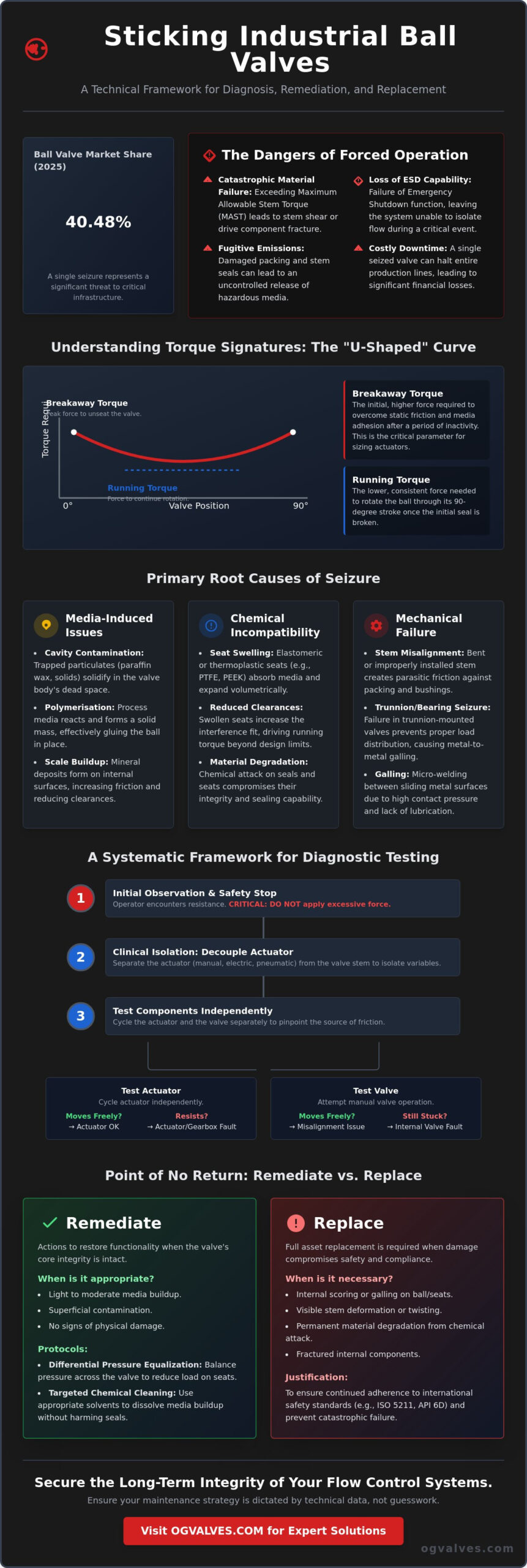
Given that ball valves accounted for 40.48% of the industrial valve market share in 2025, a single mechanical seizure represents a significant threat to critical infrastructure. When an operator encounters resistance during a cycle, the immediate impulse to apply excessive torque often leads to stem deformation or seat damage. Effective troubleshooting a sticking industrial ball valve requires a clinical isolation of variables, ranging from media build-up to the mechanical interface requirements defined in the February 2026 update of ISO 5211. You recognize that forced operation in high-pressure systems is a catalyst for catastrophic material failure and costly operational downtime.
This technical guide provides a rigorous, step-by-step framework for diagnosing valve seizure and restoring flow control while ensuring strict compliance with international safety standards. We’ll evaluate torque signatures, actuator alignment, and the updated ISO 22109:2026 requirements for gearboxes to identify the root cause of failure. By following this engineering protocol, you’ll secure the long-term integrity of your flow control systems and prevent the recurrence of mechanical resistance in high-stakes environments. This methodical approach ensures that technical data, rather than guesswork, dictates your maintenance strategy.
Key Takeaways
- Differentiate between breakaway and running torque signatures to determine if mechanical resistance originates at the seat interface or within the valve stroke.
- Utilize a clinical isolation protocol for troubleshooting a sticking industrial ball valve by decoupling the actuator to distinguish between mechanical interface friction and internal media interference.
- Identify specific root causes ranging from media-induced scale and polymerisation to mechanical failures such as stem misalignment or trunnion seizure.
- Execute remediation protocols, including differential pressure equalization and targeted chemical cleaning, to restore functionality while protecting the integrity of internal seals.
- Define the technical “point of no return” where internal scoring or material degradation requires full asset replacement to ensure continued adherence to safety standards.
Identifying the Mechanics and Risks of Industrial Ball Valve Seizure
In high-pressure industrial environments, a sticking valve isn’t merely an operational nuisance. It’s a mechanical failure state where the operating torque required to rotate the closure member exceeds the specified design limits of the actuator or manual handle. This imbalance occurs when internal friction overcomes the mechanical advantage of the system. Troubleshooting a sticking industrial ball valve requires a forensic understanding of how these forces interact within the valve body to prevent permanent component damage.
The fundamental ball valve mechanics rely on a precise interference fit between the ball and the seats to maintain a bubble-tight seal. While this contact is essential for compliance with API 6D or ISO 5208 leakage standards, any deviation in material integrity or media composition can escalate friction to the point of seizure. Identifying the specific torque profile is the first step in a clinical diagnosis. Engineers must distinguish whether the resistance is constant or isolated to specific points in the 90-degree stroke.
Breakaway Torque vs. Running Torque
Initial resistance is almost always higher than the force required for mid-cycle rotation. This phenomenon, known as breakaway torque, occurs because the elastomeric or metal seats “set” against the ball surface during periods of inactivity. Media can also act as an adhesive, increasing the force needed to initiate movement. Running torque represents the force needed to complete the rotation once the initial seal is broken. Breakaway torque is the critical design parameter used to size actuators, ensuring the power source can overcome static friction and potential media bonding. In a standard ball valve, the torque requirement usually peaks at the start and end of the cycle, creating a “U-shaped” torque curve that engineers must account for during specification.
The Safety Implications of Forced Operation
Operators often attempt to overcome resistance by using “cheater bars” or extended levers to increase manual torque. This practice is dangerous. Exceeding the Maximum Allowable Stem Torque (MAST) can lead to stem shear or the fracture of internal drive components. Such failures result in a loss of Emergency Shutdown (ESD) capability, leaving the system unable to isolate flow during a critical event. Beyond mechanical breakage, excessive force stresses the packing gland and stem seals. This degradation directly impacts fugitive emission compliance, potentially leading to an uncontrolled release of hazardous media. Maintaining asset integrity requires a refusal to force operation when torque thresholds are breached. Identifying the root cause is the only path to restoring safe performance.
Primary Root Causes of Industrial Ball Valve Sticking
Determining the precise origin of mechanical resistance is the foundational step in troubleshooting a sticking industrial ball valve. While external lubrication might provide temporary relief, it doesn’t address the underlying material degradation or environmental interference that leads to seizure. A clinical analysis must account for the interaction between the process media, the internal valve components, and the surrounding thermal environment.
Chemical incompatibility remains a frequent, yet often overlooked, cause of increased torque. When elastomeric or thermoplastic seats, such as PTFE or PEEK, absorb specific process media, they undergo volumetric swelling. This expansion reduces the critical clearances required for rotation, driving the running torque beyond the design capacity of the actuator. Mechanical issues also contribute significantly to failure; stem misalignment or trunnion bearing wear introduces parasitic friction. If a trunnion-mounted valve experiences bearing failure, the lateral loads from line pressure aren’t distributed correctly, leading to localized metal-to-metal contact and potential galling.
Media Buildup and Cavity Contamination
Cavity contamination occurs when the “dead space” between the ball and the valve body shell traps process particulates. In petrochemical applications, paraffin wax or polymerization creates a solid mass within this cavity that resists movement. High-temperature hydrocarbon service often results in “coking,” where thermal decomposition leaves carbon deposits that effectively bond the ball to the seat interface. For metal-seated valves handling abrasive slurries, even minor scale buildup can compromise the hardened coating and increase friction. Engineers often reference documentation on troubleshooting valve shut off problems to determine if the resistance is caused by a simple blockage or a terminal material failure.
Thermal Expansion and Material Seizure
Thermal gradients present distinct challenges for material integrity and dimensional stability. In high-temperature service, a ball manufactured from SS316 or Duplex steel expands at a higher coefficient than a cast WCB or LCC body. This differential expansion can “wedge” the ball into the seat assembly, causing a total mechanical lock. Cryogenic service presents the opposite risk; moisture ingress leads to ice formation within the cavity, causing immediate seizure upon operation. Pressure balancing holes are a mandatory specification in high-temperature designs to prevent pressure lock from fluid expansion. Selecting the appropriate industrial valve grade for these extreme thermal ranges is a prerequisite for maintaining operational safety and asset longevity.
A Systematic Framework for Diagnostic Testing
A structured diagnostic framework is essential to isolate mechanical friction from environmental interference. Troubleshooting a sticking industrial ball valve begins with a systematic visual assessment of the external assembly. Engineers must inspect the stem packing for signs of leakage, as excessive compression of the packing gland can significantly increase operating torque. Additionally, verify that mechanical stops on the valve or actuator haven’t shifted; misalignment at the end of travel often simulates a seized condition. All diagnostic steps should align with API 6D specifications, which define the maximum allowable operating torque and leakage rates for pipeline valves.
If external inspections are inconclusive, the next phase involves pressure differential analysis. High differential pressure (ΔP) increases the load on the downstream seat, which directly correlates to a higher torque requirement. Utilizing a bypass line to equalize pressure across the ball can often reveal if the sticking is purely a function of process conditions or a deeper mechanical failure within the valve body. This methodical isolation prevents unnecessary disassembly of high-integrity systems.
Isolating the Actuator from the Valve Body
The most definitive diagnostic step is the physical decoupling of the drive train. Remove the mounting bolts and lift the actuator from the valve stem to test each component independently. For pneumatic or hydraulic systems, verify that the supply pressure matches the nameplate requirement. Even a 10% drop in instrument air can prevent the actuator from overcoming breakaway torque. In electric units, check the limit switch settings and torque bypass parameters. If the valve stem remains immobile when operated manually with a calibrated wrench, the seizure is internal to the valve body.
Cavity Pressure and Seat Integrity Analysis
On Double Block and Bleed (DBB) designs, use the body bleed valve to vent the internal cavity. A sudden release of pressure followed by a “pop” sound during the first few degrees of rotation indicates seat stiction, often caused by media-induced bonding or pressure lock. Cavity pressure exceeding the upstream line pressure triggers the self-relieving seat mechanism by forcing the seat ring away from the ball to equalize internal forces. If the bleed valve reveals continuous flow, the seats are likely displaced or damaged, contributing to the mechanical resistance observed during operation. Testing must confirm that the valve maintains integrity under these conditions before returning to service.
Once the diagnostic framework has isolated the internal valve body as the source of friction, remediation must follow a non-invasive protocol to preserve seal integrity. Troubleshooting a sticking industrial ball valve requires a hierarchical approach, starting with pressure equalization and moving toward chemical intervention. Attempting to force movement through increased actuator torque without addressing the underlying resistance often results in permanent deformation of the stem or the ball-to-seat interface.
Pressure equalization is the first mandatory step for valves in high-differential pressure (ΔP) service. High ΔP increases the axial load on the downstream seat, significantly elevating the breakaway torque. By utilizing a bypass line to equalize pressure between the upstream and downstream sections, you reduce this load and allow the valve to cycle within its design parameters. If the valve remains seized after equalization, the focus shifts to thermal management. In high-temperature petrochemical applications, applying controlled heat via steam tracing or industrial heating jackets can alleviate the “wedge” effect caused by differential thermal expansion between the ball and the body. Conversely, in cryogenic service, localized heating may be necessary to sublimate ice formation within the cavity.
Flushing and Lubrication Procedures
Chemical cleaning is effective when media-induced buildup, such as paraffin wax or scale, is the primary cause of seizure. Injecting a specialized valve cleaner through the grease fittings allows the solvent to penetrate the seat-to-ball interface. Use the “inject and wait” method, allowing the cleaner to dwell for 30 to 60 minutes to dissolve hardened deposits. Following this, apply a high-pressure synthetic lubricant compatible with the process media. For oil and gas service, synthetic greases meeting API 6D requirements provide the necessary film strength to reduce friction. It’s critical to avoid over-greasing soft-seated valves; excessive lubricant can trap abrasive particulates against the PTFE or PEEK surfaces, leading to accelerated seat erosion and subsequent leakage.
Operational Adjustments for High ΔP Systems
In automated systems, adjusting the actuator speed or “dwell time” can help overcome static friction without exceeding the Maximum Allowable Stem Torque (MAST). If the valve cycles partially but sticks mid-stroke, perform a full cavity flush via the drain plug to remove accumulated solids. This is particularly vital in slurry or wastewater service where 20% to 30% of the cavity volume can become occupied by sediment over time. For critical assets, implementing a regular Partial Stroke Test (PST) protocol ensures the valve remains mobile without interrupting the process flow. If these remediation steps fail to restore smooth operation, the asset has likely reached a terminal state of mechanical wear. In such cases, procurement specialists should consult an authoritative valve manufacturer to specify a replacement with materials better suited to the operational environment.
Long-Term Asset Integrity and Replacement Specifications
The clinical process of troubleshooting a sticking industrial ball valve often reaches a conclusion where mechanical remediation is insufficient to restore safety compliance. When internal friction remains high despite pressure equalization and chemical flushing, engineers must identify the technical “point of no return.” Terminal conditions include internal scoring of the ball surface, permanent stem deformation, or erosion of the seat pocket. These failures compromise the primary seal and increase the risk of a catastrophic release. In such instances, the immediate replacement of the asset is the only path that maintains the integrity of high-pressure systems and ensures adherence to ISO 9001 safety audits.
Effective Preventive Maintenance (PM) is a prerequisite for extending industrial valve life and preventing future seizure events. A rigorous PM schedule should include partial-stroke testing at 90-day intervals and the precise application of synthetic lubricants. Documentation of these interventions is mandatory for regulatory compliance. If a valve requires frequent troubleshooting a sticking industrial ball valve, it indicates an underlying mismatch between the component specification and the operational environment. Upgrading the technical specification is then necessary to prevent recurrent downtime in the 2026 fiscal year, where industrial valve market demand is projected to reach USD 81.21 billion.
Selecting the Correct Valve for Severe Service
Trunnion-mounted designs provide a superior mechanical solution for high-torque and high-pressure applications. Unlike floating ball designs, trunnion-mounted valves utilize a fixed ball with spring-loaded seats, which significantly reduces the operating torque requirements and prevents the “wedging” effect under high differential pressure. For abrasive or corrosive media, material upgrades are essential. Specifying Inconel 625 or Stellite 6 overlays on metal seats provides the hardness required to resist media-induced scoring. In critical infrastructure, the availability of fast-track procurement for specialized check valves and ball valves is vital to minimize the impact of mechanical failures on production cycles.
The OG Valves Advantage in Technical Supply
OG VALVES LTD. prioritizes material integrity through a rigorous testing protocol that includes Positive Material Identification (PMI) and high-pressure gas testing. We ensure that every component meets the February 2026 updates for ISO 5211 and ISO 5210 standards, providing a precise mechanical interface for automated systems. Our global logistics network is structured to support the rapid replacement of seized components in power generation and gas processing facilities. We act as a dependable partner in critical infrastructure, providing the engineering excellence required to manage the cost of failure. Consult with our technical team for high-specification valve procurement to secure your long-term asset integrity.
Securing Operational Continuity through Engineering Precision
Successful troubleshooting a sticking industrial ball valve requires moving beyond surface-level lubrication to a standards-compliant diagnostic arc. We’ve established that isolating the actuator from the valve body and analyzing torque signatures are essential for identifying terminal material failure versus media-induced resistance. By adhering to the updated February 2026 ISO standards, engineers can differentiate between manageable friction and the point of no return for asset integrity. Forced operation in high-pressure environments remains a primary catalyst for catastrophic release; clinical diagnosis is the only safe path forward.
OG VALVES LTD. maintains a comprehensive inventory of API 6D and ASME compliant ball valves to ensure your facility avoids the risks of mechanical seizure. Our specialists utilize high-specification alloys for corrosive and extreme-temperature service, backed by global fast-track delivery to minimize industrial downtime. Contact OG VALVES LTD. for Expert Technical Support and Valve Procurement to restore your flow control systems with unwavering reliability. Trust the precision of a seasoned industrial partner to protect your critical infrastructure.
Frequently Asked Questions
Can I use WD-40 to loosen a sticking industrial ball valve?
WD-40 is unsuitable for industrial valve maintenance because it lacks the film strength required for high-pressure contact surfaces. It’s a light solvent that can degrade elastomeric seals like Viton or Nitrile, leading to premature leakage. Maintenance protocols should only utilize synthetic lubricants or specialized valve cleaners specified for the process media and pressure rating.
What is the difference between a stuck valve and a seized valve?
A stuck valve is typically caused by temporary factors like media accumulation or pressure lock and is often remediable through flushing or equalization. A seized valve indicates terminal mechanical failure, such as galling on trunnion bearings or stem deformation. Troubleshooting a sticking industrial ball valve involves determining if the resistance is an operational byproduct or a permanent material failure.
How often should high-pressure ball valves be cycled to prevent sticking?
High-pressure ball valves should undergo a Partial Stroke Test (PST) at 90-day intervals to verify mechanical mobility without interrupting the process. Full operational cycles are recommended every 180 days to prevent the buildup of scale, paraffin, or other contaminants. These intervals help ensure the valve meets the reliability requirements defined in safety integrity level (SIL) assessments.
What are the signs that a ball valve seat has swollen?
The primary sign of a swollen seat is a consistent, elevated torque requirement throughout the entire 90-degree rotation. Unlike breakaway torque issues, which peak at the start of movement, chemical swelling of PTFE or PEEK seats creates constant parasitic friction. This condition often results from a mismatch between the seat material and the chemical composition of the process fluid.
Is it safe to replace a valve stem seal while the system is under pressure?
Replacing a stem seal under pressure is inherently unsafe unless the valve is specifically designed with an API 6D compliant back-seat. Even with this feature, industry safety protocols generally mandate full depressurization to eliminate the risk of an uncontrolled release. Operators must prioritize the isolation of the system before attempting any maintenance on the packing gland or stem assembly.
How does temperature affect the torque required to operate a ball valve?
Thermal expansion in SS316 or Duplex components can increase operating torque by 20% to 30% when temperatures exceed 200°C. This occurs because the ball expands at a higher rate than the valve body, reducing critical internal clearances. In cryogenic service, moisture ingress can lead to ice formation within the cavity, causing immediate mechanical seizure upon operation.
What happens if the actuator torque is higher than the valve stem safety factor?
If the torque output of the actuator exceeds the Maximum Allowable Stem Torque (MAST), the stem will undergo plastic deformation or shear. This mechanical failure results in a total loss of flow control and renders the valve inoperable. Actuators must be sized with a safety factor that accounts for breakaway torque without breaching the mechanical limits of the stem material.
When should I choose a metal-seated ball valve over a soft-seated one?
Metal-seated valves are the required specification for abrasive slurries, high-solids media, or temperatures exceeding 250°C. They provide the durability necessary to resist erosion that would destroy thermoplastic seats. Soft-seated valves remain the standard for clean media applications where a bubble-tight, zero-leakage shutoff is the primary performance requirement.
 Responsive Menu