A single miscalculation in valve metallurgy under superheated conditions doesn’t just invite maintenance; it guarantees catastrophic system failure. You understand that managing high-pressure steam requires more than standard industrial specifications. The reality of wire drawing on valve seats and the risk of jammed gates due to thermal expansion are constant threats to operational uptime. Precise valve selection for steam boiler applications is the only way to mitigate these risks while maintaining strict compliance with the ASME Boiler and Pressure Vessel Code 2025 Edition, which became mandatory on January 1, 2026.
It’s clear that your priority is operational safety and the longevity of your infrastructure. This guide provides the technical framework to master critical engineering criteria, ensuring zero-leakage isolation and minimal pressure drop in the most demanding environments. We’ll examine material classifications, pressure-temperature ratings according to API 526 and API 527, and the specific roles of gate, globe, and check valves in achieving long-term mechanical integrity and regulatory adherence.
Key Takeaways
- Identify the mechanical causes of “wire drawing” and seat erosion to mitigate the effects of high-velocity, two-phase steam flow on internal components.
- Distinguish between globe valves for throttling duties and gate valves for zero-leakage isolation to maintain thermal efficiency across main steam lines.
- Master the criteria for valve selection for steam boiler applications by aligning ASTM A216 and A217 material grades with specific superheated temperature requirements.
- Verify adherence to ASME B16.34 and API 600/602 standards to ensure all hardware meets mandatory pressure-temperature ratings for high-pressure service.
- Optimize procurement strategies by accounting for extended lead times on high-alloy components to prevent costly plant shutdowns caused by hardware failure.
The Physics of Steam: Why Selection Criteria Differ from Liquid Service
Steam dynamics necessitate a fundamental departure from standard hydraulic valve selection parameters. Unlike incompressible liquids, steam is a high-velocity, compressible fluid that carries significant latent heat. This energy state creates a volatile environment where phase changes and thermal gradients rapidly degrade standard industrial hardware. Engineers must prioritize valve selection for steam boiler applications based on the unique kinetic energy and thermal cycles inherent to high-pressure steam systems. Failure to account for these variables leads to premature seat failure and compromised plant safety.
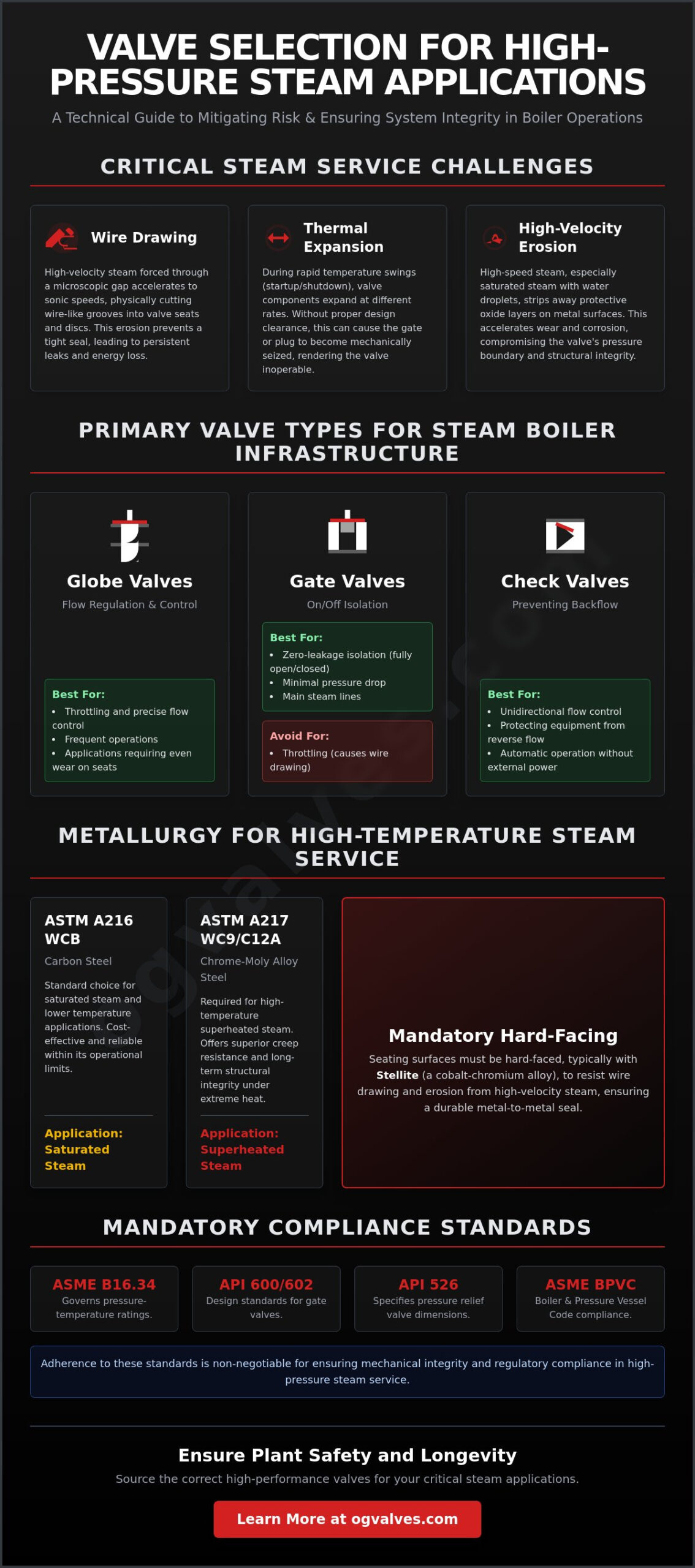
The most destructive phenomenon in steam service is “wire drawing.” This occurs when a valve is not perfectly seated or is used for improper throttling. High-pressure steam forced through a microscopic gap accelerates to sonic velocities, creating a concentrated jet that physically cuts into the metal. This erosion produces thin, wire-like grooves across the seating surface, rendering the valve incapable of achieving a tight shut-off. While isolation valves manage these flow conditions, Safety Valves remain the mandatory last line of defense for overpressure protection within the boiler circuit.
Thermal expansion presents another mechanical hurdle. During startup and shutdown, the temperature of a steam line can swing hundreds of degrees. In standard gate valves, the gate and the body often expand at different rates. If the design doesn’t provide sufficient internal clearance, the gate can become mechanically “stuck” or seized within the body seats. This risk is compounded by water hammer, where slugs of accumulated condensate are propelled by steam at high speeds. These liquid masses act as physical projectiles, delivering impact loads that can shatter brittle valve components or strip internal stems.
Saturated vs. Superheated Steam Requirements
Saturated steam contains entrained moisture, which significantly increases the risk of impingement erosion on internal valve parts. The presence of water droplets requires specific body geometries to prevent localized thinning of the pressure boundary. Conversely, superheated steam is dry but operates at temperatures where metal creep becomes a primary failure mode. For these applications, metallurgy must focus on long-term structural integrity and high-temperature oxidation resistance rather than just simple pressure containment.
The Impact of Velocity and Erosion
In steam service, velocity is a critical specification. High-velocity steam strips away the protective oxide layer on metal surfaces, accelerating corrosion and wear. To combat this, hard-facing is mandatory for most steam-contact surfaces. The application of Stellite, a cobalt-chromium alloy, provides the necessary hardness to resist both wire drawing and physical erosion. It’s also why soft-seated valves, such as those using PTFE or EPDM, are generally prohibited; these materials can’t withstand the thermal loads and are easily destroyed by the sheer force of the steam flow. Proper valve selection for steam boiler applications dictates that all sealing surfaces utilize metal-to-metal contact with appropriate hardness differentials to prevent galling.
Primary Valve Types for Steam Boiler Infrastructure
Steam boiler systems require a tiered approach to valve deployment, where each component is selected based on its specific mechanical function within the thermal cycle. While the previous section detailed the physics of steam erosion, this analysis focuses on the hardware configurations that withstand those forces. Understanding Boiler Selection Basics is the first step in identifying the mandatory safety and operational boundaries of the plant. Effective valve selection for steam boiler applications depends on categorizing valves into isolation, regulation, and non-return functions to ensure system stability.
Globe Valves for Throttling and Control
Globe valves serve as the primary mechanism for flow regulation. Their internal geometry forces steam to change direction, allowing for precise control through parabolic plug designs. This configuration ensures that the seat and plug wear evenly, extending the component’s service life during frequent operation. Strategic valve selection for steam boiler applications prioritizes globe valve throttling over gate valve usage for regulation because it avoids the high-velocity vibration and seat chatter that typically destroys isolation-only designs. For high-pressure environments, top-entry configurations are preferred to simplify maintenance without removing the valve body from the steam line.
Gate Valves for Main Steam Isolation
For main steam line isolation, gate valves are the industry standard due to their low-pressure drop in the fully open position. In steam service, flexible wedge designs are superior to solid wedges because they accommodate the thermal expansion of the valve body without seizing. High-pressure boiler feed applications often utilize pressure seal bonnets, which use the internal system pressure to tighten the seal, rather than relying solely on bolt torque. A critical safety feature is the gate valve OS&Y (Outside Screw and Yoke) design. This allows operators to visually verify the valve’s position and protects the stem threads from the corrosive steam environment.
Non-Return and Check Valve Selection
Check valves are essential for preventing backflow to the boiler drum during sudden pressure drops or pump failures. Piston check valves are generally more effective than swing checks for pulsating steam flow, as they provide more stable dampening. These check valves play a vital role in preventing thermal shock by ensuring that cooler condensate doesn’t re-enter high-temperature sections of the boiler. For large-scale infrastructure, high-performance triple-offset butterfly valves offer a compact alternative for isolation in large diameter lines where space is a constraint. If you’re designing a new system, specifying ASME-compliant globe valves ensures your infrastructure meets the latest safety benchmarks.

Metallurgical integrity is the definitive factor in ensuring operational reliability for high-pressure steam systems. While the mechanical design of a valve dictates its function, the material specification determines its survival against thermal degradation. Correct valve selection for steam boiler applications requires a rigorous alignment of ASTM material grades with the specific pressure-temperature (P-T) curves of the steam circuit. A failure to match metallurgy to the operating environment leads to rapid component thinning and potential pressure boundary breach.
Carbon Steel (ASTM A216 WCB) remains the industry standard for moderate steam temperatures. It’s cost-effective and provides sufficient structural soundness for saturated steam service. However, its application is strictly limited by thermal thresholds. For superheated steam environments, Alloy Steel (ASTM A217 WC6 or WC9) is mandatory. These Chrome-Moly alloys provide the necessary creep resistance to prevent long-term deformation under stress. In condensate return lines or clean steam applications where carbonic acid corrosion is a risk, Stainless Steel (ASTM A351 CF8M) is specified to maintain system purity and component longevity.
Internal trim materials require even higher specifications than the valve body itself. API 600 Trim 5, which features full Stellite hard-facing on both the seat and the wedge or disc, is the benchmark for steam service. This cobalt-based alloy provides the extreme hardness necessary to resist the “wire drawing” effect discussed in the physics of steam. Without this hard-facing, even high-grade alloy steel bodies will suffer from seat leakage within months of commissioning. This is particularly true in high-differential pressure environments where steam velocity is at its peak.
Managing Creep and Graphitization
Carbon steel faces a critical failure mode known as graphitization when exposed to temperatures exceeding 425°C for prolonged periods. At this stage, the carbides in the steel migrate and form brittle graphite pockets, severely compromising the pressure boundary. Chrome-Moly alloys prevent this migration, maintaining structural integrity at superheated temperatures. All critical boiler valves must be accompanied by EN 10204 3.1 material traceability certificates. This documentation ensures that the chemical composition and mechanical properties of the specific heat match the design specifications exactly.
Gasket and Packing Integrity
Sealing technology must match the thermal endurance of the valve metallurgy. Graphite-based packing is the standard for high-temperature steam due to its self-lubricating properties and thermal stability. For manways and flanged connections, spiral wound gaskets featuring a 316 stainless steel winding with a flexible graphite filler are required. These gaskets provide the resilience needed to maintain a seal during the frequent thermal cycling of a boiler. Effective valve selection for steam boiler applications also incorporates fugitive emission controls; utilize live-loaded packing systems to compensate for the mechanical wear and thermal shifts encountered in steam control stations.
Adherence to International Standards (API, ASME, BS)
Standards in high-pressure steam systems function as the primary legal and safety framework for industrial operations. The 2025 Edition of the ASME Boiler and Pressure Vessel Code (BPVC), which became mandatory on January 1, 2026, serves as the definitive legal framework for current installations. ASME B16.34 acts as the foundational benchmark for pressure and temperature ratings, dictating the maximum allowable working pressure across various material groups. If you ignore these ratings during valve selection for steam boiler applications, you risk structural yielding or catastrophic rupture. Compliance ensures that the valve body thickness and bolt strength are sufficient to contain energy at peak thermal loads.
Distinguishing between API 600 and API 602 is critical for sizing and durability. API 600 governs heavy-duty cast steel gate valves, typically used for larger diameters in main steam headers. Conversely, API 602 covers compact forged steel valves, which are preferred for smaller bore piping where higher fatigue resistance is required. For projects within the European Economic Area, adherence to the Pressure Equipment Directive (PED) is mandatory. It classifies equipment by hazard level, ensuring that every pressure-containing component undergoes rigorous third-party verification. Testing protocols must include hydrostatic shell tests at 1.5 times the design pressure to verify the integrity of the casting or forging.
Critical Standards for Isolation Valves
Verification of internal integrity relies on API 598. This standard specifies the inspection and testing requirements for every valve before it leaves the factory. It includes high-pressure gas testing and seat leakage assessments to ensure zero-leakage performance. For existing plants, ASME B16.10 is the essential reference for face-to-face dimensions. It ensures that new hardware fits perfectly into existing pipe spools without costly modifications. While steam isn’t inherently flammable, many industrial valves must meet specific fire-safe standards to prevent external leaks during a facility fire event.
Quality Assurance and Certification
Correct valve selection for steam boiler applications also requires a detailed review of Mill Test Reports (MTRs). These documents provide the chemical heat analysis and mechanical test results for the specific batch of steel used. For high-alloy valves like WC6 or WC9, Positive Material Identification (PMI) is a non-negotiable quality gate. It uses X-ray fluorescence to confirm the chromium and molybdenum content, preventing the accidental installation of standard carbon steel in superheated sections. If your system handles steam with H2S traces, NACE MR0175 compliance is required to prevent sulfide stress cracking. To ensure your facility meets these global benchmarks, source API-certified steam valves from a verified manufacturer.
Strategic Procurement: Minimizing Downtime in Steam Plants
The economic impact of valve failure in high-pressure steam systems is quantified by the cost of unscheduled outages and lost thermal efficiency. A minor steam leak represents more than just fluid loss; it’s a direct waste of generated thermal energy and treated boiler feedwater. This loss of pressure forces the boiler to work harder, increasing fuel consumption and accelerating the wear on other system components. Procurement decisions based solely on initial purchase price often overlook the operational risks of “wire drawing” and seat erosion detailed in previous sections. Effective valve selection for steam boiler applications must prioritize long-term mechanical reliability over immediate capital expenditure savings. High-performance gate and globe valves specified with full Stellite trim offer a significantly lower Total Cost of Ownership by extending the interval between forced outages.
Procurement cycles for high-alloy components, such as ASTM A217 WC9 globe valves, frequently encounter lead times exceeding 20 weeks. This duration is often incompatible with emergency repairs or compressed maintenance turnarounds. Specialist suppliers like OG VALVES LTD. mitigate these delays through robust global logistics and strategic inventory management. By maintaining a supply chain capable of fast-track delivery, industrial plants can secure critical-path components without compromising on material certifications or safety standards. This ensures that critical infrastructure remains compliant with the 2025 Edition of the ASME BPVC without suffering from extended hardware shortages or logistical bottlenecks in remote project sites.
Optimizing Inventory for Maintenance Turnarounds
Maintenance planners should standardize valve specifications across the boiler island to reduce the volume of on-site spare parts. Standardizing on specific pressure seal designs or OS&Y configurations allows for a leaner inventory of gaskets and packing sets. Regional stockists play a vital role in this ecosystem, providing the necessary surge capacity for national power generation grids during seasonal overhauls. Identifying critical-path valves, those whose failure would necessitate a full boiler shutdown, is the first step in creating a resilient procurement strategy. A proactive strategy for valve selection for steam boiler applications involves more than just verifying pressure ratings; it requires a comprehensive analysis of the vendor’s ability to provide technical documentation and logistical support.
Why Technical Expertise Trumps Unit Price
Relying on technical expertise ensures that every valve meets the rigorous ASME and API standards required for high-pressure service. Validating a specification against the latest regulatory benchmarks requires deep industrial knowledge that goes beyond a standard product catalog. OG VALVES LTD. validates technical specifications for global heavy industry, ensuring that metallurgy and trim selections are optimized for the specific steam state of the facility. This clinical focus on engineering excellence prevents the installation of under-specified hardware that would otherwise fail under thermal stress. Total Cost of Ownership calculations must include the potential revenue loss from a single hour of boiler downtime. To ensure your next outage is supported by precise engineering and reliable hardware, request a technical consultation for your steam boiler project.
Optimizing Steam System Integrity through Technical Specification
Achieving long-term mechanical integrity in high-pressure environments requires a precise alignment of valve metallurgy, trim selection, and international regulatory compliance. As established, the destructive nature of wire drawing and thermal expansion necessitates hardware that exceeds standard industrial specifications. Mastering valve selection for steam boiler applications ensures that your facility maintains zero-leakage isolation and adheres to the mandatory requirements of the ASME Boiler and Pressure Vessel Code 2025 Edition. By prioritizing Total Cost of Ownership over initial unit price, engineers can effectively mitigate the risks of catastrophic failure and unplanned downtime.
Our organization supports global heavy industry with technical expertise in high-temperature metallurgy and an extensive inventory of API 600 and API 602 valves. We provide global fast-track delivery to ensure critical components reach your site when they’re needed most. Contact OG VALVES LTD. for Expert Steam Valve Specification to secure the reliability of your thermal infrastructure. We’re ready to partner with you in maintaining the highest standards of industrial safety and operational excellence.
Frequently Asked Questions
Which valve is best for steam isolation?
Gate valves are the industry standard for main steam line isolation because they provide a straight-through flow path with minimal pressure drop. Their design allows for a tight metal-to-metal seal that’s essential for high-pressure containment. For smaller diameter lines or where frequent operation is required, globe valves are often preferred for their superior shut-off capabilities and ease of maintenance.
Can I use a ball valve for high-pressure steam throttling?
Ball valves shouldn’t be used for throttling in high-pressure steam systems. These valves are designed for on-off service; partially opening them exposes the seats to high-velocity steam that causes rapid erosion and “wire drawing.” This mechanical degradation prevents the valve from achieving a bubble-tight seal. Globe valves with parabolic plugs are the mandatory choice for precise flow regulation in these environments.
What is the difference between API 600 and API 603 for steam?
API 600 specifies heavy-duty cast carbon and alloy steel gate valves with substantial wall thicknesses designed for high-pressure industrial service. API 603 covers light-walled, corrosion-resistant valves typically made from stainless steel. While API 603 valves are useful in chemical processing, they lack the structural mass and pressure-temperature ratings required for the main steam headers found in power generation and heavy industrial boiler plants.
Why do steam valves use OS&Y (Outside Screw and Yoke) designs?
The OS&Y design is a critical safety feature that keeps the stem threads outside the valve body, protecting them from the corrosive effects of high-temperature steam. This prevents lubrication washout and thread galling, ensuring the valve remains operable over long service lives. It also provides operators with an immediate visual confirmation of the valve’s open or closed position from a distance.
What material is recommended for superheated steam at 500°C?
Alloy steel ASTM A217 Grade WC9 is the standard recommendation for superheated steam at 500°C. This Chrome-Moly alloy is engineered to provide high creep resistance and prevents the graphitization that occurs in standard carbon steel at temperatures exceeding 425°C. Precise valve selection for steam boiler applications at these temperatures must also include Stellite hard-facing on all seating surfaces to resist thermal wear.
How often should isolation valves in a boiler room be tested?
Isolation valves should be partially cycled at least every six months to ensure they don’t seize due to mineral buildup or thermal binding. Full seat leakage testing and hydrostatic inspections should follow the mandatory intervals established by the ASME Boiler and Pressure Vessel Code and local jurisdictional requirements. Regular testing is the only way to verify that the hardware will perform during an emergency shutdown.
What causes a steam valve to seize during operation?
Seizing is usually caused by differential thermal expansion between the valve gate and the body during rapid temperature shifts. If the internal clearances are too tight, the expanding metal components lock together mechanically. This issue is often exacerbated by “thermal pinching,” where a valve is closed while hot and then contracts as it cools, making it nearly impossible to open without damaging the stem or drive nut.
Is a pressure seal bonnet necessary for all steam applications?
Pressure seal bonnets aren’t required for all systems but are essential for high-pressure valve selection for steam boiler applications above Class 900. These designs use internal system pressure to tighten the seal, making them more effective as the pressure increases. For lower pressure or saturated steam service, a standard bolted bonnet is sufficient and offers simpler maintenance procedures during routine plant turnarounds.
 Responsive Menu