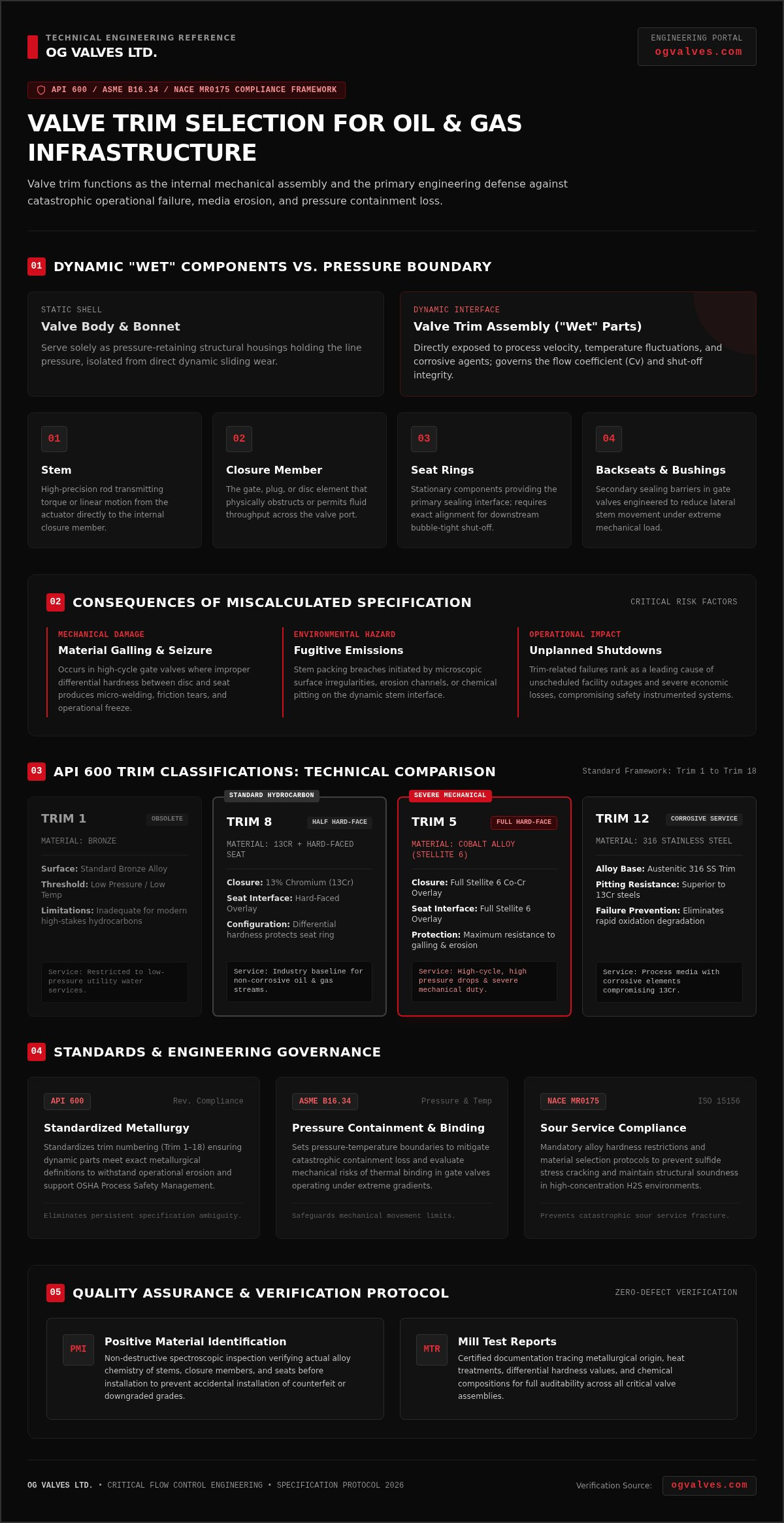
In high-pressure oil and gas environments, valve trim isn’t merely a component; it is the primary engineering defense against catastrophic operational failure. Technical experts recognize that a single miscalculation during valve trim selection for oil and gas results in accelerated material degradation, unplanned downtime, and pressure containment loss. The persistent ambiguity in API trim numbering continues to pose a significant risk to the structural soundness of critical infrastructure and NACE MR0175 compliance.
This technical guide provides the clinical precision required for definitive material specification, ensuring your components meet the rigorous demands of 2026 industrial standards. You’ll gain the engineering insights necessary to ensure unwavering reliability and strict regulatory compliance across global asset portfolios.
The following analysis examines definitive material classifications for gate, ball, and globe valves, verifies adherence to the latest API 600 revisions, and establishes engineering protocols to eliminate the risks of galling and cavitation in specialized environmental applications.
Key Takeaways
- Identify the specific material properties of API 600 Trim classifications to prevent premature erosion and ensure long-term operational output.
- Execute precise valve trim selection for oil and gas by evaluating ASME B16.34 pressure-temperature ratings and the mechanical risks of thermal binding in gate valves.
- Align material specifications with NACE MR0175/ISO 15156 requirements to maintain structural soundness in high-concentration H2S environments.
- Establish comprehensive procurement protocols using Positive Material Identification (PMI) and Mill Test Reports (MTRs) to verify the chemical and physical compliance of all internal components.
The Critical Role of Valve Trim in Oil and Gas Infrastructure
Valve trim constitutes the internal mechanical assembly responsible for the primary functions of flow regulation and positive shut-off. Trim is the interface between the valve body and the process media. Unlike the valve body or bonnet, which serve as pressure-retaining structural housings, trim components are the dynamic “wet” parts that endure direct exposure to process velocity, temperature fluctuations, and corrosive agents. Precise valve trim selection for oil and gas is therefore a core requirement for maintaining facility safety protocols and ensuring the mechanical integrity of high-pressure systems. Engineers must distinguish between the static pressure boundary and the internal elements that facilitate the operational output of the unit.
Defining Trim Components for Critical Service
In heavy industrial applications, the trim typically consists of the following essential components:
- Stem: The high-precision rod that transmits torque or linear motion from the actuator to the internal closure member.
- Closure Member: The gate, plug, or disc that physically obstructs or permits fluid flow through the valve port.
- Seat Rings: The stationary components that provide the primary sealing surface when the valve is in the closed position.
High-specification gate valves also incorporate backseats and bushings to provide secondary sealing and reduce lateral stem movement under load. Each component’s geometry directly influences the flow coefficient (Cv). This determines the valve’s capacity to manage specific pressure drops without inducing excessive turbulence. For a detailed breakdown of these mechanical interactions, engineers often reference control valve trim components and function to align mechanical design with process control requirements. Seat rings require precise alignment and material hardness to achieve the bubble-tight shut-off required in downstream gas processing.
Consequences of Improper Trim Selection
Failure to execute rigorous valve trim selection for oil and gas leads to rapid mechanical degradation and structural compromise. Galling is a frequent issue in high-cycle gate valve applications where improper material hardness leads to surface welding and seizure between the disc and seat. Beyond mechanical failure, trim wear is a primary driver of fugitive emissions. Stem packing leaks often originate from microscopic surface irregularities on the stem caused by erosion or chemical pitting. Industry performance reports indicate that trim-related failures are a leading cause of unplanned facility shutdowns, resulting in significant economic losses. Selecting materials that lack the necessary resistance to the specific process media, such as failing to specify NACE-compliant alloys in sour service, compromises the entire safety instrumented system. It’s a risk that technical procurement specialists must mitigate through rigorous material verification and adherence to international standards.
Material Specifications and API 600 Trim Standards
The API 600 trim chart serves as the definitive framework for engineers during the valve trim selection for oil and gas. This standardized system, ranging from Trim 1 to Trim 18, ensures that internal components possess the necessary metallurgical properties to withstand specific process conditions. Adherence to these standards is mandatory for meeting OSHA process safety management requirements for oil and gas, particularly when dealing with hazardous or high-pressure media. Material compatibility is the primary factor in maintaining the structural integrity of industrial valves over extended operational lifecycles.
Decoding API Trim Numbers
Technical specifications often center on the distinction between Trim 5 and Trim 8. Trim 5 represents a full hard-face configuration, where both the seat and the closure member are overlaid with cobalt-based alloys like Stellite 6. In contrast, Trim 8 utilizes a half hard-face design, featuring a 13Cr closure member against a hard-faced seat. While Trim 8 is the industry standard for non-corrosive hydrocarbons, Trim 12 (316 Stainless Steel) is specified when the media contains corrosive elements that would compromise 13Cr alloys. Trim 1, which utilizes bronze, is largely obsolete in modern high-stakes processing due to its limited temperature and pressure thresholds; it’s generally restricted to low-pressure utility water services.
The engineering logic for choosing 13Cr versus 316 Stainless Steel depends on the presence of CO2 or H2S. 13Cr provides excellent erosion resistance and sufficient corrosion protection for many upstream applications. However, 316 Stainless Steel offers superior resistance to pitting and crevice corrosion in more aggressive environments. When galling is a concern, hard-facing with cobalt-based alloys becomes a non-negotiable requirement to ensure the valve remains operable under high differential pressures.
Advanced Alloys for Erosive Media
Standard materials often fail in extreme environments, necessitating the use of specialized alloys. Monel and Inconel are frequently deployed in high-salinity or high-acid environments where standard stainless steels undergo rapid degradation. In subsea installations, the use of Super Duplex in check valves provides the necessary yield strength and corrosion resistance to withstand the external hydrostatic pressure and internal flow velocity. Seat surfaces in abrasive sand-slurry service must maintain a minimum surface hardness of 50 HRC to withstand particle impingement and high-velocity erosion.
Executing precise valve trim selection for oil and gas requires a clinical focus on these metallurgical nuances. Failure to specify the correct alloy results in localized corrosion or mechanical seizure. For technical experts, verifying these specifications against Mill Test Reports is a critical step in the quality assurance process. You can ensure your facility remains compliant by sourcing API-compliant components that meet these exact engineering benchmarks.
Engineering Criteria for Optimal Trim Selection
Mechanical integrity in high-pressure systems depends on evaluating Pressure-Temperature (P-T) ratings according to ASME B16.34. These ratings define the maximum allowable working pressure for specific material groups across a range of operating temperatures. Technical experts must ensure that valve trim selection for oil and gas accounts for the reduction in material yield strength at elevated temperatures. The U.S. Department of Energy oil and gas infrastructure research highlights how material performance under these stressors directly impacts the long-term reliability of critical assets. Utilizing flow testing data allows engineers to predict trim longevity by simulating the erosive effects of high-velocity media before deployment.
In high-temperature service, technical specialists must assess the risk of thermal binding in solid wedge gate valves. This phenomenon occurs when a valve is closed while at operating temperature and subsequently cools; the valve body contracts more rapidly than the wedge, pinning the closure member and requiring excessive torque to reopen. To mitigate this, engineers often specify flexible wedges or split-wedge designs that accommodate thermal expansion and contraction without compromising the seat seal.
For ball valves, the surface finish of the ball and seat rings is a critical engineering variable. Friction coefficients determine the required operating torque, which influences actuator sizing and overall system response time. A superior surface finish reduces the mechanical wear on soft seats and prevents localized pitting in metal-seated configurations. Achieving industrial precision in these finishes ensures that the valve remains operational through thousands of cycles in high-torque applications.
Managing Cavitation and Flashing
Cavitation occurs when local pressure drops below the vapor pressure of the liquid, forming bubbles that collapse violently upon reaching higher pressure zones. This process causes severe pitting and structural degradation. While often associated with control valves, cavitation also threatens isolation valves during the transition between open and closed states. The design of multi-stage trim, such as labyrinth or cascade paths, dissipates kinetic energy across several stages to maintain pressure above the critical vapor point. Material selection for these environments favors hardened 410SS or Tungsten Carbide to resist the high-impact energy of collapsing vapor bubbles.
Preventing Galling in High-Cycle Service
Galling represents a significant failure mode in valve trim selection for oil and gas, particularly where sliding contact occurs under high loads. Engineering protocols require a differential hardness of at least 50 HB (Brinell) between the disc and seat rings to prevent surface welding. Lubrication protocols provide temporary relief but often fail in high-temperature environments where traditional greases carbonize. Specifying nitriding or Electroless Nickel Plating (ENP) for stem protection provides a low-friction, high-hardness barrier that prevents seizure and maintains the structural soundness of the stem assembly over its service life.
Application-Specific Trim Configurations
Standardized API trim classifications provide a baseline, yet specialized operational environments necessitate bespoke configurations to maintain structural soundness. Valve trim selection for oil and gas must account for extreme chemical stressors and thermal variances that exceed standard process parameters. In applications involving sour gas or cryogenic fluids, material performance is the primary variable in preventing catastrophic containment loss. Precise engineering of these internal elements ensures facility safety during both steady-state operations and transient pressure events.
Sour Gas Compliance (H2S)
Sour service environments require strict adherence to NACE MR0175/ISO 15156 standards to prevent sulfide stress cracking and hydrogen-induced cracking. Stress Corrosion Cracking (SCC) is mitigated through controlled heat treatment processes that ensure uniform grain structure and eliminate residual stresses. The maximum hardness for metallic trim components in sour service is restricted to 22 HRC to mitigate the risk of sulfide stress cracking. Beyond the primary closure members, material restrictions extend to internal trim fasteners and bolting, which must also meet NACE hardness and chemistry requirements. Verification of these properties requires comprehensive documentation, including Mill Test Reports (MTRs) and hardness testing certificates, to confirm regulatory adherence.
High-Pressure and Cryogenic Trim
Cryogenic LNG service introduces the challenge of managing seal integrity at temperatures reaching -196°C. Trim configurations for these applications utilize extended bonnets to position the stem packing away from the cryogenic liquid, preventing packing freeze and ensuring operational output. PCTFE is frequently specified for soft seats due to its dimensional stability and sealing performance at temperatures below -150°C. In high-pressure butterfly valves, the technical preference often shifts toward lip-seals rather than O-rings to accommodate the rapid thermal contraction of the valve body. For large-bore globe valves, pressure-balanced trim designs are utilized to reduce the axial forces on the stem, allowing for smaller actuators and more precise flow control. High-temperature steam in Enhanced Oil Recovery (EOR) requires similar rigor, favoring cobalt-based hard-facing to resist thermal erosion. For critical infrastructure projects, you should source high-specification trims that meet these exact engineering benchmarks to ensure long-term reliability.
Procurement Rigor and Quality Assurance in Valve Supply
Engineering specifications for valve trim selection for oil and gas are only as effective as the verification processes that govern the supply chain. In high-stakes industrial sectors, the risk of material substitution or non-compliant metallurgical properties poses a direct threat to operational safety. Procurement rigor involves a clinical transition from theoretical design to the physical verification of every internal component. Technical experts recognize that visual inspection is insufficient for identifying the subtle differences between alloy grades. Rigorous quality assurance protocols ensure that the structural integrity of critical infrastructure is never compromised by substandard components or documentation errors.
Technical Documentation and PMI Testing
Positive Material Identification (PMI) is a non-negotiable requirement for verifying the chemical composition of stems, discs, and seat faces. Standard protocols utilize X-ray fluorescence (XRF) or optical emission spectroscopy (OES) to confirm that the delivered materials match the Mill Test Reports (MTRs). This verification is critical for preventing the installation of 13Cr components in environments where 316 Stainless Steel was specified. Engineers must review MTRs to ensure chemical and physical property compliance with global standards. For critical service components, verifying EN 10204 3.1 or 3.2 certification provides the necessary traceability for insurance and regulatory audits.
Non-destructive testing (NDT) further secures the mechanical reliability of the valve. Liquid penetrant testing and ultrasonic examinations are utilized to verify hard-facing thickness and adhesion on Stellite-faced components. These tests detect microscopic surface cracks or bonding failures that could lead to trim erosion during high-pressure service. Maintaining this level of technical oversight eliminates the ambiguity often found in generic procurement cycles.
Sourcing for Fast-Track Projects
Valve trim selection for oil and gas significantly impacts delivery timelines. Common API configurations, such as Trim 5, Trim 8, and Trim 12, are typically maintained in global inventory for immediate dispatch. However, custom trim requirements involving Super Duplex or Inconel often necessitate extended lead times for raw material sourcing and specialized machining. Technical supply expertise allows procurement specialists to identify where standard trims meet operational needs, avoiding the unnecessary costs and delays of over-specification. Leveraging established global supply chains ensures that high-specification valves reach the site without compromising quality or safety benchmarks. If you require assistance with complex material specifications, contact OG VALVES LTD. for technical support on your next project specification to ensure your assets meet 2026 industrial standards.
Expediting custom trim manufacturing requires a methodical approach to project management. Reliable partners coordinate with foundries and testing laboratories to streamline the production of high-spec alloys without bypassing essential quality control gates. This clinical focus on both speed and precision allows operators to minimize downtime during scheduled turnarounds or emergency replacements. Every component must undergo the same rigorous testing protocols, regardless of the urgency of the delivery schedule.
Securing Infrastructure Integrity through Technical Specification
Effective valve trim selection for oil and gas requires a clinical focus on metallurgical properties and unwavering adherence to global standards. Technical experts must align material choices with specific environmental stressors, such as H2S concentration or cryogenic temperatures, to ensure consistent operational output. This guide has detailed the necessity of verifying API 600 trim classifications and implementing rigorous procurement protocols to mitigate the risks of erosion, galling, and non-compliance. Every internal component serves as a critical barrier against operational failure and unplanned downtime.
As an ISO 9001 certified supplier, OG VALVES LTD. provides the deep technical expertise in ASME and API standards necessary to eliminate ambiguity in the procurement cycle. Our global fast-track logistics ensure that high-specification components reach your facility with minimal delay, maintaining the structural soundness of your assets. Request a Technical Quote for API-Compliant Industrial Valves to verify your next project specification against 2026 industrial benchmarks. We’re committed to supporting your critical infrastructure through precise engineering and a no-nonsense focus on long-term performance.
Frequently Asked Questions
What is the difference between valve trim and valve body?
Valve trim refers to the internal components responsible for flow control and shut-off, including the stem, disc, and seat rings. The valve body is the external pressure-containing shell that houses these components. While the body maintains structural integrity under line pressure, the trim manages the dynamic forces of the process media. Understanding this distinction is essential for valve trim selection for oil and gas to ensure internal parts withstand erosive and corrosive stressors.
How do I choose the correct API trim number for sour gas service?
Selecting the correct API trim number for sour gas requires strict adherence to NACE MR0175/ISO 15156 standards. Trim 12 or Trim 16 are common choices, provided the materials meet specific hardness limits. Metallic components must not exceed a maximum hardness of 22 HRC to prevent sulfide stress cracking. Engineering teams must verify these properties through Mill Test Reports and Positive Material Identification to ensure the structural soundness of the installation.
What are the most common causes of valve trim failure in oil and gas?
Trim failure typically results from high-velocity erosion, chemical corrosion, or mechanical galling. In abrasive services, suspended solids induce rapid material loss on seat faces. Sour service environments lead to sulfide stress cracking if material hardness isn’t strictly controlled. Additionally, cavitation during high-pressure drops causes localized pitting that compromises the bubble-tight shut-off. Rigorous valve trim selection for oil and gas mitigates these risks by matching metallurgical properties to the specific environmental stressors.
Is Stellite 6 always required for high-pressure seat rings?
Stellite 6 isn’t universally mandatory, but it’s the industry standard for high-pressure and high-temperature seat rings. This cobalt-based alloy provides superior resistance to thermal erosion and mechanical galling compared to standard 13Cr. In steam service or high-cycle applications, hard-facing is essential for maintaining seal integrity. However, for low-pressure utility services, standard 13Cr or 316SS trims without hard-facing may provide sufficient durability while reducing the initial procurement costs of the component.
Can valve trim be replaced without replacing the entire valve?
Valve trim is designed to be replaceable in most gate, globe, and check valves, provided the pressure-retaining body remains within its wall-thickness tolerances. This allows operators to restore sealing performance during scheduled turnarounds without the expense of replacing the entire valve housing. Proper maintenance involves swapping out stems, discs, and seat rings. However, replacing trim requires precision machining and alignment to ensure the new components achieve the required leakage class and operational output.
What does ‘half hard-faced’ mean in an API trim specification?
A ‘half hard-faced’ specification, such as API Trim 8, indicates that only the seat rings are overlaid with a hardened material like Stellite 6. The closure member, such as a gate wedge or globe disc, remains a standard 13Cr stainless steel. This configuration provides a balance of durability and cost-efficiency. It places the most wear-resistant material at the primary sealing interface while utilizing standard alloys for the dynamic components that are less susceptible to localized impingement.
How does temperature affect the selection of elastomer vs. metal trim seats?
Operating temperature is the primary factor in choosing between elastomer and metal trim seats. Elastomeric or soft seats, such as PTFE or Viton, provide excellent bubble-tight shut-off but degrade rapidly at temperatures exceeding 200°C. Metal-seated trims are required for high-temperature steam or cryogenic LNG service where polymers lose dimensional stability. While metal seats require more precise machining to achieve tight sealing, they offer the structural soundness necessary for extreme thermal ranges.
Why is 13Cr stainless steel the default for many oil and gas gate valves?
13Cr stainless steel is the default material due to its balanced mechanical properties and cost-effectiveness. It offers significant resistance to atmospheric corrosion and high-velocity erosion in non-corrosive hydrocarbon service. 13Cr provides sufficient yield strength for stems and wedges in standard oil and gas applications. When process media contains higher concentrations of CO2 or H2S, engineers typically upgrade from 13Cr to 316SS or higher alloys to prevent localized pitting and maintain component longevity.
 Responsive Menu