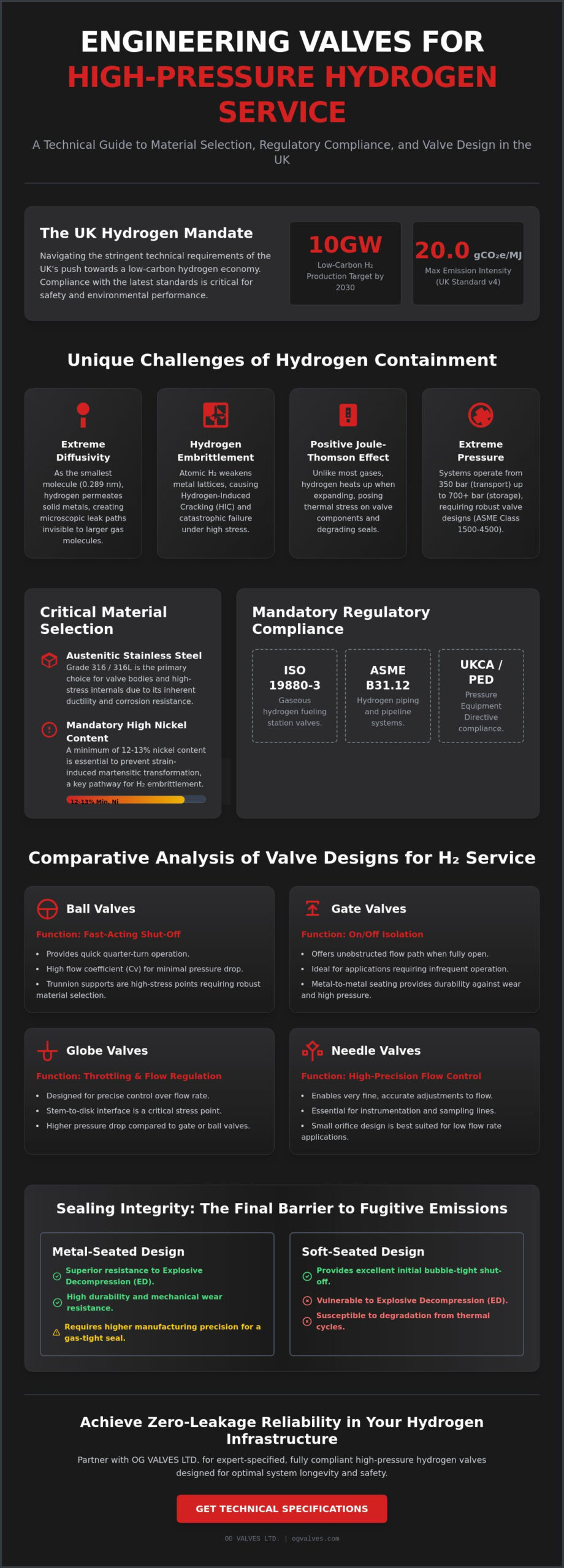
Standard high-pressure engineering protocols are insufficient for the molecular realities of hydrogen containment. As the UK scales toward its 10GW low-carbon hydrogen production target by 2030, technical requirements for infrastructure have become increasingly stringent. Selecting valves for high pressure hydrogen service uk now demands strict adherence to the UK Low Carbon Hydrogen Standard Version 4, published in January 2026. This regulation mandates a greenhouse gas emission intensity threshold of 20.0 gCO₂e/MJLHV, placing a clinical focus on fugitive emission control and material integrity.
Engineers recognize that hydrogen embrittlement and molecular diffusion pose existential risks to standard industrial components. This technical guide delivers a comprehensive analysis of the material compatibility and regulatory benchmarks required for high-stakes hydrogen infrastructure. We provide a detailed specification framework for gate, ball, globe, and needle valves to ensure compliance with ISO 19880-3 and ASME B31.12 standards. Readers will gain the precise data necessary to achieve zero-leakage reliability and optimized system longevity in extreme pressure environments.
Key Takeaways
- Identify critical material requirements for austenitic stainless steels, specifically 316/316L with high nickel content, to mitigate hydrogen embrittlement and ensure long-term fatigue life.
- Evaluate the engineering selection criteria for valves for high pressure hydrogen service uk, focusing on ASME Class 1500 through 4500 pressure ratings and precise Flow Coefficient (Cv) calculations.
- Analyze the performance characteristics of different valve designs, such as industrial ball valves for fast-acting shut-off versus needle valves for high-precision flow control in gaseous hydrogen lines.
- Integrate ISO 19880-3 and ASME B31.12 regulatory benchmarks into procurement protocols to maintain compliance with the latest UK industrial safety and emission standards.
Challenges of High-Pressure Hydrogen Containment in Industrial Systems
High-pressure hydrogen infrastructure in the UK is defined by operational environments ranging from 350 bar in heavy-duty transport to upwards of 700 bar in localized storage and refueling systems. These pressures present unique containment challenges that exceed the capabilities of standard industrial fluid control. Hydrogen’s molecular diameter is approximately 0.289 nm, making it the smallest known molecule. This characteristic results in extreme diffusivity, allowing the gas to permeate solid metal structures and escape through microscopic leak paths that would remain sealed in nitrogen or methane service. Engineering valves for high pressure hydrogen service uk requires a clinical focus on molecular containment and structural integrity under these extreme conditions.
Thermal management is a critical factor during rapid compression and expansion cycles. Unlike most gases, hydrogen possesses a positive Joule-Thomson coefficient at ambient temperatures. It heats up when expanding through an orifice or valve seat. This phenomenon necessitates precise thermal modeling to prevent seal degradation and ensure the valve body can withstand localized temperature spikes without compromising its mechanical properties. Failure to account for these thermal shifts often leads to premature component fatigue and compromised safety margins.
The Mechanism of Hydrogen-Induced Cracking
Hydrogen-induced cracking (HIC) and hydrogen embrittlement (HE) occur when atomic hydrogen dissociates at the metal surface and permeates the grain boundaries of carbon and low-alloy steels. Once inside the lattice, these atoms accumulate at inclusions and high-stress zones, creating internal pressure that initiates sub-critical crack growth. High-stress internals, such as the stem-to-disk interface in globe valves or the trunnion supports in ball valves, are particularly susceptible. Temperature acts as a catalyst; while embrittlement is often most severe at ambient temperatures, elevated temperatures increase the diffusion rate, allowing hydrogen to penetrate deeper into the valve’s structural components. It’s essential to select materials with high nickel and chromium content to maintain ductility in these environments.
Sealing Integrity and Fugitive Emissions
Achieving zero-leakage performance is the primary benchmark for safety in high-pressure hydrogen systems. Standard Hydrogen valve technology distinguishes between soft-seated and metal-seated designs based on the specific pressure and temperature profile of the application. While soft seals provide initial bubble-tight shut-off, they’re vulnerable to explosive decompression (ED). This occurs when gas absorbed into the elastomer at high pressure expands rapidly during a pressure drop, physically rupturing the seal. Metal-to-metal seating, often utilized in gate and check valves, offers superior resistance to ED and mechanical wear, though it requires higher precision in manufacturing to ensure a gas-tight interface. Minimizing fugitive emissions isn’t just a safety requirement; it’s a regulatory necessity for valves for high pressure hydrogen service uk to meet evolving environmental standards.
Material Science and Regulatory Standards for Hydrogen Valves
Material selection for high-pressure hydrogen service is governed by the chemical interaction between the gas and the metallic lattice. Austenitic stainless steels, specifically grades 316 and 316L, serve as the primary choice for valve bodies and internals. These alloys must maintain a nickel equivalent that ensures structural stability under high stress. Low-nickel variants are prone to strain-induced martensitic transformation, which creates pathways for atomic hydrogen diffusion. For valves for high pressure hydrogen service uk, specifying a minimum nickel content of 12% to 13% is a standard engineering safeguard against embrittlement and subsequent fatigue failure.
Regulatory compliance requires a multi-layered approach to certification. ISO 19880-3 defines the specific requirements for gaseous hydrogen fueling station valves, but industrial applications often require broader adherence to API 6D for pipeline service or API 600 for heavy-duty gate valves. Compliance with the Pressure Equipment Directive (PED) and the UKCA marking is mandatory for all equipment operating in the UK. Rigorous testing protocols, including those found in the EU Type-Approval for Hydrogen Components, establish the baseline for endurance and pressure cycle resistance. The intersection of high operating pressures and the small molecular size of hydrogen makes ISO 15848-1 compliance a primary engineering hurdle. While standard valves might pass Class C leakage tests, hydrogen service typically demands Class AH or BH to prevent the accumulation of flammable gas in confined industrial spaces.
Standardisation and Certification Requirements
Industrial safety in hydrogen environments depends on fire-safe validation. API 607 certification ensures that a valve maintains sealing integrity during and after exposure to high-intensity fire. This is critical in high-pressure H2 systems where leakages can lead to catastrophic jet fires. Engineering teams must also verify that components meet the stringent fugitive emission standards of ISO 15848-1. This standard measures the leakage of the stem seal under high-pressure cycles, a factor that determines the operational safety of the entire facility. Technical professionals seeking reliable infrastructure should consult with specialists in industrial valves to ensure every material choice aligns with these rigorous global benchmarks.
Advanced Material Specifications
Precision in procurement is verified through Positive Material Identification (PMI) testing. This non-destructive process confirms that the alloy composition matches the design specification before the component enters service. Material traceability is further reinforced by EN 10204 3.1 or 3.2 certification, providing a documented audit trail of the chemical and mechanical properties of the heat. Surface treatments, such as specialized nitriding or advanced coatings, are sometimes employed to reduce the permeability of the base metal. These specifications ensure that valves for high pressure hydrogen service uk maintain their design life despite the aggressive nature of the media. Every component must be backed by quantifiable data to eliminate the risk of material substitution in the supply chain.
Comparative Analysis of Valve Designs for High-Pressure H2 Service
Designing a procurement framework for valves for high pressure hydrogen service uk requires a clear distinction between isolation and control requirements. High-pressure hydrogen infrastructure demands components that can manage rapid pressure fluctuations while maintaining absolute sealing integrity. While quarter-turn designs offer speed, linear valves provide the throttling precision necessary for complex pressure regulation. Selecting the correct valve geometry is as critical as material compatibility to ensure the long-term reliability of the UK’s growing hydrogen network.
Industrial ball valves are the primary choice for fast-acting shut-off applications due to their quarter-turn operation and high-integrity sealing. In high-pressure H2 lines, these valves typically utilize metal-to-metal seats to resist the erosive effects of high-velocity gas particles. For primary isolation in bulk transport or storage headers, gate valves provide a full-bore flow path with minimal pressure drop. This is essential for maintaining system efficiency in high-capacity pipelines where energy loss must be minimized. When the application calls for precision throttling or pressure regulation, globe valves offer superior control characteristics, allowing for fine-tuned flow adjustment through their linear stem motion.
Isolation Valve Performance Matrix
Trunnion-mounted ball valves are the engineering standard for high-pressure hydrogen, as they distribute the mechanical load across the stem and trunnion rather than the seats alone. This prevents seat deformation and ensures consistent torque during operation. In contrast, floating ball designs are generally restricted to smaller diameters or lower pressure ranges where seat loading remains within manageable limits. For instrumentation and sampling lines, needle valves provide the necessary resolution for fine flow control. Backflow prevention is managed through check valves, which must be specified with high-integrity springs and dampers to handle the rapid pressure fluctuations common in hydrogen compression cycles.
Actuation and Control Integration
Automation in hydrogen zones necessitates industrial valve actuators that comply with ATEX or IECEx certifications for hazardous environments. Fail-safe logic is a mandatory safety layer; Normally Closed (NC) configurations are standard for isolation to ensure immediate system shutdown during power or pneumatic loss. These components must integrate seamlessly with Safety Instrumented Systems (SIS) to achieve the required Safety Integrity Level (SIL) for high-pressure operations. The synergy between the valve body and the actuation system determines the overall response time and reliability of the safety loop in valves for high pressure hydrogen service uk.
Engineering Selection Criteria for UK Hydrogen Infrastructure Projects
Engineering selection for valves for high pressure hydrogen service uk requires a rigorous sizing methodology that accounts for the compressible nature of hydrogen gas. Calculating the Flow Coefficient (Cv) is the primary step in ensuring system efficiency. Unlike liquid media, hydrogen’s low density and high velocity at high pressures can lead to choked flow conditions within the valve body. Engineers must ensure the selected Cv accommodates peak flow requirements without inducing sonic velocities that cause vibration or acoustic fatigue. Precise calculation prevents the premature degradation of internal components and ensures the stability of the pressure regulation loop.
Pressure rating selection follows ASME B16.34 standards to ensure structural integrity. In the context of UK hydrogen infrastructure, Class 1500 is often the baseline, while Class 2500 and 4500 are specified for high-pressure storage and injection systems. These ratings provide the necessary wall thickness to resist the hoop stress generated by 700 bar service. Temperature considerations further complicate selection. Valves must remain operational across a vast spectrum, from cryogenic liquid hydrogen at -253°C to high-temperature process gases exceeding 200°C. This range dictates the use of extended bonnets for cryogenic service to protect stem seals from freezing and specialized packing materials for high-temperature applications.
End connection safety is a critical design choice. While flanged connections allow for easier maintenance, high-pressure hydrogen service often favors butt-weld ends to eliminate potential leak paths at gasket interfaces. Threaded connections are generally restricted to small-bore instrumentation lines where the risk of vibration-induced loosening is minimal. Every connection point must be evaluated against the potential for gas migration and the specific safety protocols of the site.
Operational Environment Assessment
The geographical location of the installation significantly impacts valve specification. Offshore UK hydrogen projects face corrosive saline environments, necessitating external coatings and high-grade stainless steel bolting to prevent atmospheric corrosion. Cyclic loading is another critical variable. Hydrogen compression involves frequent start-stop cycles that subject valve seats and stem seals to mechanical fatigue. Specifying valves with reinforced seat designs ensures longevity under these fluctuating stress profiles. Minimizing operational downtime is essential; therefore, selecting components with accessible internals reduces the mean time to repair (MTTR). For technical consultation on these specifications, view the full range of industrial valves available for high-stakes energy projects.
Safety and Risk Mitigation
Hazardous zone safety is reinforced through specific design features. Anti-static devices and anti-blowout stem designs are mandatory to prevent ignition and catastrophic stem ejection under pressure. For high-pressure isolation, Double Block and Bleed (DBB) configurations provide a verified seal by utilizing two independent seating surfaces and a vent. This allows operators to bleed the cavity and confirm isolation before performing downstream maintenance. Secondary metal-to-metal seals provide an emergency containment layer should the primary soft seal fail. These features collectively ensure that valves for high pressure hydrogen service uk meet the highest safety benchmarks for critical infrastructure.
Strategic Procurement and Technical Support from OG VALVES LTD.
OG VALVES LTD. operates as a specialized technical partner for heavy industrial sectors, providing the engineering knowledge required for high-stakes hydrogen infrastructure. The transition to hydrogen energy necessitates a shift from standard procurement to a material-first approach where component failure is not an option. By focusing on industrial precision and safety, the organization serves as a dependable link in the global supply chain, ensuring that every component meets the clinical requirements of high-pressure service. This expertise is critical when selecting valves for high pressure hydrogen service uk, where material integrity and regulatory adherence determine the operational viability of the project.
Technical support extends beyond simple product supply to include comprehensive material consultation and documentation management. Every project is backed by rigorous quality assurance protocols, including EN 10204 3.1 or 3.2 certification and Positive Material Identification (PMI) testing. These processes eliminate the risk of material non-compliance in corrosive or high-pressure environments. Global logistics capabilities allow for fast-track delivery of critical components, ensuring that infrastructure timelines are maintained without compromising on engineering standards. This clinical focus on durability and regulatory adherence builds the high-stakes trust required by technical experts and procurement specialists in the energy sector.
Technical Sourcing and Inventory Management
The organization maintains a comprehensive inventory of gate, ball, and globe valves designed for the most demanding industrial applications. Accessing this specialized stock allows engineers to source components that meet exact Cv requirements and pressure ratings, from ASME Class 1500 to 4500. Technical teams provide support for complex material specifications, ensuring that every valve, whether a needle valve for instrumentation or a check valve for backflow prevention, aligns with international benchmarks. For a detailed analysis of selection criteria, professionals should consult the industrial valves guide to ensure all standards are met.
Partnering for the UK Hydrogen Transition
Supporting the UK’s target of 10GW low-carbon hydrogen production by 2030 requires a supply chain that understands the cost of failure. OG VALVES LTD. minimizes project risk by providing proven industrial solutions that facilitate the transition to net-zero. Reliability is anchored in rigorous testing and a deep understanding of hydrogen’s unique molecular challenges. By providing gate, ball, globe, check, butterfly, plug, and needle valves that meet the UK Low Carbon Hydrogen Standard, the company acts as a benchmark for industrial safety. Technical experts and procurement specialists are encouraged to contact OG VALVES LTD. for clinical consultation and strategic sourcing of valves for high pressure hydrogen service uk.
Securing the Future of UK Hydrogen Infrastructure
Achieving operational safety in hydrogen systems requires a rigorous adherence to material science and international certifications. Engineering teams must prioritize high-nickel austenitic stainless steels to mitigate the risk of hydrogen embrittlement while ensuring compliance with ISO 19880-3 and UKCA marking requirements. The transition toward low-carbon energy necessitates a procurement strategy that values functional reality and long-term performance over short-term cost savings. Selecting valves for high pressure hydrogen service uk is a critical decision that impacts the entire lifecycle of industrial assets.
OG VALVES LTD has operated as an established global supplier since 2014, specializing in high-specification industrial components for heavy industry. Our technical support and fast-track global delivery ensure that your project timelines remain intact without compromising on engineering precision. Whether your application requires gate, ball, or globe valves, our documentation protocols provide the necessary audit trails for high-spec projects. Consult with our technical experts for your high-pressure hydrogen valve requirements to ensure your infrastructure meets the highest safety benchmarks. We’re ready to support your technical objectives.
Frequently Asked Questions
What is hydrogen embrittlement and how does it affect valve selection?
Hydrogen embrittlement is the degradation of a metal’s mechanical properties caused by the diffusion of atomic hydrogen into the material lattice. This phenomenon leads to sub-critical crack growth and sudden structural failure under operational stress. Engineers must select valves for high pressure hydrogen service uk that utilize materials with high resistance to this effect, such as high-nickel austenitic stainless steels, to ensure the integrity of the pressure-retaining boundary.
Which materials are safest for high-pressure hydrogen service?
Austenitic stainless steels, specifically grades 316 and 316L with a minimum nickel content of 12%, are the primary materials for high-pressure hydrogen service. These alloys maintain superior ductility and resist the phase transformations that facilitate hydrogen-induced cracking. For extreme environments, high-performance alloys such as Inconel 718 or Hastelloy C-276 are specified due to their exceptional structural stability and resistance to both embrittlement and corrosive media.
What are the essential ISO standards for hydrogen valves in the UK?
ISO 19880-3 is the primary international standard governing valves for gaseous hydrogen refueling infrastructure. It defines the testing requirements for endurance, leakage, and material compatibility. Additionally, ISO 15848-1 is critical for measuring fugitive emissions, while ISO 11114-1 provides guidelines for the compatibility of metallic materials with hydrogen. Compliance with these standards is a mandatory benchmark for ensuring industrial safety within the UK’s hydrogen network.
Can standard high-pressure ball valves be used for hydrogen applications?
Standard industrial ball valves are typically unsuitable for hydrogen service without specific technical modifications. Hydrogen’s small molecular size and high diffusivity require enhanced sealing systems and materials that resist embrittlement. Standard valves often utilize elastomers prone to explosive decompression or alloys with insufficient nickel content. Using valves for high pressure hydrogen service uk ensures that the component meets the specific metallurgical and sealing benchmarks required for safe molecular containment.
How do fugitive emission standards impact hydrogen valve design?
Fugitive emission standards, such as ISO 15848-1, mandate rigorous stem seal designs to prevent the escape of the small hydrogen molecule. These regulations require the use of high-integrity packing materials and precision-machined stem surfaces to achieve Class AH or BH leakage rates. Design modifications often include live-loaded packing and secondary sealing layers to maintain zero-leakage performance over thousands of operational cycles in high-pressure environments.
What is the role of PMI testing in hydrogen valve procurement?
Positive Material Identification (PMI) testing verifies the chemical composition of valve alloys before they enter service. This non-destructive process ensures that the material matches the heat certificate and meets the minimum nickel and chromium requirements for hydrogen resistance. PMI acts as a final quality control layer; it prevents the accidental installation of sub-standard or substituted materials that could lead to catastrophic failure in high-pressure gas lines.
Why is a trunnion-mounted ball valve preferred for high-pressure hydrogen?
Trunnion-mounted ball valves are preferred for high-pressure hydrogen because they distribute mechanical loads across the trunnion and stem rather than the seats. This design minimizes seat deformation and ensures consistent operating torque under high differential pressures. In contrast, floating ball designs can suffer from excessive seat loading. This leads to premature wear and potential leakage paths for the highly diffusive hydrogen gas.
Does OG VALVES LTD. provide technical support for hydrogen project specifications?
OG VALVES LTD. provides comprehensive technical support for complex hydrogen project specifications and material selection. Technical experts assist procurement teams in navigating evolving ISO and API standards to ensure every component meets the specific needs of the application. This support includes the provision of full documentation, such as EN 10204 3.1 or 3.2 certificates, and guidance on selecting the optimal gate, ball, or globe valve configurations for high-pressure infrastructure.
 Responsive Menu