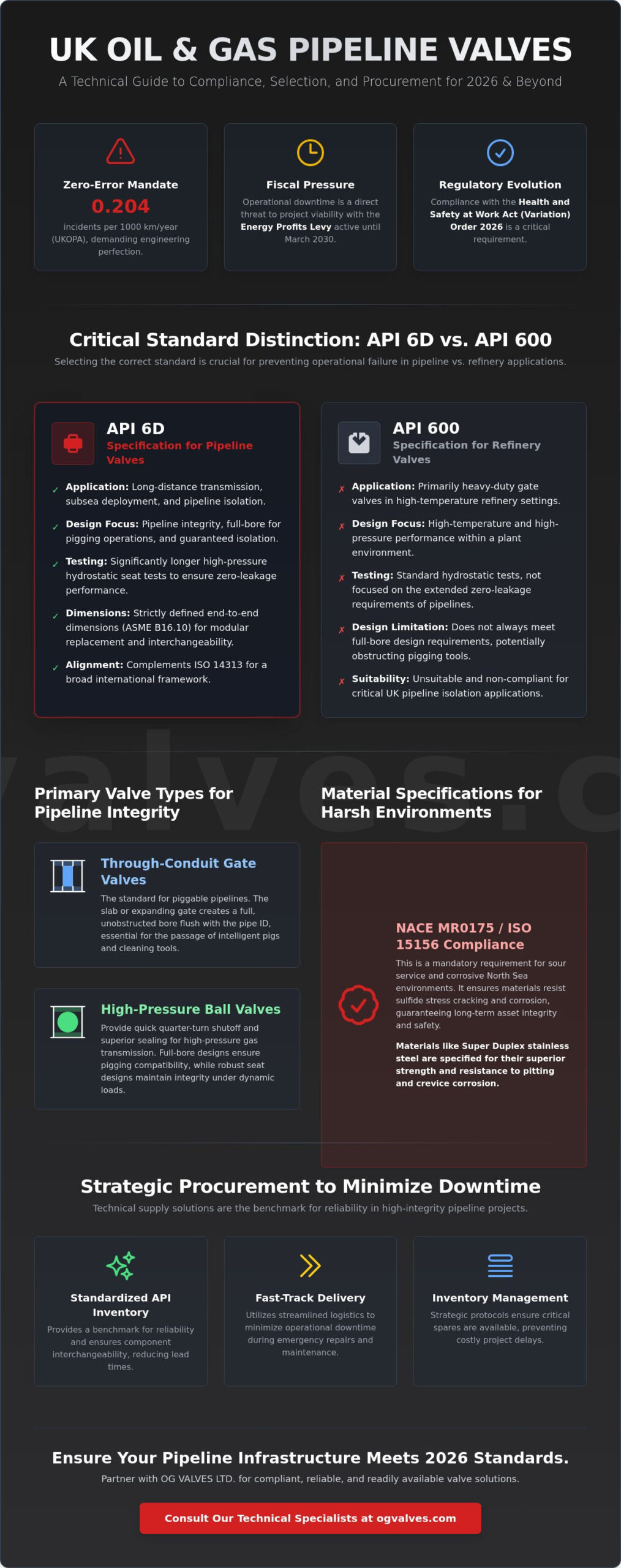
With an overall failure frequency of 0.204 incidents per 1000 km/year reported by UKOPA, the margin for engineering error in the North Sea is effectively zero. For procurement specialists and technical engineers, the selection of valves for oil and gas pipelines uk is no longer just a matter of component replacement; it’s a critical compliance requirement under the Health and Safety at Work etc. Act 1974 (Variation) Order 2026. You’re likely aware that operational downtime caused by material fatigue or regulatory non-compliance isn’t just an inconvenience. It’s a direct threat to project viability in a fiscal environment where the Energy Profits Levy remains active until 31st March 2030.
This article delivers a definitive technical analysis of pipeline valve standards, material science, and procurement strategies tailored for the 2026 regulatory landscape. You’ll learn how to specify components that exceed API 6D requirements and ensure long-term corrosion resistance in volatile offshore environments. We provide a structured overview of advanced material classifications, such as Super Duplex applications, and analyze how the recent Procurement Act implementation affects your technical supply chain and project visibility.
Key Takeaways
- Understand the critical technical distinctions between API 6D and API 600 standards to ensure full compliance with current UK offshore and onshore safety regulations.
- Evaluate the performance characteristics of through-conduit gate valves and high-pressure ball valves for specific isolation and pigging applications within transmission systems.
- Identify the specific material requirements for valves for oil and gas pipelines uk, focusing on NACE MR0175/ISO 15156 compliance for sour service and North Sea environments.
- Develop strategic procurement protocols that utilize fast-track delivery and standardized inventory management to minimize operational downtime during emergency repairs.
- Discover how technical supply solutions and standardized API inventory provide a benchmark for reliability in high-integrity pipeline infrastructure projects.
Regulatory Frameworks for UK Oil and Gas Pipeline Valves
The selection of valves for oil and gas pipelines uk is governed by a rigid hierarchy of international standards and localized safety mandates. API 6D stands as the primary benchmark for pipeline valve specifications, defining the design, manufacturing, and testing requirements for axial, ball, check, and gate valves. Unlike general industrial standards, API 6D addresses the specific rigors of long distance transmission and subsea deployment. In the UK, these specifications must align with the Pressure Equipment Directive (PED) and the Health and Safety at Work etc. Act 1974 (Variation) Order 2026, which comes into force on 6 April 2026. This regulatory update expands the existing framework to include offshore hydrogen production and carbon capture, ensuring that valves maintain structural integrity under the unique chemical stresses of these new energy streams. ASME B16.34 complements these frameworks by providing standardized pressure-temperature ratings, which are essential for the high-pressure environments typical of North Sea infrastructure.
API 6D vs API 600: Critical Distinctions
Engineers must differentiate between API 6D (Pipeline) and API 600 (Refinery) to prevent operational failures. API 600 typically governs heavy-duty gate valves used in refinery settings where high-temperature performance is paramount. Conversely, API 6D focuses on the integrity of the pipeline’s through-conduit path and isolation capabilities. A critical technical difference lies in the testing durations; API 6D requires significantly longer high-pressure hydrostatic seat tests to verify zero-leakage performance over extended periods. API 6D also mandates full-bore designs to accommodate pigging operations, a requirement that standard API 600 valves don’t always meet. End-to-end dimensions in API 6D systems are strictly defined to allow for modular replacement without altering existing pipeline geometry. You can consult a comprehensive list of valve types to identify which specific designs are compatible with these stringent pipeline isolation standards.
ASME and ISO Standards in Pipeline Design
ASME B16.10 provides the essential face-to-face and end-to-end dimensions that ensure interchangeability across global supply chains. In the UK sector, ISO 14313 adoption is standard as it mirrors many API 6D requirements while providing a broader international framework for petroleum and natural gas industries. This alignment ensures that procurement specialists can source components that meet both British and global benchmarks. For a detailed analysis of how these standards influence the broader category of industrial valves, technical teams should refer to selection frameworks that prioritize material traceability and pressure containment. Effective design also considers the 2026 regulations regarding carbon storage information disclosure, which impacts how technical data for these components is managed and shared across the supply chain.
Primary Valve Types for Isolation and Throttling in Pipelines
The technical selection of valve architectures is a decisive factor in long-term pipeline reliability. Under the Pipelines Safety Regulations 1996, operators must ensure that every component facilitates safe isolation and pressure containment under both static and dynamic loads. When specifying valves for oil and gas pipelines uk, engineers must prioritize designs that accommodate the operational reality of North Sea and onshore transmission networks. This involves a clinical assessment of flow characteristics, pressure drops, and the physical requirements of maintenance routines.
Through-conduit gate valves are the standard for piggable pipelines. Their slab or expanding gate geometry ensures a bore that’s flush with the pipe internal diameter, which is vital for the passage of intelligent pigs and cleaning tools. In high-pressure gas transmission, ball valves dominate the landscape. Their quarter-turn capability allows for rapid isolation, which is a prerequisite for emergency shutdown systems. In auxiliary pump stations, check valves perform the critical role of backflow prevention, protecting rotating equipment from hydraulic shock. For low-pressure utility lines or firewater systems, butterfly valves offer a compact solution for flow control where high-integrity isolation isn’t the primary concern.
Isolation Strategy: Ball vs Gate Valves
Trunnion-mounted ball valves are the preferred choice for high-pressure service above 6 inches in diameter. The trunnion support absorbs the hydraulic load from the ball, preventing excessive friction on the seats and ensuring consistent operating torque. Slab gate valves, however, remain superior for pipelines requiring frequent pigging due to their minimal pressure drop and robust seat protection. Both types must be specified with Double Block and Bleed (DBB) functionality. This feature allows operators to verify the integrity of the upstream and downstream seats by bleeding the body cavity, a mandatory safety step before commencing maintenance. You can review our technical inventory to compare specific API 6D configurations for these isolation duties.
Non-Return and Regulation Mechanisms
The selection of non-return valves depends on the fluid medium and flow velocity. Swing check valves are common in liquid service, but axial flow check valves are often mandated in gas pipelines to prevent seat damage caused by high-velocity oscillation. While isolation is handled by ball and gate designs, globe valves are utilized in bypass lines for precise throttling and pressure regulation. These components often require sophisticated actuator systems for remote operation. Automation is essential in the UK’s infrastructure to enable real-time response from centralized control rooms, reducing the risk of environmental incidents and operational downtime.
Material Specifications for North Sea and Onshore UK Pipelines
Material selection for valves for oil and gas pipelines uk is a strictly engineering-driven process dictated by fluid chemistry and environmental exposure. Under The Pipelines Safety Regulations 1996, operators must demonstrate that materials are suitable for the specific hazards of the operational site. For standard onshore transmission, carbon steel grades such as ASTM A216 WCB or LCC are the industrial baseline, providing the necessary tensile strength and pressure containment for non-corrosive fluids. However, the aggressive nature of North Sea environments has necessitated a shift toward corrosion-resistant alloys (CRAs). Stainless steel ASTM A351 CF8M provides enhanced protection against general corrosion, but subsea tie-backs increasingly require Duplex or Super Duplex steels to combat pitting and stress corrosion cracking in high-chloride environments. These specialized materials are essential for maintaining the structural soundness required for a projected 25-year service life. For internal components exposed to high-velocity flow or abrasive media, weld overlay cladding with Inconel 625 offers a cost-effective alternative to full alloy bodies. This process provides a metallurgical bond that resists extreme chemical degradation while maintaining the structural integrity of the carbon steel housing.
Corrosion Resistance in Sour Gas Environments
The presence of Hydrogen Sulfide (H2S) and Carbon Dioxide (CO2) in sour gas streams causes rapid embrittlement and sulfide stress cracking (SSC). Mitigation requires strict adherence to NACE MR0175/ISO 15156 standards. NACE MR0175 compliance for carbon steel valves mandates specific heat treatment and hardness limits, typically below 22 HRC, to prevent brittle failure in sour service. Technical teams must utilize Positive Material Identification (PMI) testing during the procurement of valves for oil and gas pipelines uk to verify that the chemical composition of the valve body and trim matches the certified mill test reports. This clinical verification process eliminates the risk of installing non-compliant materials that could lead to catastrophic containment loss.
Low-Temperature Service Requirements
Onshore UK infrastructure must account for seasonal temperature fluctuations that can compromise the ductility of standard carbon steels. ASTM A352 LCC is the preferred specification for low-temperature pressure containment, offering reliable performance down to -46°C. To validate this performance, Charpy V-Notch impact testing is mandatory. This test measures the energy absorbed by the material during fracture, ensuring the valve remains ductile rather than brittle under thermal stress. For specialized cryogenic gas applications, austenitic stainless steels are required to maintain structural integrity at temperatures approaching -196°C. Every material choice must be documented through comprehensive quality assurance protocols to ensure long-term operational safety.
Strategic Procurement: Minimising Downtime in Pipeline Operations
Pipeline operators face substantial fiscal exposure during unplanned outages, particularly as the Energy Profits Levy remains active through March 2030. Strategic procurement of valves for oil and gas pipelines uk requires a shift from reactive purchasing to a model based on technical inventory readiness. This approach prioritizes the immediate availability of common API 6D sizes, such as 6-inch to 24-inch trunnion ball valves, to mitigate the impact of material lead times. Under the new rules of the Procurement Act implemented in May 2026, there’s a greater requirement for transparency and earlier visibility of planned infrastructure projects. This regulatory shift allows for more structured procurement cycles, but it doesn’t eliminate the technical necessity of fast-track delivery for emergency repairs. A reliable supply partner must maintain a robust inventory of gate, ball, and check valves that are already certified and ready for immediate dispatch from a UK-based logistical hub.
Rigorous document control is the foundation of pipeline integrity. Every component must be accompanied by comprehensive Material Test Reports (MTRs) and EN 10204 3.1 certification as a minimum standard. This level of traceability ensures that the chemical and mechanical properties of the valve body and trim align with the original design specifications. Without this documentation, a valve cannot be integrated into a high-pressure transmission system without violating UK safety protocols. Technical teams must verify that all supply chain partners adhere to these strict data management standards to ensure long-term operational output and regulatory compliance.
Technical Verification and Testing Protocols
Procurement isn’t complete until technical verification is finalized through rigorous testing. Standard protocols include hydrostatic and high-pressure pneumatic shell and seat testing to confirm zero-leakage performance. For projects focused on emissions reduction, fugitive emission testing according to ISO 15848-1 is mandatory. This testing identifies microscopic leaks through the valve stem and body joints, ensuring environmental compliance in sensitive North Sea regions. Coordination with Third-Party Inspection (TPI) bodies during these tests provides an additional layer of quality assurance, validating that the valves for oil and gas pipelines uk meet the project’s specific engineering benchmarks before they leave the facility.
Logistics and Supply Chain Resilience
Managing lead times for specialized alloys like Super Duplex or large-bore through-conduit gate valves is a primary challenge in heavy industry. Supply chain resilience is built through technical support that identifies potential specification errors before an order is placed, reducing the risk of costly returns or site delays. Fast-track delivery serves as a critical risk mitigation strategy, allowing operators to respond to the 0.204 incidents per 1000 km/year failure frequency reported by UKOPA with minimal disruption. You can access our technical valve inventory to streamline your procurement of API-standard components and ensure your infrastructure remains compliant with the latest 2026 safety regulations.
Technical Supply Solutions: The OG VALVES LTD. Inventory Advantage
OG VALVES LTD. serves as a decisive technical resource for the UK energy sector, bridging the gap between international manufacturing benchmarks and site-specific operational needs. Our adherence to API and ASME standardization ensures all components in the stock profile meet the strict requirements for high-pressure oil and gas transmission. We maintain a comprehensive inventory of gate, ball, globe, and check valves, along with plug and needle valves, specifically selected for their alignment with API 6D and ASME B16.34. This immediate availability is essential for operators managing mature North Sea assets or transitioning to hydrogen and carbon capture infrastructure under the 2026 regulatory framework. Our inventory is structured to support the 2026 Procurement Act’s demand for increased transparency and earlier visibility in supply chain planning.
Expert Technical Support and Specification
Technical teams require precise data to maintain pipeline integrity and consistent operational output. OG VALVES LTD. assists in the selection process for complex media, ensuring that valve pressure-temperature ratings and sealing mechanisms are optimized for the intended service. This support includes verifying compliance with ISO 15848-1 for fugitive emissions and ensuring components meet the quality assurance benchmarks defined in earlier technical sections. Our specialists provide the oversight necessary to ensure valve specifications align with the 0.204 incidents per 1000 km/year safety targets identified by UKOPA, reinforcing our commitment to engineering excellence.
Contact OG VALVES LTD. for Pipeline Solutions
Operators can leverage our global network to secure fast-track delivery of essential pipeline components. We provide detailed technical quotes that account for specific project requirements, including NACE MR0175 compliance and third-party inspection coordination. OG VALVES LTD. acts as a dependable technical partner that understands the cost of failure and the necessity of precision in heavy industry. We don’t provide on-site installation, focusing instead on the excellence of component supply and technical verification to ensure your infrastructure remains compliant with the latest safety regulations.
Consult with OG VALVES LTD. for your pipeline valve requirements
Securing Infrastructure Integrity through Technical Precision
Operational readiness in the UK energy sector is a direct result of aligning technical specifications with the 2026 regulatory environment. This guide has demonstrated that pipeline integrity relies on a clinical approach to valve selection, where material science and rigorous standardisation converge. By prioritizing components that meet the demanding conditions of the North Sea and onshore networks, engineering teams ensure long-term pressure containment and environmental safety. The synthesis of correct valve architecture and compliant metallurgy is the only viable strategy for maintaining high-integrity transmission systems.
Selecting high-performance valves for oil and gas pipelines uk is the most effective method for mitigating operational risk and ensuring sustained output. OG VALVES LTD. provides the technical foundation for these critical projects through our extensive inventory of API 6D compliant components and a global logistics hub optimized for fast-track delivery. Every component is backed by comprehensive technical testing and EN 10204 3.1 certification to guarantee total metallurgical traceability. Request a technical specification and quote from OG VALVES LTD. to secure your infrastructure with components engineered for absolute reliability. We remain a committed partner in maintaining the safety and efficiency of the UK’s critical energy assets.
Frequently Asked Questions
What are the primary differences between API 6D and API 600 for pipeline use?
API 6D specifies pipeline requirements such as full-bore geometry and extended hydrostatic testing, whereas API 600 governs heavy-duty refinery gate valves. API 6D valves must include specific features for venting and draining the body cavity, which aren’t standard in API 600 designs. This distinction ensures that valves for oil and gas pipelines uk can handle the debris and pigging operations inherent in transmission networks.
Which valve types are considered piggable for oil and gas pipelines?
Full-bore trunnion ball valves and through-conduit slab gate valves are the primary piggable designs utilized in high-pressure systems. These configurations ensure the internal diameter of the valve matches the pipe bore exactly, providing a flush transition. This unobstructed path is critical for the safe passage of intelligent pigs and cleaning tools, preventing mechanical damage to both the valve internals and the inspection equipment.
How does NACE MR0175 compliance affect material selection for UK pipelines?
NACE MR0175 compliance limits the hardness and chemical composition of materials to prevent sulfide stress cracking in sour environments. For UK pipelines, this requires rigorous heat treatment processes and hardness testing, typically capping carbon steel at 22 HRC. Selecting compliant materials is a mandatory safety step to ensure structural integrity when exposed to the corrosive effects of hydrogen sulfide and carbon dioxide.
What testing certifications are mandatory for oil and gas valves in the UK?
Mandatory certifications include EN 10204 3.1 for material traceability and API 6D for pressure containment verification. Operators also frequently require ISO 15848-1 fugitive emission certification to meet stringent UK environmental standards. These documents provide the clinical evidence of metallurgical soundness and operational reliability required for high-pressure infrastructure, ensuring all valves for oil and gas pipelines uk meet legal safety benchmarks.
Why is Trunnion-mounted design preferred for large-bore pipeline ball valves?
Trunnion-mounted designs utilize fixed bearings to support the ball, which significantly reduces operating torque in large-bore applications. In a floating design, the ball is pushed against the downstream seat by line pressure, creating excessive friction in larger sizes. The trunnion approach ensures consistent sealing performance and extends the service life of the seats under high differential pressures typical of transmission lines.
What is the role of a Double Block and Bleed (DBB) valve in pipeline safety?
A Double Block and Bleed (DBB) valve provides two independent seating surfaces that isolate the upstream and downstream pressure, with a central cavity for venting. This configuration allows technicians to verify the integrity of the seals by monitoring the bleed point. It’s a critical safety protocol in the UK sector, ensuring zero leakage before maintenance activities commence on isolated sections of the pipeline.
How can lead times for specialised pipeline valves be minimised?
Minimizing lead times requires partnering with technical stockists that maintain a ready inventory of API 6D compliant components. Operators should also standardize their technical specifications around common material grades like ASTM A216 LCC where possible. This strategy reduces the need for custom manufacturing cycles and leverages established global logistics hubs for fast-track delivery to industrial sites during emergency repairs.
Are butterfly valves suitable for high-pressure gas transmission pipelines?
Butterfly valves are generally unsuitable for high-pressure gas transmission because they don’t provide the high-integrity isolation or piggability required by API 6D standards. Their disc remains in the flow path, which obstructs pigging tools and creates significant pressure drops. These valves are typically restricted to low-pressure utility services, firewater systems, or cooling water loops within the broader pipeline infrastructure.
 Responsive Menu