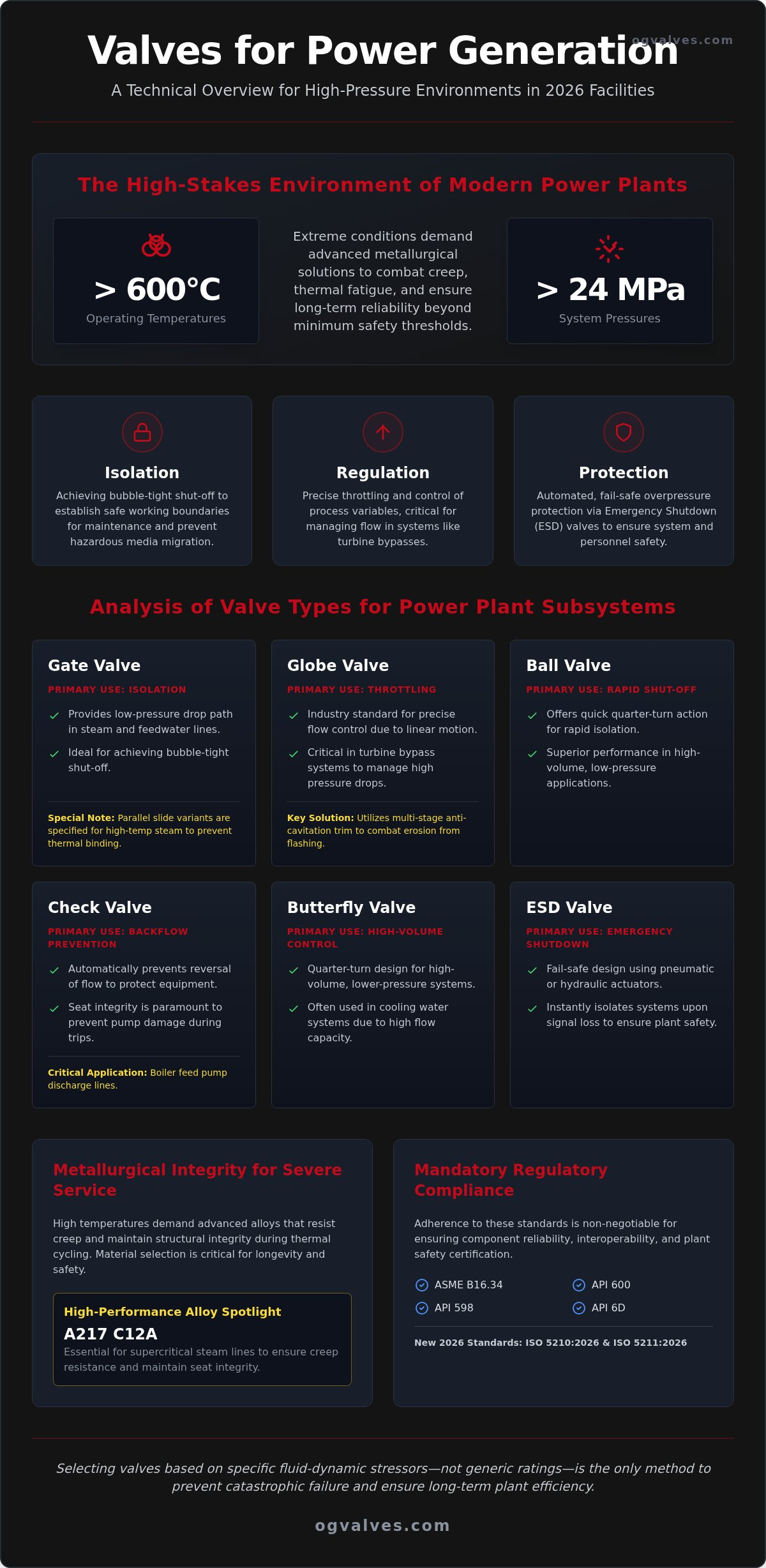
Power plant efficiency is a direct result of metallurgical integrity. Selecting valves for power generation based on specific fluid-dynamic stressors rather than generic pressure ratings is the only method to prevent catastrophic failure in high-pressure environments. Technical experts understand that interpreting the intersection of ASME B16.34 and API 598 is complex, especially when operational downtime from valve seizure or seat erosion threatens grid stability. You need components that exceed minimum safety thresholds to ensure long-term reliability.
This article provides a comprehensive technical analysis of industrial valve applications, focusing on the rigorous material specifications and regulatory standards required for 2026 facilities. You’ll learn how to identify valve types that minimize maintenance cycles while ensuring full compliance with the newly published ISO 5210:2026 and ISO 5211:2026 standards. We examine high-performance alloys like A217 C12A for supercritical steam lines and detail strategies for securing a global supply chain to mitigate the risks associated with long lead times for specialized components.
Key Takeaways
- Learn how valve reliability directly impacts plant thermal efficiency and prevents operational downtime in critical infrastructure.
- Understand the regulatory landscape for valves for power generation, including adherence to ASME B16.34, API 600, and API 6D standards.
- Identify metallurgical requirements for high-temperature service to ensure creep resistance and maintain seat integrity during thermal cycling.
- Master selection criteria for severe service applications by calculating flow coefficients and mapping valve types to specific fluid media.
- Optimize procurement strategies by leveraging technical inventories and global logistics to reduce lead times for high-pressure components.
The Critical Function of Valves in Modern Power Generation Infrastructure
In modern infrastructure, valves for power generation serve as the primary mechanical interface for fluid control and system safety. These components execute three fundamental roles: isolation for maintenance, precise regulation of process variables, and automated overpressure protection. The operational integrity of these units is inextricably linked to plant thermal efficiency. Even minor internal leakage across a high-pressure seat results in significant heat rate degradation, forcing the boiler to work harder to maintain turbine output. As global energy demand increases, the economic consequences of valve failure in 2026 have intensified. Unplanned outages lead to immediate revenue loss and potential grid instability, making the selection of high-specification components a financial necessity.
The engineering requirements for these systems have evolved alongside the shift toward supercritical and ultra-supercritical (USC) power plants. Modern facilities operate at temperatures exceeding 600°C and pressures surpassing 24 MPa. These extreme conditions demand advanced metallurgical solutions to combat creep and thermal fatigue. Engineers must consult a comprehensive list of valve types to ensure the mechanical design matches the specific fluid-dynamic stressors of the subsystem. It’s essential that these components maintain structural soundness under cyclical loading conditions to prevent fatigue-induced cracking.
Isolation and Shut-off Requirements
Achieving a bubble-tight shut-off is mandatory for critical steam and feedwater lines. Gate valves provide a low-pressure drop path during normal operation, while ball valves offer rapid quarter-turn isolation. Both designs are essential for establishing safe working boundaries during scheduled maintenance. For high-risk zones, Emergency Shutdown Valves (ESD) utilize fail-safe pneumatic or hydraulic actuators to isolate the system instantly upon signal loss. These units must meet stringent leakage classifications to prevent hazardous media migration during an event. Reliability in these components isn’t optional; it’s a prerequisite for plant safety certification.
Control and Throttling Dynamics
Globe valves remain the industry standard for precise throttling service because their linear motion allows for fine adjustment of the flow area. They’re critical in turbine bypass systems where managing mass flow and significant pressure drops is required. However, these applications often face cavitation and flashing. Cavitation occurs when liquid pressure drops below vapor pressure, forming bubbles that collapse violently against the valve trim. Flashing happens when the downstream pressure remains below vapor pressure, causing a permanent phase change. Both phenomena cause rapid material erosion. High-performance valves for power generation utilize specialized multi-stage anti-cavitation trim to dissipate energy and maintain operational longevity.
Analysis of Valve Types for Primary Power Plant Subsystems
Effective selection of valves for power generation requires mapping mechanical designs to the specific physical properties of the process media. Steam headers require robust metallurgical integrity to withstand thermal expansion, while cooling systems prioritize high flow rates and corrosion resistance. Multi-turn valves, such as globe and gate designs, are preferred for high-pressure circuits due to their ability to handle high differential pressures without compromising seat integrity. Conversely, quarter-turn designs like ball and butterfly valves offer superior performance in high-volume, low-pressure applications. Integrating high-specification check valves is critical in boiler feed pump discharge lines to prevent damaging backflow during pump trips. Seat integrity is paramount in these circuits.
Gate and Globe Valves in Steam Circuits
High-pressure steam headers typically require a gate valve rated for ASME Class 1500 or 2500. Wedge-type gates provide a mechanical seal through seating force, making them suitable for standard isolation. However, parallel slide gate valves are often specified for high-temperature steam because they accommodate thermal expansion without risk of thermal binding. For throttling service, globe valves utilize specialized trim designs to manage noise and dampen vibration. Perforated plug or multi-step cage trims are common in these circuits to ensure stable mass flow regulation. These designs prevent the internal erosion typically seen in standard trim configurations.
Butterfly and Ball Valves in Cooling Water Systems
Circulating water systems demand valves that manage large diameters and high velocities. A high-performance butterfly valve with an offset disk design reduces seat wear and provides reliable isolation in these low-pressure environments. For high-flow isolation where zero leakage is mandatory, a trunnion-mounted ball valve is the engineering benchmark. These units distribute pressure loads through the trunnion support rather than the seats, extending service life. In facilities utilizing seawater cooling, material selection shifts to Super Duplex or Nickel alloys to prevent pitting and crevice corrosion. If you’re managing a complex cooling circuit, consulting a specialized valve supplier ensures material compatibility with site-specific chemistry. Selecting the wrong alloy leads to rapid component degradation.
Material Science and Regulatory Standards in Power Generation
Compliance with international benchmarks is the primary mechanism for mitigating risk in high-pressure steam and water circuits. For valves for power generation, adherence to ASME B16.34 provides the necessary pressure-temperature ratings that define the safe operating envelope of the pressure boundary. Standards like API 600 for heavy-duty gate valves and API 6D for ball valve configurations ensure that mechanical designs withstand the rigorous demands of 2026 infrastructure. Beyond dimensional accuracy, metallurgical integrity is the deciding factor in component longevity. Positive Material Identification (PMI) is a mandatory quality assurance protocol; it verifies that the alloy composition matches the design specification, preventing the catastrophic failure associated with material mix-ups in high-temperature service. Utilizing high-specification industrial valves that meet these criteria is essential for maintaining plant safety certifications.
In boiler blowdown and fly ash handling systems, valves face aggressive corrosion-erosion mechanisms. These subsystems require materials that resist the abrasive nature of particulate-laden fluids and the chemical stressors of concentrated boiler water. Failure to specify the correct hardness or corrosion resistance leads to rapid seat degradation and internal leakage, which compromises the entire system’s efficiency. You’ve got to ensure the metallurgy matches the specific fluid-dynamic stressors of the application.
ASME and API Compliance Frameworks
ASME B16.34 serves as the definitive reference for pressure-temperature ratings, ensuring that valve bodies maintain structural soundness under peak loads. Compliance requires precise calculations for minimum wall thickness and stem diameters, which are critical for high-stakes safety in steam headers. For systems handling combustible gases, fire-safe testing and certification according to API 607 or API 6FA are required to ensure the valve maintains its seal during an external fire event. These standards provide a predictable framework for engineering excellence.
Advanced Metallurgy: From Carbon Steel to Exotic Alloys
Material selection is driven by the operating temperature and the presence of corrosive agents. Standard ASTM A105 and WCB/WCC carbon steels are utilized for general service in feedwater and low-pressure steam where temperatures don’t exceed 425°C. For high-temperature steam applications, Chrome-moly alloys like C5, C12, and F91 are mandatory. Advanced alloys such as F91 and F92 are specifically designed to provide the necessary creep resistance for ultra-supercritical plants operating above 600°C. In corrosive condensate environments, stainless steel and duplex alloys are specified to prevent pitting and maintain long-term structural integrity.
Critical Selection Criteria for Severe Service and Steam Applications
Precision in component sizing is mandatory for maintaining system stability. Calculating the Flow Coefficient (Cv) allows engineers to select valves for power generation that operate within their optimal range, avoiding the turbulence and seat erosion associated with oversized units. In modern facilities, environmental compliance has become a technical benchmark. Evaluating fugitive emissions according to ISO 15848-1 ensures that stem packing and gasket interfaces meet the leak detection and repair (LDAR) requirements of 2026. These standards prioritize the reduction of hazardous output while maintaining operational integrity. You’ve got to ensure the sizing matches the specific fluid-dynamic stressors of the circuit.
Thermal cycling presents a unique challenge to valve seat integrity. Frequent start-up and shut-down sequences subject internal components to rapid temperature fluctuations, which can lead to seat distortion or cracking. It’s essential that the selected valve design accommodates these shifts without losing its ability to provide a bubble-tight shut-off. If you’re managing high-pressure steam circuits, these selection criteria are the difference between a reliable facility and one plagued by chronic maintenance issues.
Addressing Severe Service Stressors
High-pressure steam service frequently introduces the risk of “stuck” valves, often caused by thermal binding or particulate accumulation in the guide areas. Hard-facing requirements are essential in these environments; applying Stellite to valve seats and discs provides the necessary hardness to resist high-velocity steam erosion. Large-bore isolation valves must also be engineered to manage thermal expansion and contraction. If the design doesn’t account for the differential expansion between the stem and the body, the valve may seize in the closed position, preventing critical system activation during an event.
Actuation and Control Integration
Selecting high-performance actuators depends on the specific torque and response requirements of the application. Pneumatic actuation remains the standard for rapid-response safety circuits due to its inherent fail-safe capabilities. Electric actuation is increasingly utilized for remote power plant operations where precise modulation and digital integration are prioritized. Manual overrides are mandatory in all critical safety circuits to ensure manual intervention remains possible during a complete control system failure. Modern smart positioners and diagnostic sensors now provide the data necessary for predictive maintenance, allowing technical teams to address wear before it leads to component failure.
Review our technical inventory of high-pressure components to secure your plant’s critical infrastructure and minimize maintenance cycles.
Strategic Procurement and Technical Supply for Power Generation Facilities
Procurement of valves for power generation in 2026 requires more than a simple vendor-client relationship. It demands a partnership with a supplier that maintains a deep technical inventory of high-specification components. Unplanned outages in heavy industrial sectors carry immense financial penalties. Relying on standard lead times for specialized chrome-moly or stainless steel valves often results in prolonged downtime. A strategic approach involves identifying suppliers with established global logistics capabilities that enable fast-track delivery to international sites. Technical expertise is also required for cross-referencing legacy specifications with modern standards, such as the newly published ISO 5210:2026, to ensure perfect interoperability during emergency replacements.
Optimizing the Industrial Supply Chain
Downtime mitigation relies on fast-track delivery protocols. When a critical steam header valve fails, the supply chain’s got to respond with industrial precision. This process involves consolidated project management, especially during large-scale facility turnarounds where hundreds of components are replaced simultaneously. Every component must arrive with comprehensive compliance documentation, including material test reports and pressure test certifications. Full traceability isn’t optional; it’s a mandatory requirement for maintaining the safety integrity level of the plant. Suppliers must demonstrate adherence to rigorous testing protocols to verify that every unit meets the specified performance benchmarks before it leaves the warehouse.
The OG VALVES Commitment to Engineering Excellence
OG VALVES LTD. acts as a dependable partner in critical infrastructure maintenance. We leverage deep industry experience to solve complex flow control challenges, providing technical support that focuses on industrial precision. Our commitment to engineering excellence is reflected in our rigorous quality control processes and unwavering adherence to global industrial benchmarks. We maintain an extensive inventory of gate, globe, check, ball, and butterfly valves for power generation. This inventory’s specifically curated for high-pressure systems, ensuring that technical experts and procurement specialists have immediate access to the components they need. By positioning ourselves as a global entity with project management capabilities, we provide the reliability necessary for high-stakes industrial operations.
Optimizing Infrastructure Reliability through Technical Precision
Maintaining operational stability in 2026 demands a rigorous approach to component selection. We’ve established that the integrity of valves for power generation is a function of metallurgical excellence and strict adherence to international standards like ASME B16.34 and the latest ISO 2026 updates. Selecting the correct alloy for ultra-supercritical steam lines isn’t just an engineering choice; it’s a safety requirement. Structural soundness must be verified through rigorous testing protocols to prevent catastrophic failure in high-pressure circuits.
Reducing maintenance cycles and preventing unplanned outages requires a dependable supply chain. You must prioritize components that offer verified compliance with API and ISO testing protocols. Securing a partner with global logistics capabilities ensures that critical replacements arrive without the delays typically associated with specialized industrial components. By integrating smart diagnostics and high-performance actuation, you can transition from reactive repairs to a predictive maintenance model. This proactive strategy ensures long-term durability and regulatory adherence across all plant subsystems.
Request a Technical Quote for Power Generation Valves to ensure your facility meets the highest benchmarks for safety and efficiency. We look forward to supporting your next critical infrastructure project with industrial precision.
Frequently Asked Questions
What are the most common valves used in thermal power plants?
The primary valves for power generation include gate, globe, check, and ball valves. Gate valves provide reliable isolation for high-pressure steam headers, while globe valves are utilized for precise mass flow regulation in turbine bypass systems. Check valves are mandatory for preventing backflow in boiler feed pumps. Ball valves are frequently specified for rapid shut-off in fuel gas lines. Each type’s selected based on its mechanical ability to withstand specific fluid-dynamic stressors.
How does ASME B16.34 influence valve selection for high-pressure steam?
ASME B16.34 is the definitive standard for pressure-temperature ratings. It establishes the safe operating boundaries for valve bodies by correlating specific material groups with their maximum allowable working pressures at varying temperatures. This standard ensures that the pressure boundary maintains structural soundness under peak loads. Engineers use these tables to verify that the selected valve’s wall thickness and metallurgy are sufficient for the plant’s specific design conditions and safety requirements.
Why is Stellite hard-facing used in power generation valves?
Stellite hard-facing is applied to valve seats and discs to provide superior resistance to erosion and galling. In high-velocity steam applications, standard alloys suffer from rapid material loss, leading to internal leakage. Stellite, a cobalt-based alloy, maintains its hardness at elevated temperatures and prevents thermal binding in gate valves. This treatment is a technical prerequisite for ensuring a bubble-tight shut-off in severe service environments where maintenance cycles must be strictly minimized.
What is the difference between a parallel slide and a flexible wedge gate valve?
Parallel slide gate valves utilize two independent discs that rely on line pressure to create a seal, making them ideal for high-temperature service where thermal expansion occurs. Flexible wedge gate valves use a one-piece wedge that is mechanically forced into the seat. While wedges provide a tight seal at low pressures, they’re susceptible to thermal binding as the system heats up. Parallel slides accommodate these shifts without seizing, ensuring consistent operational reliability.
How do you prevent cavitation in power plant control valves?
Preventing cavitation requires the use of multi-stage anti-cavitation trims that dissipate pressure energy in controlled increments. Standard trims cause a sharp pressure drop below the vapor pressure, leading to bubble formation and subsequent collapse against the valve body. By utilizing specialized cage designs or labyrinth paths, the pressure remains above the vapor threshold. This engineering approach eliminates the abrasive material erosion and vibration that typically compromise control valve longevity in high-pressure feedwater systems.
What material grades are required for supercritical steam service?
Supercritical and ultra-supercritical steam circuits require advanced chrome-moly alloys such as ASTM A182 F91 or F92. These materials are engineered for high creep-rupture strength at operating temperatures exceeding 600°C. Standard carbon steels like A105 are restricted to lower-temperature applications because they lack the metallurgical stability required for long-term structural integrity under extreme thermal stress. Specifying these high-performance alloys is mandatory for ensuring the safety and durability of modern valves for power generation.
Can butterfly valves be used for isolation in cooling water circuits?
High-performance butterfly valves are the industry standard for isolation in circulating cooling water circuits. These systems involve large pipe diameters and high flow rates at relatively low pressures. Double or triple offset butterfly designs reduce seat friction and provide reliable shut-off without the weight or footprint of a gate valve. For seawater applications, these valves must be manufactured from corrosion-resistant alloys like Super Duplex to prevent pitting and maintain long-term operational output.
How does valve sizing (Cv) affect power plant efficiency?
Accurate valve sizing using the Flow Coefficient (Cv) directly impacts a plant’s heat rate and thermal efficiency. Oversized valves operate too close to the seat, causing high-velocity erosion and unstable control. Undersized valves create excessive pressure drops, forcing pumps and boilers to work harder to maintain turbine output. Precise sizing ensures that the valve operates within its optimal linear range, minimizing parasitic energy losses and extending the interval between scheduled maintenance cycles.
 Responsive Menu